
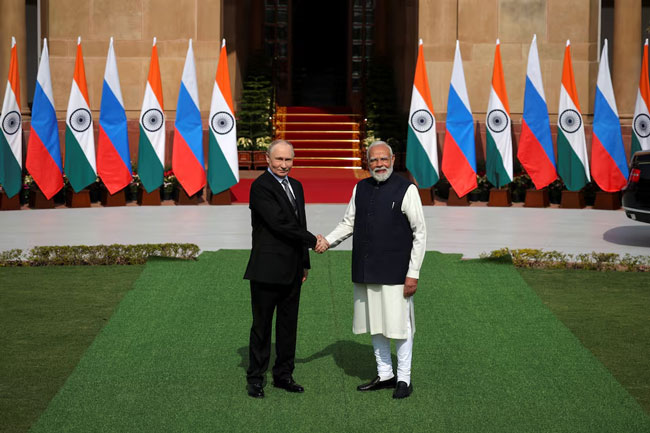
Russian President Vladimir Putin and Indian Prime Minister Narendra Modi began high-level summit talks in New Delhi on Friday, with India rolling out the red carpet for the Russian leader. Modi reiterated that India supports all efforts toward peace in Ukraine, marking a key diplomatic message during the visit.
Putin’s trip—his first to India in four years—comes as Moscow seeks to deepen trade with one of its top buyers of arms and seaborne oil, while facing mounting Western sanctions. At the same time, New Delhi is engaged in negotiations with the United States to resolve tariff disputes linked to India’s purchases of Russian oil.
Russia has long been India’s largest arms supplier and is now aiming to push bilateral trade to USD 100 billion by 2030, in part by increasing imports of Indian goods. Since Europe reduced its dependence on Russian energy following the invasion of Ukraine nearly four years ago, India became a major buyer of discounted Russian crude—though purchases have since dipped under U.S. pressure.
Modi Emphasizes India’s Position on Ukraine
“India is not neutral — India has a position, and that position is for peace,” Modi told Putin. “We support every effort for peace, and we stand shoulder to shoulder with every initiative taken for peace.”
Putin expressed appreciation for Modi’s engagement, saying the two had discussed the situation in Ukraine and steps being taken, including with partners such as the United States, toward a potential peaceful settlement.
He added that bilateral cooperation continues to expand into high technology, aviation, space, and artificial intelligence, alongside India and Russia’s long-standing military-technical partnership.
Ceremonial Welcome and Expected Agreements
Putin arrived in New Delhi on Thursday to a warm greeting from Modi, followed by a private dinner. On Friday morning, he received a ceremonial welcome at Rashtrapati Bhavan, complete with a 21-gun salute.
A number of agreements are expected following the formal talks. Indian companies are set to sign a deal with Russia’s Uralchem group to jointly establish a urea production plant in Russia. Russian banks Gazprombank and Alfa Bank have also sought approval to operate in India to facilitate expanding trade.
Defence, Nuclear Energy, and U.S. Pressure
Defence Minister Andrei Belousov, part of Putin’s delegation, held talks with Indian Defence Minister Rajnath Singh. Russia reiterated its readiness to support India’s goal of self-reliance in defence manufacturing.
In an interview with India Today, Putin questioned U.S. pressure on India over Russian oil imports, pointing out that Washington continues to buy Russian nuclear fuel.
“If the U.S. has the right to buy our fuel, why shouldn’t India have the same privilege?” he asked.
Despite Western criticism, India has argued that U.S. tariffs are unfair and has pointed to ongoing American and European purchases of Russian energy products—including LNG and enriched uranium.
Geopolitical Balancing Act
Putin’s visit follows his meeting with U.S. envoys seeking progress on a Ukraine peace initiative, though no agreement was reached.
India has consistently avoided condemning Russia, instead urging dialogue and diplomacy while maintaining a delicate balance between its strategic ties with Russia and growing partnership with the United States.
“India faces a conundrum; by strengthening ties with Moscow or Washington, New Delhi risks setting back ties with the other,” wrote Michael Kugelman, Senior Fellow at the Atlantic Council, in Foreign Policy this week.