
By BAISHALI SARKAR[1] & DR PORTIA CONRAD[2]
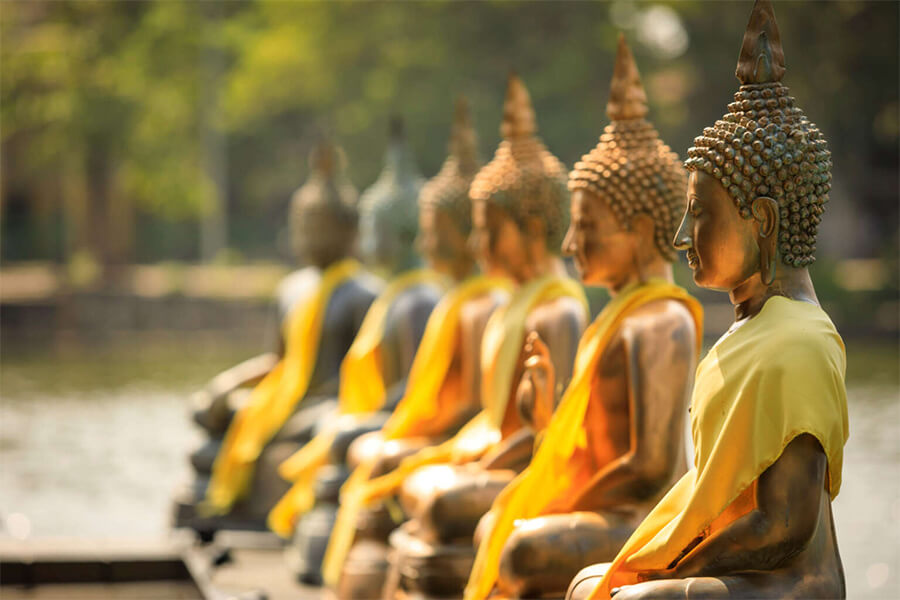
The transmission of Buddhism from India to Sri Lanka stands as one of the earliest and most enduring examples of the spread of ideas across the Indian Ocean world, rooted in spiritual exchange rather than conquest. Buddhism travelled from India to Sri Lanka not by the sword or trade alone, but through a shared quest for the Dhamma, beginning in the 3rd century BCE during the reign of Emperor Aśoka.
Emperor Ashoka’s embrace of Buddha Dhamma marked a pivotal era in Buddhist history, around 250 BCE. Guided by the senior monk Moggaliputta Tissa at the Third Buddhist Council, he dispatched missions across Asia, including his son Thera Mahinda[3] to Sri Lanka. There, Thera Mahinda encountered King Devanampiya Tissa during a hunt at Mihintale, preaching the Four Noble Truths alongside key suttas—Devadūta (MN 130), Bālapaṇḍita (MN 129), Aggikkhaṇḍa (MN 31), and Āsīvisa (SN 36.21)—which won over the king and his court.[4]
King Devānampiya Tissa urged Queen Anulā to pay her respects to Thera Mahinda and his monastic retinue, recognising the transformative power of their teachings. In addition to the foundational suttas delivered to the royal court, Mahinda expounded upon the Peta Vatthu and Vimāna Vatthu, poetic expositions on the realms of petas and devas from the Khuddaka Nikāya; as well as the Sacca Saṃyutta from the Saṃyutta Nikāya and select other discourses, captivating Queen Anulā and her five hundred attendants. Deeply moved, the queen and her companions expressed their fervent aspiration for ordination and entry into the Saṅgha.
However, as per the Vinaya regulations upheld since the Buddha’s time, the upasampadā (higher ordination) for women required the presence of fully ordained bhikkhunīs led by a senior nun; which still remains a stipulation that is normative in contemporary Sri Lanka’s Theravāda tradition. To fulfill this, Aśoka arranged for his daughter Theri Saṅghamittā, accompanied by elders, to journey from India with a sapling of the sacred Bodhi Tree. Her arrival not only enabled Anulā’s ordination alongside her attendants at the newly established Thūpārāma vihāra but also firmly planted the seeds of the Bhikkhunī Saṅgha on the island, ensuring the enduring vitality of the Dhamma for both mendicant lineages. Transplanting a Bodhi Tree sapling and establishing the Mahavihara as Theravāda’s stronghold; this Sthavira-Vibhajyavāda lineage, as noted by Gao (2022), blossomed into Sri Lanka’s vibrant Dhamma heritage, embodying Ashoka’s vision of universal ethical harmony.
King Devānampiya Tissa’s royal patronage decisively anchored Buddha Dhamma on Sri Lanka’s soil through a cascade of visionary acts. His acceptance of Dhamma, alongside his court, served as an unparalleled exemplar, galvanizing societal embrace and laying the bedrock for Buddha Dhamma’s flourishing. Tissa’s commission of the Thūpārāma stūpa, enshrining the Buddha’s right collar-bone relic, which was brought by Thera Mahinda drew pilgrims from China and Korea from the fourth century onward, who venerated its sanctity and bore suttas eastward; succeeding kings amplified this legacy with grand vihāras like Abhayagiri, propelling the Dhamma’s transcontinental radiance.
The inaugural Dhamma gathering on Sri Lankan soil convened during the reign of King Devānampiya Tissa (ca. 247–207 BCE), under the presidency of the Venerable Arittha Thera, shortly after the arrival of Emperor Aśoka’s son, Thera Mahinda, at the head of the island’s pioneering missionary delegation. According to tradition, this assembly drew sixty thousand arahants, who, at Mahinda’s behest, heard the recitation of the entire Tipiṭaka by Arittha a Sinhalese bhikkhu revered as Mahinda’s foremost disciple and the seventh link in the ācariya-paramparā (teacher lineage). Held at the sacred precincts of the Thūpārāma shrine in Anurādhapura, the gathering enshrined the Dhamma’s oral heritage amid the nascent monastic landscape. Succeeding this, the Dhamma gathering under King Vaṭṭagāmaṇī Abhaya (29–17 BC) according to the Theravāda tradition which witnessed not only the rehearsing of the Tipiṭaka but also the meticulous revision, recasting, and thematic arrangement of its commentaries, fortifying the island’s doctrinal bulwark for posterity. Under royal patronage, Vaṭṭagāmaṇī convened five hundred erudite reciters and scribes at the cavernous Alu Vihara in the Matale hills. Their meticulous labor yielded the first written redaction of the Pāli Tipiṭaka; as Theravāda’s authoritative scripture, outlasting India’s vanished manuscripts to illuminate the Dhamma for posterity.
During the reign of King Mahānāma in 5th century CE, another gathering was convened under the aegis of the venerable Bhadanta Buddhaghosa. This luminary scholar, whose erudition had been rigorously tested by both divine agencies and Ceylon’s learned bhikkhus, rendered these vital atthakathā into the canonical lingua franca, fortifying Theravāda’s doctrinal exegesis for universal dissemination. Traditional accounts relate that the Mahāvihāra’s elder bhikkhus, wary of this Indian scholar’s intent, first subjected Buddhaghosa to a rigorous trial by commissioning him to elaborate the Dhamma upon two verses from the suttas. Undaunted, he composed the majestic Visuddhimagga—the “Path of Purification”[5]; a comprehensive manual synthesizing meditation, doctrine, and ethics in luminous prose. His mettle was tested further when deities, thrice concealing his manuscript, compelled him to reconstruct it verbatim from memory. Upon unveiling the three identical recensions—which encompassed the entire Tipiṭaka’s essence in perfect fidelity; the elders relented, granting access to their pristine Sinhala aṭṭhakathā commentaries for translation into Pāli, thereby enshrining Ceylon’s doctrinal heritage for posterity Later in under the presidency of the Venerable Mahākassapa during the reign of King Parākramabāhu I the Great (1153 to 1186); a Dhamma gathering was convened which focused on the Mahātheras’ commentaries to the Tipiṭaka, endured for a full year, culminating in their meticulous revision and resounding recitation, thereby, enshrining interpretive orthodoxy amid the Saṅgha’s resplendent tradition.
Foot Notes
[1] Research Consultant, Academics, International Buddhist Confederation
[2] HoD, International Relations,International Buddhist Confederation
[3] Out of the monks who accompanied him was Sumana Sramanera, (son of Theri Saṅghamittā) and Bhanduka Upasaka (maternal first cousin’s son)
[4] Dīpavaṁsa – nisinna pallaṅkavare Mahindo gaṇapuṅgavokathesi tattha suttantaṁ devadūtaṁ varuttamaṁ. p155; Dīpavaṁsa – kathesi tattha suttantaṁ bālapaṇḍitam uttamaṁ, tattha pāṇasahassānaṁ dhammābhisamayo ahū. p156; Dīpavaṁsa -kathesi tattha suttantaṁ aggikkhandhaṁ varuttamaṁ. tattha pāṇasahassānaṁ dhammābhisamayo ahū. p166; Dīpavaṁsa – bhuttāvi anumoditvā nikkhami nagarā purā. divāvihāraṁ karitvā Nandanuyyānamuttame. p167.
[5] Note on Visuddhimagga – The Path of Purification
The Sinhala Bhikkhus tested Ven. Buddhaghosa expertise in Pali and asked this verse orininally from the Jaṭā Sutta (Tangled Sutta) in the Samyutta Nikaya of the Pali Canon (SN 1.23).
Question :
Antojaṭā bahijaṭā jaṭāya jaṭitā pajā
taṃ taṃ Gotama pucchāmi ko imaṃ vijaṭaye jaṭaṃ ti.
“Tangled within, tangled without,
All beings are tangled in a tangle;
Therefore I ask you, Gotama:
Who can untangle this tangle?” To this Ven Buddhaghosa answered the following verse. This phrase is the first line of a well-known Pali stanza from the Jaṭā Sutta (Samyutta Nikaya 1.23) and the Visuddhimagga, which describes the path to enlightenment through the three trainings of morality, concentration, and wisdom :
Pali verse
Sīle patiṭṭhāya naro sapañño,
cittaṃ paññaṃ ca bhāvayaṃ,
ātāpī nipako bhikkhu,
so imaṃ vijaṭaye jaṭan’ti.
Translation (English) The Buddha’s Response was quoted by Ven Buddhaghosa in the above mentioned Verse:
The Buddha explains that it is the wise person (bikkhu) who is established in virtue (sīla), and who develops concentration (citta) and wisdom (paññā), can untangle this tangle.
The verse concludes by stating that for the Arahants—those in whom lust, hatred, and ignorance have been destroyed—the tangle is already untangled.
With this Verse Ven Buddhaghosa wrote the entire voluminous text Visuddhimagga in Pali.
References
- Bapat, P.V., editor. 2500 Years of Buddha Dhamma. Publications Division, Ministry of Information and Broadcasting, Government of India, 1956.
- Gao, MingYan. “Indian Buddha Dhamma Lecture 1 Lecture Notes.” University of Hong Kong, Jan. 2022.
- Geiger, Wilhelm. The Mahavamsa or The Great Chronicle of Ceylon. London: The Pali Text Society, 1912.
- Hirakawa, Akira. A History of Indian Buddha Dhamma: From Śākyamuni to Early Mahāyān. Edited by Paul Groner, Asian Studies at Hawaii, University of Hawaii Press, 2007.
- Mori, S. “The Avalokitesvara Bodhisattva Statue at Dambegoda and Its Restoration—A Study of Mahayanism in Sri Lanka.” Recent Researches in Buddhist Studies: Essays in Honour of Professor Y. Karunadasa, Colombo: Y. Karunadasa Felicitation Committee, 1997.
- Oldenberg, Hermann. Dīpavaṁsa VIII, The Chronicle of the Island: An Ancient Buddhist Historical Record. Bristol: Pali Text Society, 1897.
- Oldenburg, Hermann. The Chronicle of the Island Dipavamsa. Edited and translated by Hermann Oldenburg. Produced by Anandajoti Bhikkhu, 2017.
- Smith, Vincent Arthur. Aśoka, the Buddhist Emperor of India. Oxford: Oxford University Press, 1901.