
At the Third Plenum of the Central Committee of the Chinese Communist Party in December 1978 the leaders of the CCP made a decisive break with the legacy of hardcore communism of Mao Zedong and decided to introduce elements of the market mechanism of the capitalist system in the Chinese economy in a phased manner. It was the beginning of a process under the leadership of Deng Xiaoping in the course of which the CCP called for the establishment of a socialist market economy in China, the Chinese economic system was progressively liberalized, the private sector was encouraged and the country was opened up for external economic interactions.
The opening up of the vast Chinese market was a great opportunity for the capitalist world, particularly West Europe and the US. There was a rapid increase in trade with China. Companies started investing in and shifting their production bases to China to take advantage of the availability of cheap labour.
Everything was hunky-dory till the advent of Xi Jinping as the supreme leader of China in 2012, with his penchant for hardcore communism and efforts to take China back to the days of Mao. Now denied a level playing field with the domestic sector and faced with restrictive legislations introduced by the Chinese government, foreign investors started finding it difficult to do business in China. Countries ran huge trade deficits with China because of the refusal of Beijing to abide by the rules of the game and the WTO regulations on fair trade.
Saddled with huge excess capacities, Beijing is offering to Chinese companies with government subsidies, low-cost raw materials, land and financial instruments to increase exports. The products exported have graduated from low skilled labour-intensive manufacturing to hi-tech manufacturing sectors including electric vehicles, semiconductors, railway equipment and next-generation IT and telecommunications.
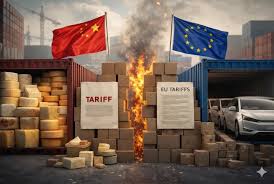
The European Union has suffered more because of its greater dependence on the Chinese market; while the US is still battling it out with measures like tariff war and curbs on technology transfer to China. In 2024, the trade deficit of the EU with China was about Euro 305 billion.
For the European Union as a whole, China has become a major economic partner. Among the EU member countries and the UK, however, there are differences in terms of economic dependence on China. Only a minority of countries have strong trade relations with China. Germany is China’s most important economic partner in Europe. China is a major source of consumer products for Germany, a production base for German cars, and a critical source of some key products; especially rare earths and pharmaceutical precursors. Mercedes Benz has a major production facility in Beijing in joint venture; employing around 11,500 people and producing some of the premium models of the car. Two other facilities in China produce vans and heavy-duty trucks. BMW has its largest manufacturing unit at Shenyang in China. Milan, the fashion capital of the world in Italy, gets most of its supply of textiles from China; and also got the Covid-19 in the process in 2020.
In the Xi Jinping era, however, in China foreign companies now face a challenging geopolitical milieu and growing politicization of the business environment. National security and self-reliance are the priorities over economics. Laws and regulations ostensibly to protect national security, with their ambiguous definitions and absence of clear provisions, create an uncertain environment for firms. Companies face difficulties in complying with China’s requirements for cross-border data flows. The Data Security Law does not clearly define what constitutes “important data,” whose transfer requires obtaining clearance from the Cyberspace Administration. The purchase of documents and data related to the broad notion of “national security and interest” is defined as espionage under an amended anti-espionage law. This has sparked fears over the extent to which regular business activities such as market research could open firms to investigation and prosecution by authorities. The legal ambiguity in these regulations and the associated political risk of businesses operating in China lead some to reconsider planned investments.
Under Xi Jinping, China has pursued a national strategy of gaining self-sufficiency in a range of strategic technologies and reducing dependencies on foreign suppliers. Using government subsidies, low-cost raw materials, inputs, land and financial instruments, China is trying to upgrade its global domination in the area of low skilled labour-intensive manufacturing to hi-tech manufacturing sectors like electric vehicles, semiconductors, railway equipment and IT and telecommunications. The policy calls for a reduction in reliance on foreign technology by increasing the domestic market share of basic core components and important basic materials. In sectors strategically important where China wants to achieve technological self-sufficiency, state owned enterprises receive access to financing and public procurement; to the detriment of private firms and foreign companies.
The responses of the US and the EU towards the Chinese emphasis on gaining self-sufficiency in hi-tech areas that can be put to dual use — civil as well as military — are at variance. Prior to 2016, the American notion had been that the rise of China did not pose a threat to the US. Since the first Donald Trump administration, however, China has been defined as an economic rival, security threat and ideological competitor. In between, the Joe Biden administration has basically continued with the same approach; containing China through tariffs, investment blockades and export controls in hi-tech areas like semiconductors.
The dependency of Europe on China as a key market and production base is much higher, however, and member states of the EU are not prepared to sever economic links with China. Lately, however, China is being viewed in the EU not only as a partner in economic cooperation but also a rising military power posing concern for regional and global security. NATO, too, is now viewing China as a military power trying to undercut the rules-based international order.
Marked divisions among its 27 member countries on the issue of how to deal with China make it difficult for the EU to develop a unified China strategy. The hawks among them prefer a tough line on China, especially on issues like human rights and Taiwan. The doves want to maintain cooperation with China and avoid policy measures that could have a negative impact on economic relations. Germany, again, being a frontline EU state but with high business exposure with China, is in a dilemma. On the one hand, Berlin has decided to revamp its military; neglected since the end of World War II. On the other hand, former German Chancellor Olaf Scholz thinks the rise of China does not warrant isolating Beijing or curbing cooperation. But he also thinks China’s growing power does not justify its hegemony in Asia and beyond. He has agreed to allow a Chinese company to take a stake in one of the harbour terminals at the Hamburg Port, but offering only a minority share of under 25 percent.
In its quest to gain supremacy over the West in hi-tech areas, China had introduced restrictions on the export of critical minerals like rare earths; though relaxed lately under US pressure. This has underscored the need for the EU to enter into more Free Trade Agreements with third countries — like the one it has entered with India — so businesses in Europe can access new markets under more competitive conditions and also secure for themselves secure supply chains for critical inputs.