
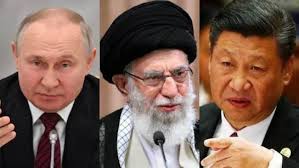
When Iran confronts Israel and the United States, it does not stand alone. Behind Tehran’s defiance lies the quiet but consequential support of China and Russia, two powers intent on reshaping the global order. Their assistance is not about ideological solidarity with Iran’s clerical regime. It is about weakening American primacy, expanding their own influence, and demonstrating that Washington can no longer dictate terms in the Middle East.
Russia and China share a common objective, to erode U.S. dominance. Moscow, bogged down in Ukraine and isolated by Western sanctions, sees Iran as a partner in defiance, a fellow pariah whose survival strengthens the case for a multipolar world. Beijing, meanwhile, seeks to secure energy supplies and expand its Belt and Road footprint, while subtly undermining U.S. alliances in the Gulf. Both benefit from Iran’s willingness to absorb the costs of direct confrontation with Washington and Tel Aviv.
The mechanics of support. Military and technological aid. Russia supplies advanced weapons systems and intelligence cooperation, while China provides dual-use technologies that bolster Iran’s resilience. Economic lifelines. China buys Iranian oil at discounted rates, sustaining Tehran’s war economy. Russia deepens trade ties, creating a sanctions-resistant bloc. Diplomatic shielding. Both use their UN Security Council seats to blunt Western efforts to isolate Iran, offering political legitimacy to Tehran’s defiance.
Neither Moscow nor Beijing wants a direct clash with Washington. Their support is calibrated, enough to keep Iran afloat but not enough to trigger open war. Yet this balancing act carries risks. Gulf states may drift closer to Washington if they perceive China as too aligned with Tehran. Russia risks overextension amid its own military commitments.
What is unfolding is not merely a regional contest but a test of world order. By backing Iran, China and Russia signal that the era of unipolarity is over. They are building a coalition of resistance, states willing to defy U.S. pressure, survive sanctions, and assert sovereignty against Western dictates. For Washington, the challenge is not just Iran’s defiance but the broader architecture of support that makes that defiance sustainable.
The United States must recognize that isolating Iran is no longer a unilateral endeavor. Countering Tehran requires not only military deterrence but also a strategy to blunt the appeal of China’s economic lifelines and Russia’s military partnerships. Without addressing the broader coalition behind Iran, Washington risks fighting symptoms while ignoring the disease, the erosion of its global primacy.