
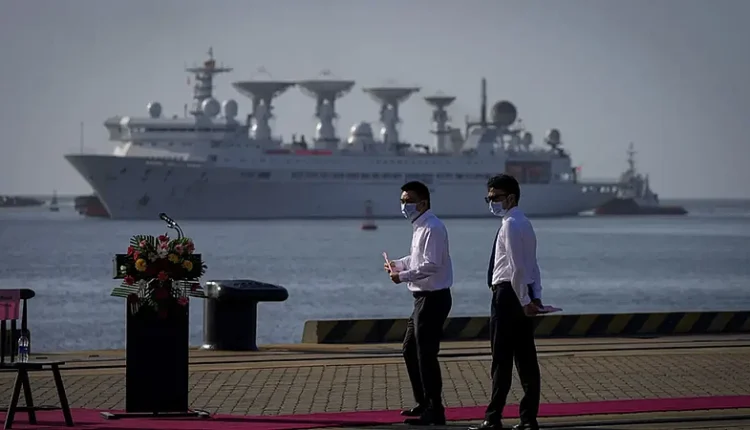
A bombshell investigative report released this week by Reuters, titled “China is mapping the ocean floor as it prepares for submarine warfare with the U.S.,” has sent shockwaves through the Indo-Pacific. While the report frames the issue as a high-tech arms race between superpowers, for Sri Lanka, the revelation is a clarion call. The “scientific research” conducted by Chinese vessels in our backyard is no longer a matter of academic curiosity—it is a clear and present danger to our national security.
The Reuters investigation exposes a chilling reality: the data being gathered by Chinese survey ships is the “digital backbone” for future underwater conflict. According to the report, these vessels are meticulously documenting “high-resolution data on the seabed, water temperature, and salinity”. While Beijing markets these missions as civilian oceanography, Reuters notes that this specific data is “foundational for submarine navigation and the deployment of underwater sensors”.
For Sri Lanka, allowing these “spy ships” to dock at our ports or traverse our Exclusive Economic Zone (EEZ) is a gamble we can no longer afford to take. By opening our waters to the People’s Liberation Army Navy’s (PLAN) scientific proxies, we are effectively allowing a foreign power to map the battlefield of a war that would inevitably devastate our shores.
The Reuters report highlights that the Indian Ocean is becoming a “key theater for China’s underwater ambitions”. As an island nation positioned at the world’s most critical maritime chokepoint, Sri Lanka is being used as a pawn in this “dual-use” game. The article quotes defense experts who warn that “the line between civilian research and military intelligence is non-existent in China’s maritime strategy”. Therefore, every nautical mile mapped in Sri Lankan waters is a mile where Chinese nuclear submarines can eventually run silent and run deep, undetected by regional security forces.
This creates a massive security crisis for Colombo. By facilitating these surveys, Sri Lanka risks violating its own commitment to regional neutrality. We are inviting the “shadow war” described by Reuters into our sovereign territory, heightening tensions with our closest neighbor, India, and the broader international community. The presence of these vessels does not bring progress; it brings a target onto our backs.
The argument for a total ban is now undeniable. We cannot permit “research” that is explicitly designed to “prepare for submarine warfare”. If Sri Lanka continues to grant access to these vessels, we are not just hosting scientists—we are hosting the vanguard of a military expansionist policy.
To protect the peace of the Indian Ocean and ensure that Sri Lanka does not become a casualty of a superpower collision, the government must implement an immediate and permanent moratorium on Chinese research activities. Our waters must remain a zone of peace, not a laboratory for the PLAN’s underwater dominance. As the Reuters investigation proves, the “dangerous game” has already begun; it is time for Sri Lanka to opt out before the depth of the crisis becomes inescapable.