
Pakistan has roughly 25 million children between the ages of 5 and 16 who are not in school — the second largest out-of-school population in the world. However, this figure alone does not guide action. Policymakers need to know where these children are and why they are out of school.
Aggregate data do not explain whether these children lack access or face issues in attending nearby schools . And that matters a lot, because a child who lives two hours from the nearest school and a child who lives two blocks from three different schools but still isn’t enrolled faces very different obstacles. One is a crisis of supply; the other a crisis of demand. For decades, local government officials have lacked the tools to tell these two problems apart.
In a new working paper, developed in part as a response to discussions with government officials, we combine satellite imagery, machine learning, and administrative records from over 137,000 public schools and 72,700 private schools, and produce the first community-level map of school accessibility across Pakistan’s four main provinces.
Seeing schools from space reveals that nationally, 51 percent of the population lives within roughly 20 minutes of a school. However, 37 percent of population blocks — each representing a community of about 1,500 people — have no school nearby at all. This allows policymakers to distinguish between access gaps and other barriers for the first time.
Aggregate statistics mask the private sector footprint
Official statistics suggest private schools account for 39 to 43 percent of Pakistan’s total enrollment. Using open source data, we identify over 72,700 private schools – around 10 percent more than official figures and estimate that 49 percent of students, roughly 21.7 million children are enrolled in private schools. This reflects undercounting of unregistered schools and evening shifts.,
The distribution of private schools visible from satellite imagery is striking. In Lahore, 88 percent of schools are private, enrolling 80 percent of students. In Karachi, the figures are 83 and 87 percent. Across Pakistan, in less well-off communities (the bottom two quintiles, meaning the poorest 40 percent of communities), private schools make up only 9.5 percent of all schools. In the top two quintiles, representing the wealthiest 40 percent, the figure is 83.6 percent.
Aggregate statistics mask local out-of-school dynamics
Aggregate statistics show local variation. The view from space reveals a much more intricate mosaic of localized problems, each requiring different policy interventions.
Consider the contrast between two cities that look similar on paper. Lahore and Faisalabad have comparable out-of-school rates — 13.7 and 18.8 percent respectively, both well below the national average. But the similarity ends there. In Lahore, 70.7 percent of the school-age population has good access to schools; in Faisalabad, that figure is 47.6 percent. In Lahore, out-of-school children are dispersed as compared to Faisalabad, — a pattern suggesting specific neighborhoods are underserved rather than a citywide failure.
Figure 1: Clusters of out-of-school children in Lahore and Faisalabad
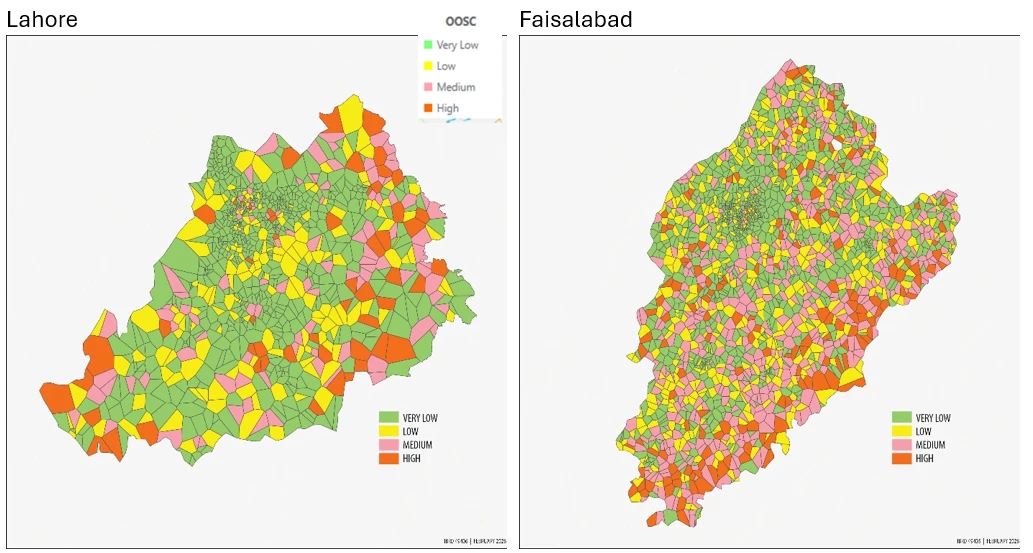
Note: Each shaded area represents the share of school-age children not enrolled within a public school catchment — from very low (0–25%) to high (76–100%). The contrast in spatial distribution between the two cities illustrates why community-level data changes what policymakers can see.
Cartography Unit clearance received on February 11, 2026.
Source: Authors.
Note: Very low = 0-25% , Low = 26-50% , Medium = 51-75% , High = 76-100%
When the floods came
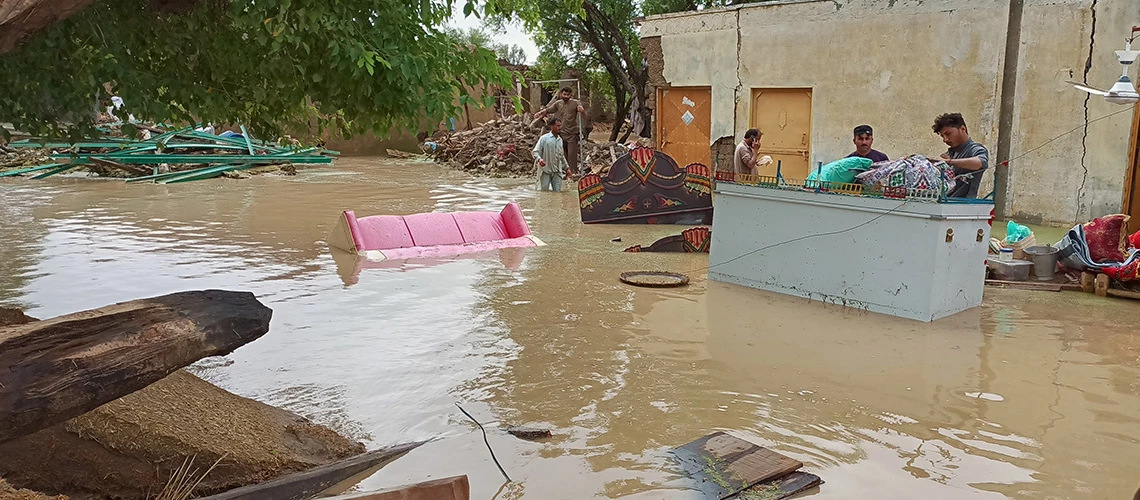
In 2022, floods submerged roughly one-third of Pakistan. The government’s post-disaster assessment counted 17,205 public schools damaged or destroyed, with 2.6 million students affected. Our satellite-based estimate is considerably higher: 20,914 public schools with total disrupted enrollment estimated at approximately 3.5 million children. The difference reflects gaps in the data.
The hardest-hit districts give a sense of the scale of the devastation. In Khairpur Mirs, the out-of-school share of the population jumped from 32.1 to 80 percent after the floods. In Jacobabad, from 46.2 to 85.7 percent. Eighteen months later, a ground-truthing survey of 1,472 households confirmed what the satellites had suggested. Of children enrolled in schools that were subsequently damaged, around 6 percent had permanently dropped out — roughly 224,000 children who may not return to schooling.
There is a broader lesson here about data systems. Official damage assessments often begin with fragmented data systems and depend on surveys and self-reporting from local education authorities using processes that can be slow and incomplete, especially in emergencies. Integrated data can help improve identification of affected schools and communities.
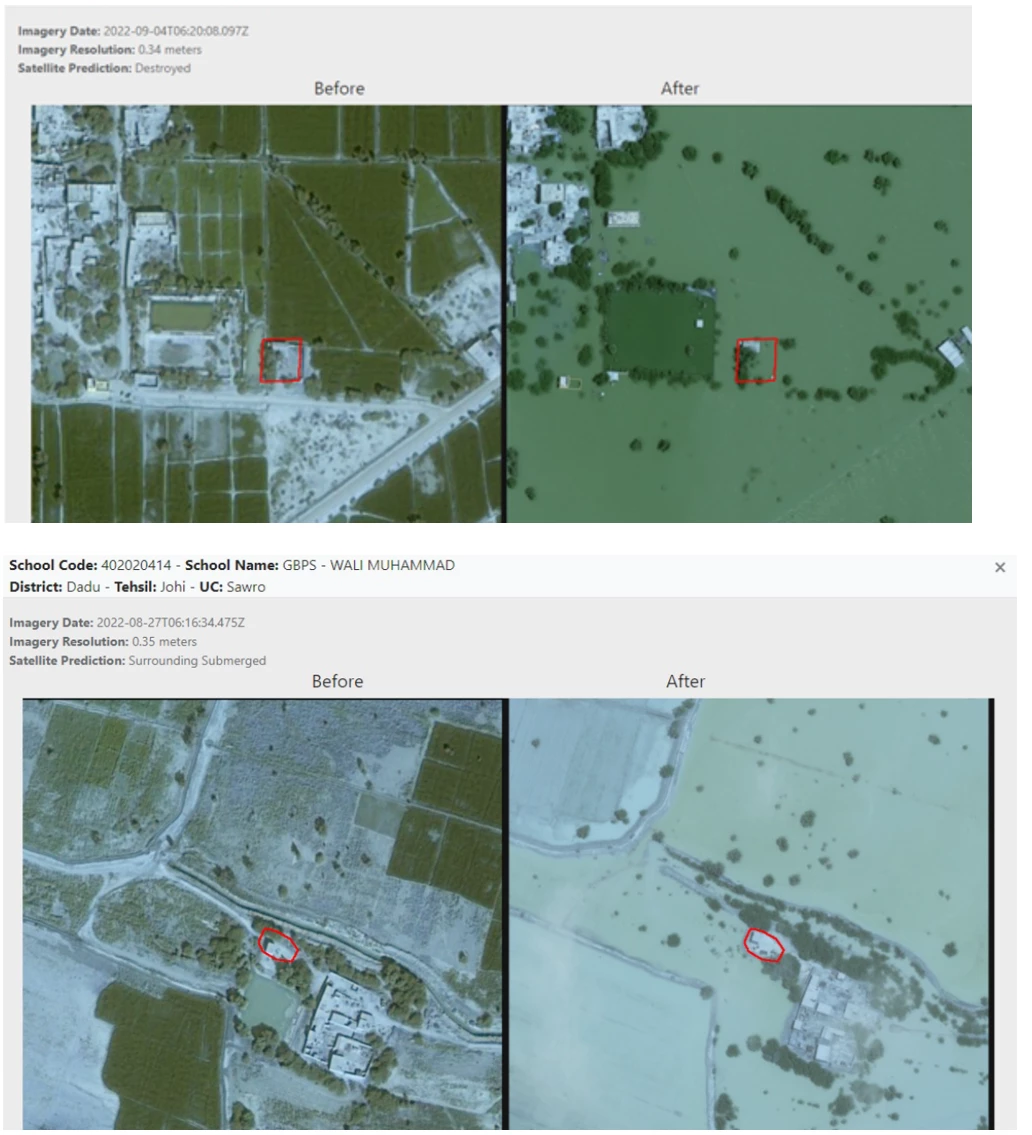
Note: The four panels show before-and-after satellite images of two school sites affected by the 2022 floods, illustrating two types of damage detected by machine learning: outright destruction (top) and surrounding submersion (bottom).
What needs to change
These findings, taken together, point to a set of practical gaps that Pakistan’s education data systems need to close — and to the kind of policy change that closing them would enable.
First, the system needs a credible, regularly updated database of private schools. Voluntary registration or census data is not enough and should be complemented by tracking open-source map systems that parents use to find schools for their children. Second, the out-of-school problem must be addressed at the community level before it is treated, because building new schools and removing barriers to attending existing ones are fundamentally different interventions. And third, school infrastructure planning clearly needs to take climate risks, such as flood risks, more seriously. Adverse climate events are becoming more frequent, not less.
Policymakers have known how many children are out of school. They now have a clear picture, of where they are. The challenge now is to translate this into targeted action. Better available data can enable more effective action, ensuring every child can access and stay in school.