

In the years when the Awami League has been out of power in Bangladesh, history has been subjected to relentless misinterpretation and distortion.
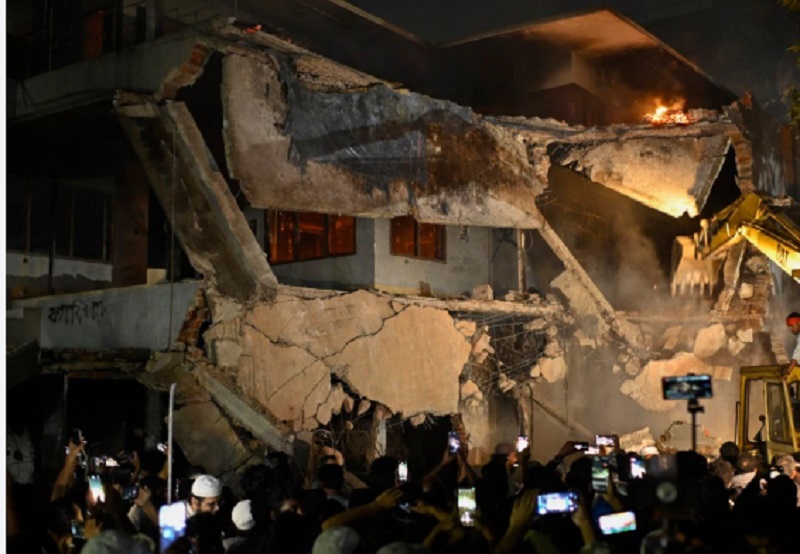
During the eighteen months in which the Yunus cabal kept power in its grip, all monuments and structures, including Bangabandhu Sheikh Mujibur Rahman’s iconic home at 32 Dhanmondi in Dhaka, which have been symbolic of Bangladesh’s victory over Pakistan in the 1971 War of Liberation, were destroyed by mobs.
Since assuming office, the party has gone out on a limb to depict the late General Ziaur Rahman as the individual who proclaimed Bangladesh’s independence and under whose leadership the country achieved freedom.
His wife, the late Khaleda Zia, has of late been portrayed as the first woman freedom fighter of the country.
As if that were not enough, a senior leader of the BNP who once served as a minister in the Khaleda Zia government cheerfully voiced the opinion that during the war in 1971, the Awami League did not conduct the military struggle against Pakistan but, in fact, had gone fugitive.
He did not care to explain the role played by the Mujibnagar government, inspired as it was by a by then incarcerated Sheikh Mujibur Rahman, in waging a nine-month-long guerrilla war against the militaristic state of Pakistan.
All too often, such moves toward distorting history have ended up as comedy. A former minister, who was a Pakistan army officer in 1971 but revolted along with General Zia, was referred to a few months ago by the chief of the Jamaat-e-Islami as the man who had first declared Bangladesh’s independence.
A senior Jamaat-e-Islami leader now in the parliament, elected at the February 2026 election, made it known on the floor of the legislature that he was a child freedom fighter back in 1971.
The height of the risible is reached when anti-Awami League elements peddle the false narrative that Bangabandhu not only wished to be the prime minister of Pakistan but had indeed courted arrest in March 1971, leaving his nation bereft of leadership.
In other words, the objective of such elements has consistently been one of denigrating not only the Father of the Nation but indeed the entire history of the war against a brutal Pakistani army all those decades ago.
But should anyone be surprised? This long tale of the distortion of history began soon after the assassination of Bangabandhu and his family in August 1975. The usurper Mushtaq regime swiftly replaced the slogan Joi Bangla with ‘Bangladesh Zindabad’, which was a throwback to the pre-1971 ‘Pakistan Zindabad’.
In early February 1976, through a senior journalist who later became part of the Zia military regime, the spurious notion of ‘Bangladeshi nationalism’, as opposed to Bengali nationalism, was first articulated. It is a notion to which the BNP and its fellow political travellers yet adhere.
Bangladesh Betar, the national radio, was turned into Radio Bangladesh. History was trifled with when the Zia regime prised socialism and secularism out of the constitution through dictatorial fiat, replacing them with ideas at variance with the foundational principles of the country.
In his time, General Hussein Muhammad Ershad went a step further when he decreed that Bangladesh needed a state religion. Thus, Islam, a faith practised by a vast majority of Bengalis in Bangladesh, was decreed as the official religion of the state.
There are other false notions of history, or call them deviations from history, which have often been placed before the nation. Individuals with little or a poor sense of history have argued that had Pakistan not been created, Bangladesh would not have been born.
In other words, the creation of Pakistan led to the creation of Bangladesh. The fact is deliberately ignored that the liberation of Bangladesh was an absolute rejection of Pakistan, that the secular premise of the Bengali struggle for freedom was an unmistakable repudiation of the religious communalism on the basis of which Pakistan was given shape in 1947.
Here is another instance of how Bangladesh’s history in non-Awami League years has been subjected to ridicule or unabashed distortion.
Some years ago, a lapsed lawmaker of the BNP peddled the untruth on Ekattor television channel that on his visit to Pakistan in February 1974 to attend the Islamic summit, Bangabandhu had been accompanied by Shah Azizur Rahman.
One recalls that Shah Aziz headed the Pakistan delegation to the United Nations in September 1971 and with him were a good number of Bengali collaborators of the Pakistan army.
In the Zia years, Shah Aziz rose to the position of prime minister of Bangladesh. Between 1975 and 1996 and again between 2001 and 2006, a number of other Bengali collaborators of the Yahya Khan-Tikka Khan junta were placed in power by successive anti-Awami League regimes.
To cut a long story short, that lawmaker on Ekattor channel was exposed when it transpired that he had deliberately been trying to undermine Bangabandhu by suggesting that Pakistan’s President FazleElahi Chaudhry, who was standing with Prime Minister Bhutto beside Bangabandhu at Lahore airport, was Shah Azizur Rahman!
One can be quite certain that the distortion of Bangladesh’s history will attain newer and in fact quixotic dimensions in the times ahead.
ALSO READ: Tofail Ahmed: A defining figure in Bangladesh’s history
Citizens will simply have to wait for a government wedded to the Spirit of 1971 for the history and political heritage of the country to be restored, yet again, to its proper place.
One will recall that national history was restored and anti-history was run out of town in June 1996, when the Awami League, led by Sheikh Hasina, formed the government.
And that was twenty-one years after the fall of Bangabandhu’s government in a violent coup d’etat on 15 August 1975. History was again upheld in the years between 2009 and 2024, when the Awami League held power in the country.