

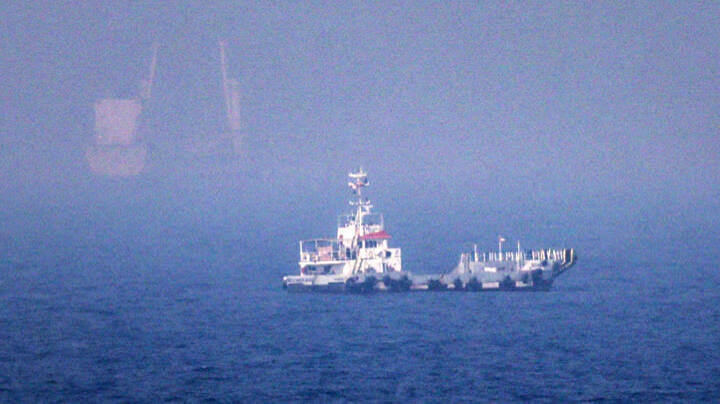
The United States has reimposed its blockade on Iranian ports in response to Iran’s attacks on commercial vessels in the Strait of Hormuz, as a fragile interim ceasefire continues to unravel and fears of a wider regional conflict grow.
The US military announced the renewed blockade on Tuesday. The blockade was first introduced in mid-April before being lifted in mid-June, one day after an interim peace agreement was signed to help bring the conflict to an end.
The agreement included a 60-day timeline for negotiations on Iran’s nuclear programme. However, talks have stalled amid renewed fighting around the strategically important Strait of Hormuz.
On Monday, US President Donald Trump announced the return of the blockade and initially proposed a 20% fee on ships using the strait. However, he later withdrew the fee proposal after requests from Gulf allies, saying he preferred investment commitments over imposing shipping charges.
“They said we’d love to do it a different way. We’d love to invest in the United States with billions and billions of dollars,” Trump told reporters at the White House on Tuesday.
The interim agreement was intended to reopen one of the world’s most important maritime trade routes and provide time for negotiators to reach a permanent peace deal. Instead, renewed military activity has heightened concerns over global energy supplies, international trade and aviation safety.
According to a US official who spoke to the Associated Press on condition of anonymity, the US launched another round of airstrikes before reimposing the blockade. The US Central Command said the strikes targeted Iran’s coastal defence systems, missile and drone sites, and maritime capabilities.
“These strikes will continue imposing a heavy cost on Iranian forces and degrade their ability to attack innocent civilians and commercial shipping in the Strait of Hormuz,” the US military said.
Iran confirmed the strikes but did not immediately provide details on casualties or damage.
Iran’s Deputy Foreign Minister for Legal and International Affairs, Kazem Gharibabadi, accused Washington of trying to prevent Tehran from exercising what he described as “effective sovereignty” over the Strait of Hormuz.
“The passage of vessels is not important to the US. The US is not dependent on the Strait of Hormuz, and Trump has announced it many times,” Gharibabadi said in an interview aired by Iran’s state broadcaster, IRIB.
Before the conflict, nearly one-fifth of the world’s traded crude oil and natural gas passed through the Strait of Hormuz. Since the outbreak of hostilities, attacks on commercial shipping have disrupted traffic and contributed to sharp increases in global oil prices.
Iran has recently targeted vessels travelling through a US-supervised shipping route outside Tehran’s control, prompting retaliatory military action. The US has warned it could reopen the waterway by force, although military experts say such an operation would require a much larger deployment.
Iran also launched attacks targeting Bahrain, Kuwait, Jordan and three tankers travelling through the strait.
The International Maritime Organization said two mariners were killed and 14 others injured in attacks on two UAE-linked tankers, Mombasa and Al Bahiyah. The United Arab Emirates warned it would respond.
Iran’s Revolutionary Guard claimed the vessels had ignored repeated warnings.
Qatar condemned what it described as repeated Iranian attacks on Jordan, Bahrain and Kuwait, calling them “an egregious violation” of the three countries’ sovereignty and international law. Doha also renewed its call for dialogue, diplomacy and de-escalation.
Hours after the US announced the end of its latest strike campaign, fresh explosions were reported in the Iranian cities of Bushehr, Ahvaz and Bandar Abbas, according to Iranian state media.
The renewed violence has further undermined the interim peace agreement, which is now approaching the halfway point of its 60-day negotiation period. The deal was also intended to address Iran’s disputed nuclear programme and other regional security concerns.
Trump’s abandoned proposal to charge transit fees through the Strait of Hormuz would have marked a major shift in longstanding US policy supporting free navigation through the strategic waterway.
Under the interim agreement, Iran agreed to allow toll-free passage through the strait for 60 days, although both sides continue to disagree over Tehran’s long-term authority to regulate and charge for maritime traffic.
Global oil markets remain volatile. Brent crude briefly rose above US$87 per barrel on Tuesday before falling to around US$78 following Trump’s decision to abandon the proposed shipping fees.
Regional mediators, led by Pakistan, are continuing efforts to revive ceasefire negotiations between Washington and Tehran, according to two regional officials familiar with the diplomatic process.
Meanwhile, Lebanese and Israeli delegations met in Rome on Tuesday and are expected to continue US-mediated talks on Wednesday. A separate framework agreement aimed at securing the withdrawal of Israeli forces from southern Lebanon in exchange for Hezbollah’s disarmament has also stalled.
The situation remains highly uncertain, with concerns growing that further escalation around the Strait of Hormuz could trigger a broader regional conflict and disrupt global energy markets.
Source: Associated Press (AP)