

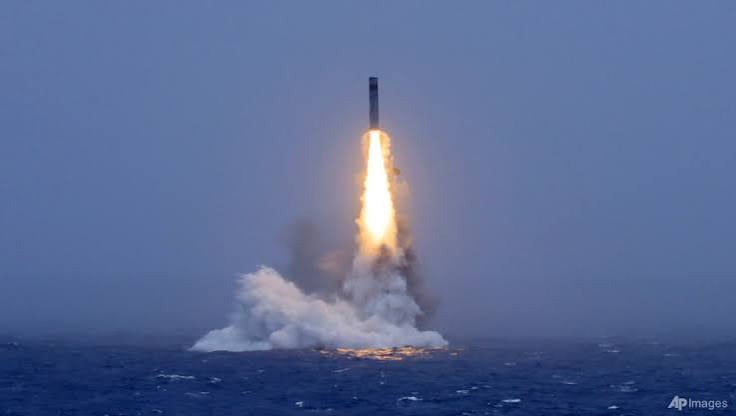
Beijing would like the world to treat its July 6 submarine-launched ballistic missile test as routine. The accumulating details suggest that interpretation is too narrow.
At 12:01pm on Monday, a Chinese nuclear-powered submarine fired a ballistic missile into the Pacific, an action Beijing had never previously acknowledged in public. Navigation warnings indicate that planners might initially have considered two different launch profiles: one from the Bohai Sea flying over Japan, and another from the South China Sea likely crossing the Philippines. Only the latter appears to have been executed. Official statements described the test as part of China’s People’s Liberation Army’s annual training cycle, emphasized that it was not directed at any specific country, and said that relevant governments had been notified in advance.
The timing also coincided with the opening of this year’s Joint Sea in Qingdao, China’s annual naval exercise with Russia, though there is no evidence that Moscow was involved in the missile launch itself.
The most restrained interpretation comes from arms control analysts. Jeffrey Lewis of the Middlebury Institute said that the test should not be over-interpreted, adding that nuclear-armed states routinely test their missile systems.
That argument has merit. Yet Lewis’ own follow-up illustrates how uncertain the technical picture remains. Revisiting the available data, he said that the missile’s range was closer to 7000km, more consistent with the older JL-2 than the longer-range JL-3 initially cited by Chinese commentators. That shift matters. It highlights how little clarity Beijing has provided and how quickly confident conclusions can give way to ambiguity.
Taiwan’s National Security Council moved more decisively. National Security Council Secretary-General Joseph Wu (吳釗燮) released a flight-path graphic within hours of the launch, identifying the missile as a JL-2 fired from a Type 094 submarine. The trajectory he outlined, about 6,300km across the Philippines, Palau, Guam and Micronesia before splashdown near Nauru, has broadly matched independent reconstructions circulating online.
Wu framed the launch as a destabilizing provocation, and his office was the first government-linked source to assign a specific missile type to the test. Other experts, including leading scholars of China’s nuclear forces, have urged caution, saying that many operational details remain unconfirmed. That caution is justified, but it does not negate the broader strategic pattern.
That pattern becomes clearer when viewed alongside China’s September 2024 test of a DF-31AG intercontinental ballistic missile into the Pacific. That launch, which traveled more than 11,000km from Hainan to waters near French Polynesia, was also presented as routine. Subsequent reporting revealed that China had positioned tracking ships across the Pacific to support the test, underscoring the level of preparation involved. This year’s launch follows the same template but adds a critical dimension: a submarine platform. A sea-based launch demonstrates a more survivable nuclear deterrent, signaling that China can maintain second-strike capability from concealed positions.
Reactions across the Pacific reflect how the geography of the test has been interpreted. Australia’s prime minister described the launch as provocative, while the Solomon Islands’ leadership criticized it as inconsistent with the behavior of a partner. New Zealand objected to the testing of a nuclear-capable system into the South Pacific Nuclear Free Zone, adding that it was the second such instance in the past few years. The timing intensified these concerns, coinciding with a new defense agreement between Australia and Fiji and reinforcing the perception that the Pacific Islands are becoming an increasingly contested strategic space.
Japan sits at the center of the political implications. Tokyo stated that the missile did not pass through its airspace and instead followed a trajectory south of Japan, consistent with a South China Sea launch. Even so, the episode has been interpreted through a wider historical lens. An assumed Japan overflight, linked to the eve of the July 7 anniversary of the Marco Polo Bridge Incident, carried an unmistakable symbolic resonance before official clarifications emerged. That symbolism does not depend on the exact trajectory. During the same week, China Aerospace Science and Technology Corp, the state contractor responsible for the JL-series missiles, released a commemorative poster marking the outbreak of the 1937 war with Japan, incorporating missile imagery into the design. The juxtaposition of a live missile test with historically charged messaging invites a broader reading.
Taken individually, each element of this episode can be explained. Missile testing is standard practice for nuclear powers. Flight paths over international waters are not unusual. Historical commemorations are a routine feature of Chinese political messaging. The significance lies in their convergence. This test combined technical ambiguity, a strategically expansive trajectory, synchronized symbolism and immediate regional reaction, all within a single event described as routine.
The result is a form of signaling that operates through accumulation rather than declaration. By leaving the missile type uncertain, by selecting a trajectory that intersects key parts of the Indo-Pacific security architecture, and by allowing historical narratives to frame the moment indirectly, Beijing creates a layered message that different audiences interpret in different ways. For Washington, it highlights the maturation of China’s sea-based deterrent. For Japan, it intersects with contemporary security concerns and historical memory. For Pacific Island states, it underscores their exposure within a shifting strategic environment.
The question is not whether the test was routine in a technical sense. It is whether it was routine in a political one. On that point, the evidence points in a different direction.