

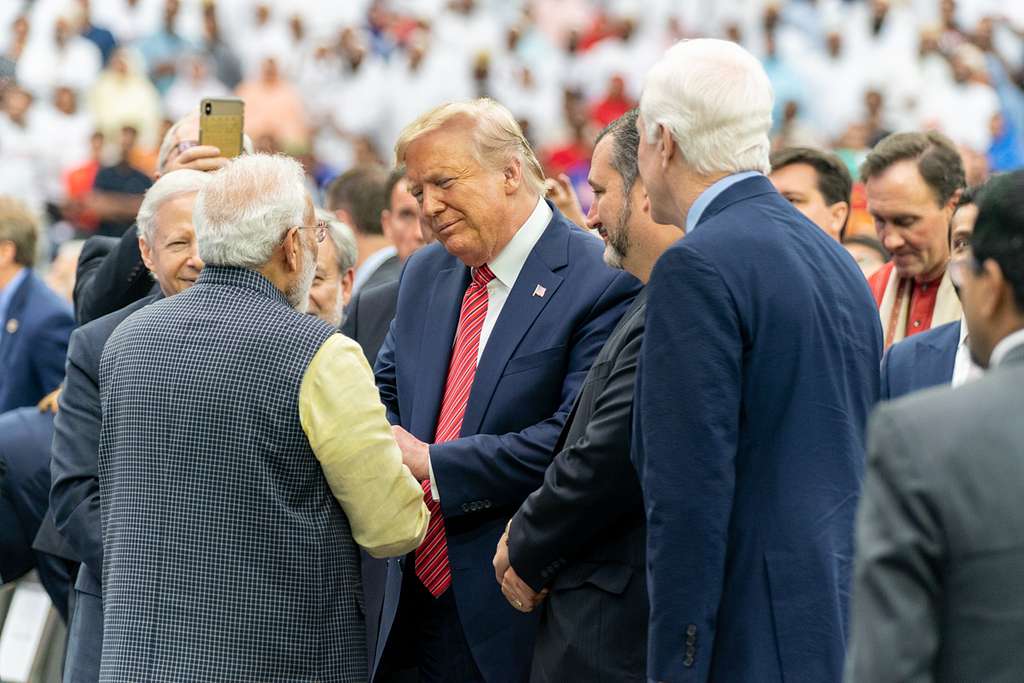
The recent turbulence in India-US relations has prompted questions about whether one of the world’s most consequential strategic partnerships is beginning to lose momentum. A series of decisions by the Trump administration, including renewed tariffs on India, the symbolic removal of ‘Indo’ from references to the US Indo-Pacific Command, an official map depicting Pakistan-occupied Kashmir as part of Pakistan, and renewed outreach to Islamabad, have collectively generated unease in New Delhi. Taken together, these developments suggest a relationship facing unexpected headwinds. Yet such an assessment risks confusing political disruption with strategic reality.
It is important to note that the current strains are less the product of structural divergence than of a personality-driven and transactional approach to foreign policy. They reflect President Trump’s preference for short-term bargaining, symbolic signaling, and bilateral leverage rather than a fundamental reassessment of America’s long-term strategic interests. Personal leadership styles can alter diplomatic atmospherics, but they cannot erase geopolitical realities. This distinction is important because the India-US partnership has never rested solely on personal chemistry between leaders. From the civil nuclear agreement to the designation of India as a Major Defense Partner and the conclusion of foundational defence agreements, successive US administrations have recognized India’s unique strategic role.
Indeed, some of Washington’s recent decisions are strategically counterproductive. Recent tariffs sit uneasily with efforts to build resilient supply chains alongside trusted partners as both countries seek to reduce dependence on China. Likewise, removing “Indo” from the military vocabulary may appear administratively insignificant, yet strategic terminology carries political meaning. The Indo-Pacific concept recognized the strategic centrality of the Indian Ocean and India’s role within it. The depiction of Pakistan-occupied Kashmir as part of Pakistan was particularly damaging. Cartography in South Asia carries strategic meaning, and such avoidable errors undermine trust at a time of expanding defence cooperation. Likewise, engaging Pakistan is not inherently problematic, but treating India’s strategic value as comparable to Pakistan’s tactical utility reflects an outdated geopolitical mindset. Today’s geopolitical landscape is fundamentally different from the Cold War or the post-9/11 era. India has emerged as a major maritime power whose strategic importance rests on geography, economic scale, naval capability, and technological growth- not on rivalry with Pakistan. Neither tariffs nor symbolic political decisions can alter that reality.
The Indian Ocean Is the Real Anchor
If there is one enduring factor that explains why India and the United States will continue to converge strategically, it is geography. Much commentary continues to interpret India-US relations primarily through the prism of China. Beijing’s expanding military capabilities, growing naval presence and increasingly assertive behaviour across the Indo-Pacific undoubtedly reinforce strategic cooperation between New Delhi and Washington.
The real foundation of the relationship lies in the Indian Ocean region itself: a maritime space where American and Indian interests are not merely complementary but increasingly parallel. For the United States, the Indian Ocean is indispensable for sustaining military presence, protecting energy flows and the security of global trade. Operations from Diego Garcia to the Strait of Hormuz illustrate this enduring strategic importance. For India, these waters constitute its primary strategic neighbourhood. Nearly 95% of India’s trade by volume and the overwhelming majority of its energy imports traverse the Indian Ocean. Ensuring secure Sea Lines of Communication is therefore not simply a maritime priority but an economic necessity. Here lies the real strategic convergence: both Washington and New Delhi seek an open, stable and rules-based Indian Ocean where no single power can dominate the maritime commons.
A Partnership Bigger Than Trump
This convergence extends far beyond responding to China’s growing assertiveness. Beijing’s growing military presence reinforces India-US cooperation, but it is not the partnership’s sole rationale. To view India merely as a counterweight to China is to underestimate both India’s strategic agency and America’s long-term interests. China’s expanding naval footprint across the Indian Ocean illustrates why closer cooperation has become imperative. The establishment of a military base in Djibouti, the regular deployment of People’s Liberation Army Navy task groups in the Gulf of Aden, expanding submarine patrols in the Indian Ocean, and Beijing’s access to strategically located ports from Gwadar to Hambantota have steadily altered the region’s security landscape. Through the Belt and Road Initiative (BRI), China has acquired not only commercial influence but also strategic leverage across key maritime corridors. This has naturally encouraged greater coordination between India and the US. Yet the strategic logic binding Washington and New Delhi is considerably broader than balancing Beijing.
Both countries share interests in maritime security, resilient supply chains, freedom of navigation and emerging technologies including semiconductors, AI, quantum computing, cyber security and critical minerals. In this context, the economic dimension is equally compelling. India is projected to remain among the world’s fastest-growing major economies over the coming decade, offering enormous opportunities for American investment, innovation and manufacturing partnerships. Bilateral trade has crossed USD 140 billion in FY 2025-26. What is important is that American companies continue to deepen their presence across India’s digital economy, renewable energy sector, pharmaceutical industry and advanced technology ecosystem. Defence ties have evolved toward co-production, joint research and industrial collaboration. Energy security further reinforces this convergence. Stable sea lanes across the Indian Ocean remain essential for transporting Gulf energy supplies. While India depends directly on these routes, the United States has a broader interest in safeguarding global shipping and allied energy security. Their interests differ in scope but converge strategically.
Beyond immediate security concerns, the long-term stability of Gulf energy flows has become a strategic imperative for both countries. India imports well over half of its crude oil from the Gulf, making uninterrupted maritime access indispensable for sustaining economic growth, industrial production and energy affordability. Even temporary disruptions to commercial shipping can increase insurance costs, freight rates and energy prices, with ripple effects across global markets. For the United States, preserving predictable energy flows is equally important, not only for its own economic interests but also for ensuring the energy security of allies and partners whose prosperity depends upon reliable Gulf supplies. Maintaining the uninterrupted movement of energy through the Indian Ocean is therefore a shared strategic objective rather than merely a crisis-management challenge.
The Indian Ocean, therefore, should not be viewed as India’s sphere and the Pacific as America’s. Such compartmentalisation no longer reflects geopolitical realities. The Indo-Pacific has emerged precisely because these maritime theatres are strategically interconnected. American influence in the Indian Ocean cannot be sustained through naval deployments alone. It requires trusted regional partners capable of sharing responsibilities, maintaining maritime awareness and responding rapidly to humanitarian crises, piracy, illegal fishing and regional contingencies. India has steadily demonstrated its willingness and ability to play that role.
Recent humanitarian assistance and disaster relief operations, anti-piracy deployments in the Gulf of Aden, evacuation missions during regional conflicts, and India’s role in providing maritime security across the Indian Ocean all illustrate its growing profile as a net security provider. These contributions have enhanced regional confidence in India’s leadership while simultaneously advancing broader American interests without requiring direct US intervention in every contingency. This is precisely why attempts to downgrade India’s strategic significance or revive the aforementioned outdated US Pakistan-centric calculations are likely to prove self-defeating. Pakistan may retain limited tactical utility for Washington, but India represents a long-term geopolitical investment shaping the regional balance of power. The distinction is fundamental. One offers episodic utility; the other contributes to shaping the regional balance of power over decades.
President Trump’s emphasis on transactional diplomacy has undoubtedly complicated this strategic narrative. Tariff disputes, symbolic policy decisions and fluctuating diplomatic priorities have introduced uncertainty into a partnership that had previously enjoyed remarkable bipartisan continuity in Washington. Fortunately, institutions generally outlast personalities. Defence cooperation continues to deepen. Military exercises have become increasingly sophisticated. Intelligence sharing has expanded. Cooperation in emerging technologies continues to accelerate. Private sector investment remains robust. None of these structural trends have fundamentally changed over the last year and a half.
History repeatedly demonstrates that durable strategic partnerships are ultimately sustained by converging national interests rather than political personalities. Presidents come and go. Governments change. Policies evolve. Geography, however, remains the same. The Indian Ocean will remain central to global commerce, energy security, and military competition irrespective of who occupies the White House. India will continue to occupy its central geographic position astride these vital maritime routes. The United States will likewise remain invested in preserving an open maritime order that safeguards international trade, protects allied interests and prevents the emergence of regional hegemony. Those realities will not become victims of temporary disagreements and tensions.
For Washington, therefore, the question is not whether India remains important. It is whether the US is prepared to align its diplomacy with its own long-term strategic interests. Allowing temporary political disagreements to overshadow enduring geopolitical convergence would represent a costly strategic error. America may choose to recalibrate its policies towards India, but it cannot afford to overlook the country that sits at the very heart of the Indian Ocean. The India-US partnership has never been about personalities alone, nor should it become hostage to them. It rests upon a shared appreciation of maritime security, economic resilience, technological innovation and the preservation of stable regional order. China undoubtedly reinforces this convergence, but it does not define it. The real foundation lies in the strategic geography of the Indian Ocean and the recognition that a secure, prosperous and influential India remains indispensable to America’s own vision of the Indo-Pacific. For that reason, the current strains should be understood not as the beginning of strategic separation but as a temporary political detour. The sooner Washington recognises that reality, the stronger and more enduring the partnership will become.