

To understand India, it is not enough to focus on events alone; one must first understand how India sees the world.
In the past few years, India’s strategic autonomy in the Russia-Ukraine war, its security calculations during the India-Pakistan conflict and its engagement with the US amid tariff policies have each generated different narratives about Indian foreign policy. Yet the more such events unfold, the harder India becomes to understand, because events can describe India’s behavior, but cannot fully explain the strategic thinking that underpins it.
Since independence, uncertainty in the strategic environment has been a constant feature of India’s security landscape. Whether during the Cold War or today’s US-China strategic competition, India’s pursuit of strategic autonomy does not imply a rejection of power politics. Rather, it is about retaining the ability to define its own national interests and choose its own development path amid major-power competition.
The Yarlung Tsangpo offers a useful illustration of this strategic thinking at the regional level.
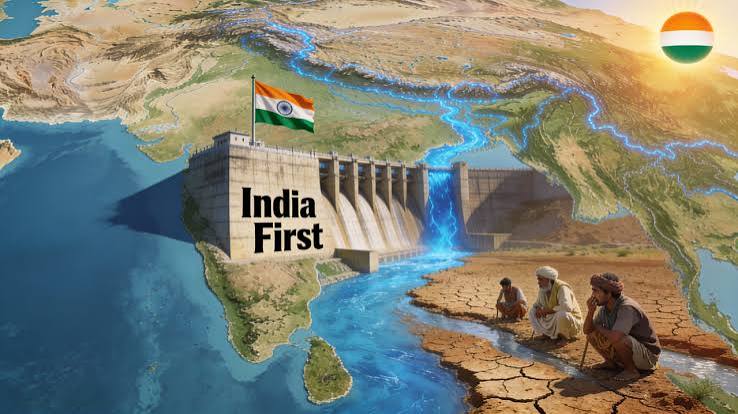
China’s launch of construction on the Lower Yarlung Tsangpo Hydropower Project last year has once again brought this transboundary river to the center of Sino-Indian strategic competition. Since the 2017 Doklam standoff, transboundary hydrological data-sharing between China and India has weakened, limiting India’s access to information about developments upstream. As a downstream state, India has consequently become increasingly concerned that geographic asymmetries could be translated into strategic leverage.
Because much of the Brahmaputra basin lies within Indian territory, India has pursued a series of basin development projects in Arunachal Pradesh, including the Siang Upper Multipurpose Project and other tributary hydropower schemes. These initiatives are intended not only to expand hydropower generation, but also to regulate river flows, improve flood management and enhance resilience against external shocks.
India’s response is not a “dam for dam” engineering race. Rather, it reflects two competing approaches to water governance: One treats water resources as an extension of strategic capability, while the other emphasizes institutional cooperation as a means of managing uncertainty.
Although India is a downstream state on the Yarlung Tsangpo, it is simultaneously a major upstream state within South Asia’s river systems. India is concerned about China’s management of transboundary waters, yet it also recognizes its own unique position in South Asian river politics. Accordingly, it seeks to establish a governance framework for transboundary rivers through information sharing, basin management, flood-control cooperation and disaster resilience.
If water resources are viewed merely as an extension of national capability and strategic advantage, transboundary rivers are likely to become trapped in a security dilemma in which upstream states compete for greater control. By contrast, if managed through institutional cooperation, information transparency and basin-wide governance, water resources can be transformed from instruments of power into foundations for regional cooperation.
India’s approach to the Yarlung Tsangpo is not merely a passive response to China. Rather, it reflects how India seeks to exercise strategic autonomy by responding to a changing strategic environment while redefining its regional role.
Lin Hsiao-chen is an assistant professor at Tamkang University’s Graduate Institute of International Affairs and Strategic Studies.