
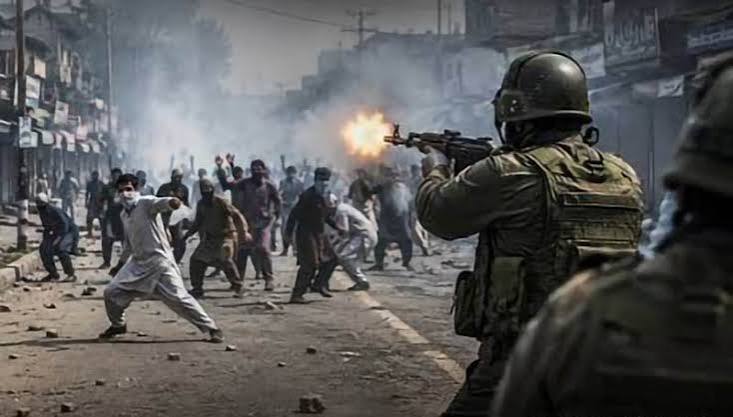
The comparison between Jammu and Kashmir and Pakistan Occupied Jammu and Kashmir (PoJK) is no longer a contest of narratives. It is a question of measurable outcomes, and the gap has become indefensible for Pakistan. In Jammu and Kashmir, an elected assembly is functioning, the economy is projected to touch INR 2.86 lakh crore, terrorism has fallen to its lowest level in more than three decades, and trains now cross the world’s highest railway arch bridge into the Valley. In PoJK, Pakistani security forces have shot dead scores of unarmed protesters since June, the occupied territory’s largest civic movement has been proscribed under anti-terrorism law, all types of communications have been cut for close to 60 days, a two-phase election has been boycotted, and all outcomes will be rigged by Islamabad. Jammu and Kashmir is developing on every measurable front. PoJK is being illegally administered by force under Field Marshal Syed Asim Munir’s ‘hard state’ doctrine.
In June, the so-called AJK home department proscribed the Jammu Kashmir Joint Awami Action Committee (JAAC) under the Azad Jammu and Kashmir Anti-Terrorism Act, 2014, within days of the election schedule being announced for 27 July. Mobile and internet services were suspended and stayed down across the region for close to 60 days, restored only partially on the eve of polling. Islamabad has even restricted the telecast of Al Jazeera across the country for a report revealing ground reports of the poll boycott. According to JAAC, 45 people were killed before July 27, and an additional 37 people were killed on July 27 and 28. It also alleges that Pakistani authorities removed bodies from hospitals and streets to suppress the count. Amnesty International recorded at least 40 deaths in the run-up to the farce elections. The UN High Commissioner for Human Rights has called for an investigation into the killings of innocent civilians.
JAAC is a coalition of traders, transporters, lawyers and students demanding cheaper electricity, subsidized wheat, an end to elite privileges, and the abolition of 12 assembly seats reserved for refugees who live in Lahore, Rawalpindi and Sialkot rather than in the territory itself. Those 12 constituencies carry roughly 439,000 registered voters located outside PoJK, and they let Islamabad’s parties decide who governs the occupied territory. Furthermore, the electricity grievance is equally concrete. The Mangla Dam operates at 1,310 MW and supplies close to five billion units a year to the national grid, about 15 percent of Pakistan’s installed hydropower capacity. Local production costs run between PKR 3 and PKR 4 per unit while consumers in PoJK have been billed at many times that rate, and the federal government pays the territory no royalty. Islamabad signed an agreement covering all 38 JAAC demands in October 2025 with a 90-day implementation deadline. As expected, their demands were never met and the region has been forced to participate in fake polls. A vote held under a total communications blackout, with JAAC banned as a ‘terrorist’ outfit and coalition partners accusing each other of fraud, manufactures no legitimacy in PoJK and further confirms Pakistan’s illegal occupation.
The contrast across the Line of Control in Jammu and Kashmir is documented in the same currency of hard numbers. The region continues to witness all-round development, with a far-improved security situation and a reliable counterterrorism apparatus to counter Pakistan-run cross-border terrorist activities. The first six months of 2026 saw only 12 casualties, of which 10 were militants killed largely while attempting to infiltrate J&K. Local recruitment into militancy has collapsed from 125 youths in 2021 to around 100 in 2022, 22 in 2023 and fewer than 10 in 2024. Security officials now count a single active local militant in the entire Union Territory. Still, Pakistan has not stopped its terror-sponsoring activities in the region and would continue to look for ways to create instability.
Furthermore, the economic situation follows the security record in J&K. The Economic Survey 2025-26 projects real GSDP growth of 5.82 percent and nominal growth of 8.89 percent, taking the economy to nearly INR 2.86 lakh crore. Per capita income in J&K is estimated at INR 1,68,243, rising faster than in several northern states and closing the gap with the national average. Some 2,227 industrial units carrying cumulative investment of INR 15,940 crore have become operational over seven years, and the New Central Sector Scheme has drawn proposals worth INR 14,292 crore. The Union Territory of J&K holds Top Achiever status in the national Ease of Doing Business assessment.
On the infrastructure aspect, J&K has seen significant transformation in recent years with the government’s focus on enhancing physical access to the region. The Udhampur-Srinagar-Baramulla Rail Link and the Chenab bridge connected the Valley to the national railway network, and the Katra-Srinagar Vande Bharat now carries about 3000 passengers a day, cutting the journey to roughly five hours against 10 by road. Tourism absorbed a real shock after the Pahalgam massacre of April 2025, with arrivals falling from 2.36 crore in 2024 to 1.78 crore in 2025. The Amarnath Yatra crossed three lakh pilgrims in 12 days this year, the fastest ever, and reached 4.14 lakh in 18 days, matching the entire 2025 total with a month of the pilgrimage still to run.
However, the political contrast is the sharpest of all in providing a clear contrast between PoJK and Jammu and Kashmir. The region voted in 2024 at a turnout above 63 percent, the highest in decades, and is governed by an elected chief minister. Whatever contentious issues and policy disagreements are conducted peacefully in the J&K assembly. Disagreement in PoJK is conducted at gunpoint of the Pakistan military establishment, with all communications and the internet switched off. Islamabad has spent nearly eight decades branding PoJK as ‘Azad’ (Free). However, the cat is out of the bag now as the international community is witnessing the real growth in Jammu and Kashmir against a brutal illegal occupation of the Pakistani regime in PoJK. However, the people of PoJK have delivered their verdict after boycotting sham elections and peacefully taking to the streets to demand their basic rights, despite the brutal killings of innocent protesters.