
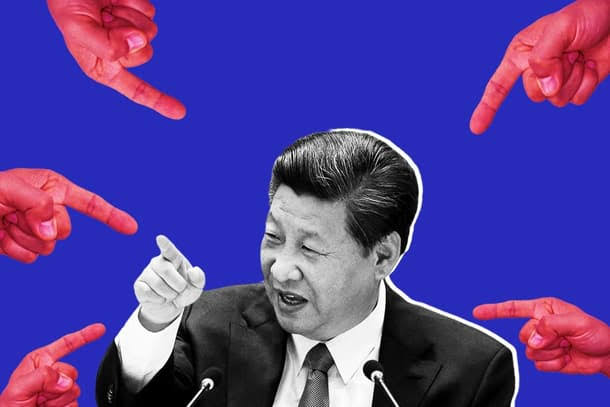
Over the past twenty years, China has built one of the world’s most extensive systems of information control. The Great Firewall, restrictions on foreign media, the removal of online content and the detention of journalists and activists have become familiar features of the country’s political landscape. Under Xi Jinping, however, information control has acquired a broader institutional and political purpose. The objective is no longer confined to preventing politically sensitive material from reaching the public. Increasingly, the Chinese Communist Party seeks to shape the wider environment in which information is produced, circulated and interpreted.
This shift is visible in the growing emphasis on what Chinese authorities describe as the management of public opinion and the promotion of “positive energy” online. State media, government agencies and digital platforms operate within an increasingly coordinated system in which politically desirable narratives are amplified while alternative accounts can be restricted, discredited or made difficult to verify. Legislation has also extended the state’s role into areas such as patriotic education, historical memory and online information governance.
In July, comedian Guo Degang altered the lyrics of a revolutionary song during a performance in Wuhan. Authorities subsequently fined the companies involved, arguing that the altered lyrics distorted a song carrying the memory and sentiments of China’s wartime resistance. Guo’s troupe has since gone silent.
Days later, catastrophic flooding along the China-Nepal border produced another example. While Nepal released extensive information about casualties and missing people and permitted journalists to report from affected areas, access on the Chinese side was tightly controlled. Chinese authorities restricted reporting, deleted online posts and punished people accused of spreading “rumours” about the disaster.
At first glance, the two episodes have little in common. One concerns a comedian altering a patriotic song, while the other concerns information emerging during a humanitarian disaster. Yet both demonstrate how the boundaries of permissible public discourse are being constructed across very different areas of social life.
From deleting speech to managing interpretation
The significance of the Guo Degang case lies less in the punishment of a comedian than in what it says about the changing boundaries of permissible cultural expression. China’s 2023 Patriotic Education Law, which came into force in January 2024, explicitly extends patriotic education into literature, film, music, theatre and online content. It also prohibits conduct deemed to distort or denigrate the deeds and spirit of heroes and martyrs and empowers relevant state departments to intervene where such acts produce “adverse social effects.”
This provides an important institutional context for the Guo case. Revolutionary songs are no longer simply cultural artefacts. They form part of a state-defined historical narrative whose interpretation can carry political consequences. A joke or alteration can therefore become more than artistic improvisation and can instead be treated as a deviation from an officially sanctioned understanding of national history.
This expansion of political control into cultural expression is particularly important because it does not require the elimination of entertainment, humour or creativity. Rather, it establishes the political boundaries within which they can operate. The distinction between acceptable and unacceptable expression can consequently become dependent not only on what is said, but on the context, symbolism and historical meaning attached to it.
In January 2025, filmmaker Chen Pinlin was sentenced to three-and-a-half years in prison for making a documentary about the 2022 “White Paper” protests. Human Rights groups identified the conviction as one of the notable cases illustrating China’s restrictions on expression during 2025. The significance of the case lies in the fact that Chen was not simply publishing a political manifesto but was documenting an event that had already occurred.
When independent accounts are prevented from circulating, the state acquires greater influence over which versions of an episode remain available to the public. Political control therefore extends beyond the immediate suppression of dissent and into the construction of historical memory.
The experience of journalist Zhang Zhan demonstrates another dimension of this problem. Zhang gained international attention for her reporting from Wuhan during the Covid-19 outbreak and was subsequently imprisoned for her work. In September 2025, she was sentenced to another four years on charges of “picking quarrels and provoking trouble”. Her case illustrates how independent documentation can remain politically sensitive even after the immediate crisis has passed.
Taken together, these cases suggest that the state is increasingly concerned with the afterlife of information. Who is permitted to document an event, which accounts remain accessible and how an episode enters public memory have become questions with political implications. China’s information system is therefore increasingly better understood as a form of narrative governance.
The politics of uncertainty
The Tibet floods offer perhaps the clearest example of how this system operates during a crisis. The disaster destroyed the Gyirong border crossing after a glacier collapse triggered catastrophic flooding on August 26. By early September, more than 1,300 people had reportedly died and thousands remained missing across Nepal and Tibet. Yet the information environments on the two sides of the border were markedly different. Nepalese authorities released names of missing people and permitted extensive reporting, while information from the Chinese side remained substantially more restricted. The structure of available information shaped what could reasonably be known.
Foreign journalists were prevented from freely accessing the affected areas, while Chinese reporting concentrated heavily on rescue operations and official responses. People who challenged the official narrative online were reportedly punished under the government’s “Clean Internet 2026” campaign.
The mechanism has appeared in earlier disasters as well. The 2021 Zhengzhou floods, for example, produced intense online discussion about passengers trapped in the city’s subway system and questions concerning official preparedness and infrastructure. Research on the disaster has shown how social-media-based information sharing could create a real-time alternative information environment during emergencies. For Chinese authorities, the challenge posed by such episodes is therefore not simply the circulation of false information. It is the possibility that decentralised information networks can generate an account of events that exists outside official control.
China’s broader censorship system has increasingly been designed around precisely this problem. A 2024 US-China Economic and Security Review Commission assessment noted that Chinese internet governance increasingly emphasises proactive measures such as “public opinion guidance” and the promotion of positive propaganda rather than relying exclusively on deleting undesirable content. It also highlighted the use of technological systems to monitor online discourse.
This helps explain why the language of “misinformation” has become politically significant. Tackling fraud, fabricated stories and malicious rumours is a legitimate function of any information system. The difficulty arises when the same mechanisms are used to determine which interpretations of politically sensitive events are legitimate. The distinction between combating falsehood and suppressing inconvenient narratives can then become increasingly difficult to maintain.
Writers, journalists, entertainers and ordinary users do not need to be punished every time they cross a line. If the consequences of crossing it are sufficiently unpredictable, many will adjust their behaviour beforehand. Self-censorship then becomes more efficient than direct censorship.
China has nonetheless not achieved complete control over its information environment. Information continues to circulate through private networks, overseas platforms, citizen journalism and informal communication. The censorship apparatus remains uneven and cannot always keep pace with the speed of digital communication.
Its effectiveness, however, should not be measured only by whether alternative information disappears. A more revealing measure is whether citizens learn to anticipate what information is safe to produce and which interpretations are likely to attract official attention.
That is where the evolution of China’s information controls becomes most significant. The Party is not necessarily attempting to eliminate every competing narrative. It is seeking to ensure that when citizens encounter an event, they encounter it within boundaries that the state has already helped define. China’s information politics is therefore becoming less a question of what can be said and increasingly a question of who gets to determine what an event means.