
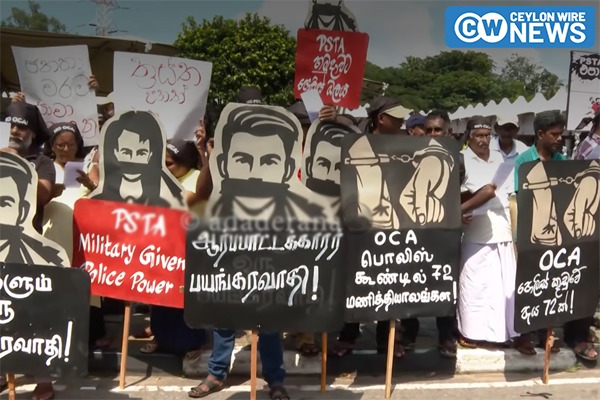
The Protection of the State from Terrorism Bill (PSTA) and the Prevention of Organised Crimes Bill (OCB) are not merely new security laws; they are pre-emptive legal shields for the next, more brutal phase of neoliberal reform, designed to criminalize the inevitable social resistance. This strategy is not new. It is a continuation of a playbook first deployed in 1978, when the Executive Presidency and the Prevention of Terrorism Act (PTA) were used not as incidental constitutional and security measures, but as instrumental tools to enforce a radical free-market agenda and crush the ensuing youth resistance in the late 1980s.
Today, the context is far more fragile. The NPP government, for the last two years, has tried to outperform the IMF targets, creating a surface-level stability while deepening the misery of ordinary people. Behind overflowing Treasury coffers lies deepening household debt, collapsing livelihoods, and youth desperate to emigrate. After failing to secure a substantial reduction in the debt stock, more than 25% of government revenue goes to debt service. Revenue directed towards debt obligations will increase from 2028. Peter Breuer of the IMF has warned that Macro-Linked Bonds could “introduce political complications in the future in case higher [debt] payments are triggered but not socially accepted” (IMF, WP/25/175). Even if the economy deteriorates after macro-linked bonds take effect in 2028, higher debt payments will persist, which the IMF rightly recognizes as a potential cause for social grievances and political instability.
Instead of negotiating to expand public spending, addressing structural weaknesses of the economy, and providing relief against inevitable internal and external shocks, the government is preparing for the social unrest of the crisis to come by adding new legal weapons to its arsenal. There has been a growth of oppressive legislation, criminalising poverty, informality and the actions people resort to when their social conditions are unbearable. The PSTA and OCB stand out as laws designed to manage the foreseeable explosion of social unrest by delegitimising dissent as “terrorism” and “serious crime”.
Crucially, the PSTA goes further than any previous law. It creates a transnational security shield for international organizations and foreign governments. While defining “offence of terrorism”, clause 3 (1) (b) of the Bill states an offence would include “unduly compelling a government or an international organisation, to do or to abstain from doing any act.”
Accordingly, a protest against the IMF, World Bank, or ADB for policies that are impoverishing Sri Lankans could be classified as a terrorist act. A demonstration in front of the US embassy over punitive tariff hikes, or in front of the Australian High Commission over destructive coastal mining carried out by Australian mining companies, could be treated as a potential terrorist offence. The qualifier “unduly” offers no real safeguard, as its interpretation rests entirely with the state.
The PSTA, therefore, is more than just a tool to protect the Sri Lankan state. It is a legal mechanism to shield the architects of global neoliberal onslaught, i.e. the IMF and foreign corporations, from the democratic dissent of the Sri Lankan people. By making protest itself a potential security threat, the state captures and neutralizes foreseeable forms of resistance to economic hardship and external policy imposition.
The new IMF program the government seeks from 2027 will demand a radical overhaul of the state, forcing privatization of not only state owned enterprises and public utilities, but of natural resources, public services, and the remaining means of subsistence that sustain communities during hard times. The PSTA and OCB are the tools that will ensure people pay the price without resistance, and that those who fight are silenced behind bars. These laws resonate with globally visible fascist trends towards intensified securitization of popular resistance, be it against the genocide in Palestine in the US and Europe, anti-IMF protests in Kenya, Pakistan and young people demanding a better future in Nepal, India and Bangladesh.
The 2022 default provided Sri Lanka a critical reflective moment to steer away from a crisis-ridden neoliberal trajectory towards a people- and ecology-centric regenerating economy. Aragalaya created conditions for new political imaginations that made the election of the NPP possible. The call for an 18th IMF programme indicates that the NPP government has missed the opportunity to reorient the economy away from crises. PSTA and OCB indicate that they are getting ready to suppress the people’s mandate for a deliberative and consultative democracy and build the IMF prison around us all.
Our future will be determined by how hard we fight to defeat the PSTA and OCB.
(The Yukthi Collective is a collaboration of activists, researchers and academics supporting working people’s movements and struggles for democracy and justice in Sri Lanka, providing a critical analysis and alternatives to neoliberalism.)