

Pakistan scored 25.5 on the 2026 Global Hunger Index, placing it 106th among 122 countries and worse than every functioning state in South Asia. Sri Lanka, which defaulted on its sovereign debt in 2022 and spent the following years under an International Monetary Fund (IMF) programme, scored 10.2 and now records South Asia’s lowest hunger levels. Bangladesh scored 19.2 and Nepal 14.5, both moderate, and India scored 24.1. Pakistan scores worse than the regional average of 23.5 and far worse than the global average of 18.1. No external shock explains this deterioration in Pakistan’s hunger levels, even though neighbours facing the same climate and commodity prices have avoided it.
The trend data is more damaging than the ranking itself. Pakistan’s score fell from 36.2 in 2000 to 25.5 today, but the index makes clear most of that improvement came before 2018. Since then, undernourishment has risen from the low to the medium band, and child wasting has climbed towards the high threshold. Pakistan is reversing gains earlier governments achieved, during the same period in which a civilian administration under military direction consolidated its hold on policy.
Underlying indicators describe a public health emergency Islamabad has chosen not to treat as one. Undernourishment affects 16.1 percent of the population, child stunting among the under-fives stands at 33.6 percent, child wasting at 9.8 percent and under-five mortality at 5.6 percent. Stunting in one in three children is a figure that should end careers, because it is largely irreversible after the first thousand days and translates into diminished cognitive capacity, lower lifetime earnings, and permanently reduced productivity. Pakistan is consuming the economic potential of the generation it claims to protect.
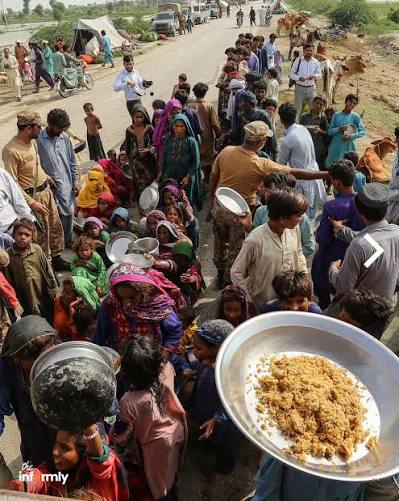
Acute food insecurity data confirms the crisis is immediate rather than a structural background issue. The Integrated Food Security Phase Classification analysis covering December 2025 to September 2026 found roughly 7.5 million people, 21 percent of those analysed, in Crisis or worse, including 1.25 million in Emergency conditions requiring immediate life-saving assistance. The projection for April to September put 6.7 million in Crisis or worse, the apparent decline attributable mainly to reduced geographic coverage rather than genuine improvement. The analysis covered just 45 rural districts, 19 in Balochistan, 12 in Sindh and 14 in Khyber Pakhtunkhwa, holding 35.6 million people or about 14 percent of the population. The worst affected provinces are the two with insurgencies and the one whose elected government was suspended this month by the military-backed government in Islamabad.
Fiscal priorities in Pakistan explain the abysmal hunger levels more completely than any analysis of climate or commodity prices. The federal budget for 2026-27 allocated PKR 3 trillion to defence services, up 17.6 percent, with the physical assets line for weapons procurement rising 39.6 percent to PKR 925.8 billion. Health received PKR 53.3 billion in total, of which PKR 24.3 billion covered the entire health and nutrition development portfolio. Military pensions, carried separately at PKR 822 billion, exceed the full health allocation more than 15 times over. The government’s own Economic Survey records public health expenditure at 0.8 percent of gross domestic product. A country spending roughly PKR 56 on its army for every rupee on its citizens’ health has declared what it values.
Furthermore, Pakistan’s wheat policy shows the failure is as much administrative as budgetary. Islamabad abolished the wheat support price mechanism under reforms tied to its IMF bailout programme, then presided over procurement that collapsed to roughly 480,000 tonnes in Punjab against a three million tonne target, with Sindh managing under 200,000. National reserves shrank accordingly, and Pakistan then imported around 3.5 million tonnes at a cost exceeding $1 billion, yet still faces a comparable shortfall, with farmer representatives warning wheat could see a steep rise and push flour out of reach for ordinary Pakistanis.
Demographic arithmetic guarantees that Pakistan’s hunger problem compounds with every passing year. The 2023 census counted 241.5 million people, up 33.8 million in six years at 2.55 percent annually, adding five to six million people a year and projecting towards 400 million by 2050. Fertility remains near 3.6 children per woman, compared with roughly 2.0 in India, 2.1 in Bangladesh, and 1.7 in Iran, and a 2018 Council of Common Interests (CCI) commitment to reach 2.8 by 2025 passed without result. Moreover, per capita water availability in Pakistan has fallen below the thousand cubic metre scarcity threshold. Around 20 million children aged five to sixteen remain out of school, removing the most reliable long-term determinant of lower fertility and better child nutrition.
Adding to these troubling facts, macroeconomic conditions have converted structural vulnerability into immediate deprivation in Pakistan. Growth slowed to 2.0 percent in the final quarter of the last fiscal year, industry contracting 4.7 percent, and inflation ran at 11.1 percent year on year in August. The World Bank reported this month that Pakistan holds roughly 48 percent of all people living below $3 a day across the South Asia region, a share matching Afghanistan, Syria and Yemen combined. The Bank attributed this partly to a prolonged adjustment that weakened household incomes and raging unemployment in Pakistan, which is an institutional way of saying the IMF stabilisation programme was financed by the hunger of the poor.
What Islamabad has pursued instead is prioritising foreign policy and increasing the defence budget over domestic governance issues. The past year brought mediation between Washington and Tehran, a trilateral defence pact with Saudi Arabia and Turkey, troop deployments to the kingdom, a request to the United States Treasury for a $10 billion stabilisation facility, and the Field Marshal Syed Asim Munir’s extensive travel. Each generated favourable coverage, and none reduced hunger levels or unemployment in the country. The Special Investment Facilitation Council (SIFC), embedding 36 serving officers in economic decision-making, delivered foreign direct investment below 0.45 percent of output. These are the activities of a military establishment managing its reputation and its massive budget, not a government managing a country. As a result, the hunger issue in Pakistan is not a misfortune but an allocation crisis because resources exist, but they get diverted to foreign travel and the coffers of the military leadership.