
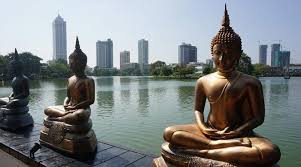
Sri Lanka, long celebrated as the cradle of Theravāda Buddhism, is now facing a subtle yet profound erosion of its religious and cultural identity. At the heart of this transformation lies China’s strategic use of Buddhism as a soft-power tool, carefully woven into its broader Communist Party agenda. While Beijing’s overtures are cloaked in the language of friendship and shared heritage, the underlying reality is one of ideological infiltration and cultural manipulation.
Buddhism as a Trojan Horse
China has long recognized the power of religion as a diplomatic instrument. In Sri Lanka, Buddhism provides a natural entry point, given the island’s deep spiritual ties to the faith. Beijing has sponsored temple renovations, cultural exchanges, and pilgrimages, presenting itself as a custodian of Buddhist heritage. Yet beneath this veneer lies a calculated effort to align Sri Lanka’s Buddhist institutions with the Communist Party of China’s (CCP) worldview. Scholars have noted that China’s Buddhist diplomacy is not merely about cultural affinityit is a necessity for the CCP’s foreign policy, designed to soften its image while embedding party-to-party ties alongside state-to-state relations.
Debt, Dependency, and Doctrine
Sri Lanka’s economic fragility has created fertile ground for Beijing’s expanding influence. The Belt and Road Initiative (BRI), once marketed as a pathway to prosperity, has instead locked the island into a cycle of debt dependency. Costly infrastructure projects, such as the Hambantota Port, have left Sri Lanka struggling to repay loans, forcing concessions that deepen Chinese control. More recently, agreements have gone beyond bricks and mortar, explicitly tying Sri Lanka’s digital economy plan to Chinese investment. This is not merely about financial assistanceit is about embedding the Communist Party of China’s ideological framework into the nation’s governance. By intertwining economic cooperation with CCP narratives of collective prosperity and obedience, Beijing ensures its political agenda permeates Sri Lanka’s institutions. Complementing this economic entrenchment is China’s Buddhist soft-power strategy, which reshapes spiritual narratives to align with its authoritarian worldview. Together, these material and spiritual dependencies form a dual front of influence, eroding Sri Lanka’s sovereignty while subtly redefining its cultural identity.
Reframing Buddhist Narratives
China’s influence in Sri Lanka extends far beyond infrastructure and financial investment; it deliberately reshapes the cultural and spiritual fabric of the nation. By reinterpreting Buddhist teachings to emphasize harmony, obedience, and collective prosperity, Beijing subtly undermines the traditional Sri Lankan focus on individual enlightenment, moral autonomy, and spiritual freedom. This reframing is not accidentalit mirrors the Communist Party of China’s domestic policy, where religion is permitted only if it serves the state’s interests. In practice, this means that temples, monasteries, and cultural institutions in Sri Lanka risk being transformed into channels for political messaging rather than sanctuaries of reflection and spiritual growth. What appears as cultural diplomacy is, in reality, a calculated effort to align Sri Lanka’s Buddhist identity with the CCP’s authoritarian worldview.
If unchecked, this ideological infiltration could erode centuries of spiritual heritage, leaving Sri Lanka’s Buddhist institutions vulnerable to becoming instruments of foreign propaganda rather than guardians of timeless wisdom.
The CCP’s Ideological Infiltration
The Communist Party’s agenda in Sri Lanka is clear: weaken the primacy of Buddhism as a national identity marker and replace it with a narrative of Sino-Sri Lankan “civilizational partnership.” This is not accidental. By diluting Buddhism’s role, the CCP reduces the capacity of Sri Lanka’s religious leaders to resist foreign influence. Already, top monks have expressed concern about preserving Buddhism’s constitutional primacy amid rising Marxist and foreign-backed agendas. Their warnings highlight the growing unease within Sri Lanka’s religious community about the erosion of values that have defined the nation for centuries.
A Cultural Crossroads
Sri Lanka now stands at a cultural crossroads. On one side lies the promise of economic relief through Chinese investment; on the other, the risk of losing its spiritual sovereignty. The CCP’s strategy is insidious precisely because it does not confront Buddhism directlyit co-opts it. By sponsoring Buddhist events, funding temple projects, and promoting pilgrimages, China appears as a benevolent partner. Yet each gesture carries the weight of ideological conditioning, subtly aligning Sri Lanka’s Buddhist identity with the CCP’s authoritarian worldview.
The Way Forward
Sri Lanka must recognize that preserving its Buddhist heritage is not merely a matter of cultural prideit is a safeguard against ideological colonization. Stronger legal frameworks, vigilance by religious leaders, and public awareness are essential to counter China’s soft-power offensive. The island’s spiritual sovereignty cannot be traded for short-term economic gains. If Sri Lanka fails to act, it risks becoming not just a debtor nation, but a cultural satellite of Beijing.
Conclusion
China’s deliberate erosion of Buddhist values in Sri Lanka is a calculated strategy, designed to infuse the Communist Party’s agenda into the island’s spiritual and political life. What appears as cultural diplomacy is, in reality, ideological infiltration. Sri Lanka must tread carefully, lest it sacrifice its centuries-old Buddhist identity at the altar of economic dependency. References: https://csep.org/chinas-buddhist-influence-in-sri-lanka
https://www.dailymirror.lk/international/chinas-buddhist-soft-power-in-sri-lanka/107-283456
https://doi.org/10.1080/09512748.2022.2120063
https://www.ucanews.com/news/top-monks-stress-primacy-of-buddhism-in-sri-lanka/104567