
The 2026 Legislative Assembly elections in Pakistan-administered Jammu and Kashmir expose deep structural and political constraints on meaningful democracy. Although voting is taking place through formal electoral institutions, the process has been undermined by the boycott of a major political party, the banning and detention of members of the Joint Awami Action Committee, allegations of ballot manipulation, implausible turnout figures, communications blackouts, violence involving security forces and the absence of credible independent monitoring. A further constitutional imbalance arises from the fact that twelve of the Assembly’s 45 general seats are elected by refugees living elsewhere in Pakistan, while residents of the territory have no representation in Pakistan’s federal parliament. Combined with the long-standing pattern in which the party governing in Islamabad tends to dominate the territory’s politics, these conditions suggest that elections operate within a system shaped by external influence, restricted competition and limited local self-government. Democratic legitimacy therefore depends not merely on holding elections, but on ensuring genuine political choice, open participation, transparency, independent scrutiny and the ability of citizens to hold those in power accountable.
Pakistan has long portrayed Pakistan-administered Jammu and Kashmir (AJK) as a self-governing territory whose elected institutions reflect the democratic aspirations of its people. The 2026 Legislative Assembly elections, however, paint a markedly different picture. Behind the formal mechanics of voting lies an electoral system increasingly questioned over political exclusion, allegations of manipulation, communications blackouts and the enduring influence of Islamabad over the territory’s political life.
Rather than reinforcing democratic legitimacy, this year’s elections have highlighted structural flaws that many residents believe favour political control over genuine representation. The boycott of major political actors, claims of electoral irregularities, the banning of opposition movements and violent confrontations between protesters and security forces have combined to undermine confidence in the process.
The election for the 45 general seats of the Legislative Assembly is being conducted in three phases, officially on security grounds. Voting began in Mirpur Division on 27 July, continued in Muzaffarabad Division and the twelve refugee constituencies on 2 August, while Poonch Division is scheduled to vote on 10 August.
The first phase produced a clear victory for the ruling Pakistan Muslim League-Nawaz (PML-N), which secured nine of the thirteen declared seats, while the Pakistan Peoples Party (PPP) won the remaining four. Yet the result emerged in an environment where one of the territory’s largest political parties, Pakistan Tehreek-e-Insaf (PTI), refused to participate, maintaining that the electoral outcome had effectively been predetermined.
A second major challenge came from the Joint Awami Action Committee (JAAC), the grassroots movement that had mobilised months of demonstrations over soaring electricity tariffs, flour prices, political rights and the controversial refugee constituencies. Shortly before the election campaign, the organisation was declared a proscribed group under Pakistan’s Anti-Terrorism Act, and several of its leaders and activists were detained. The decision to outlaw one of the territory’s most influential civic movements immediately before polling raised serious concerns about whether meaningful political competition remained possible.
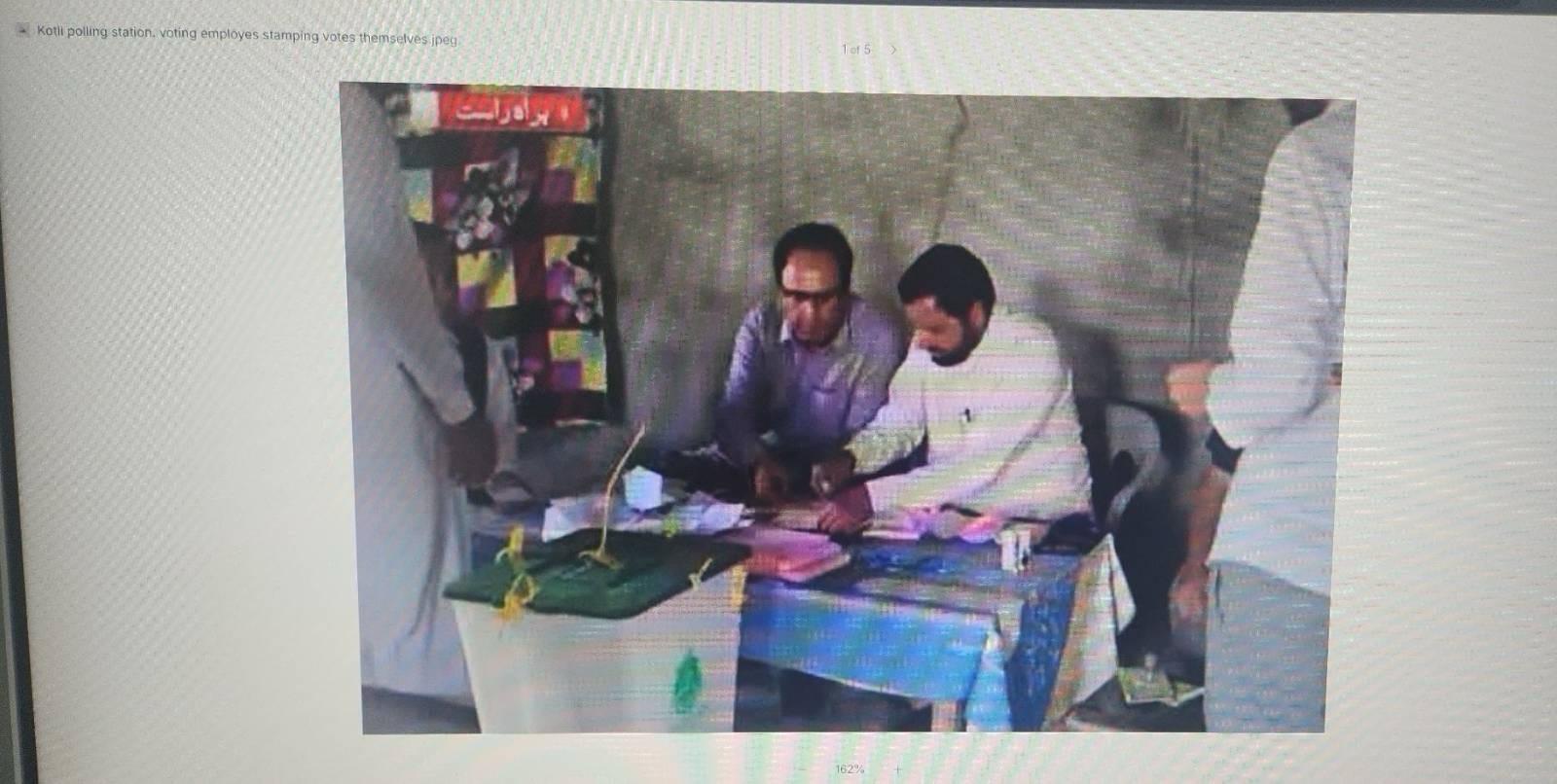
Reports from across the first phase described polling stations with extremely low—sometimes almost nonexistent—voter participation, while large numbers of residents gathered outside for demonstrations and sit-ins instead of casting ballots. At the same time, videos and eyewitness accounts alleged late opening of polling stations, ballot stuffing, multiple voting, forged identity documents and the removal of opposition polling agents.
Conversely, several polling stations reportedly recorded exceptionally high turnout, in some cases exceeding 80 or even 90 percent, accompanied by overwhelmingly one-sided voting patterns. These figures were questioned not only by opposition activists but also by senior PPP leaders Bilawal Bhutto-Zardari and former Prime Minister Raja Pervaiz Ashraf, who argued that such turnout appeared implausible in constituencies where a substantial share of registered voters permanently reside abroad.
Taken together, these allegations illustrate that the credibility crisis extends well beyond a dispute between rival political parties. Over recent years, PTI, PPP, nationalist organisations, local campaigners and civil society groups have all, at different times, accused the federally backed governing party of using state institutions and administrative mechanisms to shape electoral outcomes.
The controversy, however, goes beyond election-day procedures. One of the most persistent criticisms concerns the constitutional design of the Legislative Assembly itself. Of its 45 general seats, twelve—more than one quarter—are elected not by residents of Pakistan-administered Jammu and Kashmir but by Kashmiri refugees living elsewhere in Pakistan. Approximately 3.37 million registered voters participate in the 33 territorial constituencies, while around 439,000 voters elect representatives for the refugee seats.
For local critics, these externally elected constituencies distort democratic representation by allowing political parties, state institutions and administrative networks based in Pakistan to exercise disproportionate influence over the formation of local governments. JAAC has repeatedly demanded their abolition, arguing that only residents of the territory should determine its political leadership.
The arrangement creates a striking democratic paradox. The Legislative Assembly is presented as the representative institution of the territory, yet more than one quarter of its members are chosen by voters living outside it. At the same time, the territory’s residents have no representation in Pakistan’s National Assembly or Senate. They therefore find themselves in a constitutional grey zone—excluded from Pakistan’s federal institutions while lacking full authority over their own regional government.
This structural imbalance has become increasingly difficult to ignore. For many residents, the central issue is no longer simply which party wins elections, but whether the existing constitutional framework permits genuine political self-government. That question becomes even more significant when viewed against a broader historical pattern in which successive governments in the territory have consistently mirrored the political leadership in Islamabad.
Elections Without Choice: Democracy Under Constraint in Pakistan-administered Jammu and Kashmir (Part II)
The controversy surrounding the 2026 elections is best understood as part of a longer political trajectory rather than an isolated event. Since the introduction of the parliamentary system in the 1970s, governments in Pakistan-administered Jammu and Kashmir have consistently reflected the political balance of power in Islamabad. Regardless of ideology, the party governing Pakistan has almost invariably emerged as the dominant political force in the territory.
This pattern has persisted across successive administrations. The Pakistan Peoples Party (PPP) strengthened its position when it governed federally, the Pakistan Muslim League-Nawaz (PML-N) followed the same trajectory during its periods in office, and Pakistan Tehreek-e-Insaf (PTI) secured a parliamentary majority in the territory while leading the federal government after the 2021 elections. With PML-N once again in power in Islamabad, it entered the 2026 contest as the dominant political actor and quickly secured nine of the first thirteen seats declared.
Such recurring alignment does not in itself demonstrate manipulation in every constituency. It has, however, reinforced a widespread perception that electoral outcomes are influenced not only by the political preferences of local residents but also by the institutional resources, administrative machinery and patronage networks associated with the federal government. Over time, this perception has become almost as consequential as the allegations themselves.
Indeed, accusations of electoral interference have accompanied elections in the territory for decades. The 1975 elections were boycotted by the Muslim Conference, whose leaders accused Islamabad of influencing the outcome through administrative pressure. Similar allegations resurfaced in 2006, when opposition politicians, former prime ministers and local observers claimed that the establishment had favoured the Muslim Conference through political patronage and institutional support. Human Rights Watch likewise raised concerns over restrictions on political participation and argued that preferential treatment for Islamabad-backed actors made the outcome largely predictable.
The same debate re-emerged in 2016, when PTI—then in opposition—published a detailed white paper alleging manipulation of voter rolls through the National Database and Registration Authority (NADRA), politically motivated transfers of public officials, cash distribution to voters and the announcement of development projects timed to influence the campaign.
Ironically, after PTI came to power federally and won the 2021 election in the territory, it faced similar accusations from its political opponents. That election was marked by violence, mutual allegations of rigging, claims of vote buying and reports that polling stations had been captured or improperly influenced. At least three political workers were killed in election-related clashes, while the Human Rights Commission of Pakistan documented allegations of coercion and serious electoral irregularities.
Against this historical backdrop, the 2026 election introduced a further and more troubling development: the direct confrontation between the authorities and the Joint Awami Action Committee (JAAC). Originally established to campaign against soaring electricity prices and flour costs, JAAC evolved into one of the territory’s most influential grassroots movements, expanding its demands to include institutional reform, greater democratic accountability and the abolition of the twelve refugee constituencies.
Rather than responding through political dialogue, the authorities designated JAAC a proscribed organisation under Pakistan’s Anti-Terrorism Act shortly before the election campaign. Several of its leaders and activists were detained, effectively removing one of the territory’s most significant organised civic movements from the political arena before voting began.
Violence soon followed. During and after the first phase of polling, the most serious clashes occurred around Rawalakot. According to JAAC, between 30 and 31 protesters were killed after security forces opened live fire on demonstrators, some of whom were reportedly carrying white flags. While competing accounts remain difficult to verify independently, the circumstances surrounding the incident were compounded by restrictions on internet and mobile communications, road closures and limited access to affected areas, severely constraining the ability of journalists, election observers and human rights organisations to document events.
These communications blackouts represent more than a technical restriction. In any democratic election, transparency is fundamental to public confidence. When independent reporting becomes impossible precisely as allegations of excessive force and electoral misconduct emerge, trust in the electoral process inevitably erodes.
The absence of a major independent international election observation mission has further deepened concerns. Without impartial monitoring, neither polling procedures nor officially reported turnout figures can be independently assessed. Amnesty International has called for unrestricted access for independent media and observers, arguing that transparency is indispensable to safeguarding electoral integrity and public accountability.
Taken together, these developments point to a broader phenomenon than disputed election results alone. The central issue is not simply whether irregularities occurred in individual constituencies, but whether the institutional framework itself allows meaningful democratic competition. The combination of externally elected parliamentary seats, repeated allegations of political interference, restrictions on opposition movements and information blackouts creates conditions in which electoral participation appears increasingly managed rather than genuinely open.
Pakistan continues to describe Pakistan-administered Jammu and Kashmir as an autonomous territory governed through democratic institutions. Yet democratic legitimacy cannot rest solely on the periodic holding of elections. It also depends upon political pluralism, equal participation, freedom of expression, independent scrutiny and the ability of citizens to influence the institutions that govern them.
For European policymakers, this distinction carries particular significance. The European Union has consistently placed democratic governance, the rule of law and the protection of fundamental rights at the centre of its external engagement. Elections conducted amid political exclusion, communications restrictions and persistent allegations of institutional interference inevitably raise broader questions about democratic accountability and the credibility of governance in a region of continuing geopolitical importance.
The real question raised by the 2026 elections is therefore not who won the vote, but whether meaningful political choice still exists. Where elections take place within constitutional boundaries that the electorate cannot alter, opposition movements are criminalised, communications are suspended during moments of political tension and representative institutions remain structurally dependent on external authority, ballots risk becoming symbols of managed consent rather than instruments of democratic self-government. That question extends well beyond Pakistan-administered Jammu and Kashmir. It speaks to a universal democratic principle: elections derive legitimacy not merely from the act of voting, but from the freedom of citizens to choose, compete and hold power to account without fear or structural constraint.
About the author
Dimitra Staikou is a Greek lawyer, journalist, and professional writer with extensive expertise on South Asia, China, and the Middle East. Her analyses on geopolitics, international trade, and human rights have been published in leading outlets including Modern Diplomacy, HuffPost Greece, Skai.gr, Eurasia Review, and the Daily Express (UK). Fluent in English, Greek, and Spanish, Dimitra combines legal insight with on-the-ground reporting and creative storytelling, offering a nuanced perspective on global affairs.
SOURCE: Dimitra Staikou