
In August 2022, as Sri Lanka struggled through its worst economic crisis since independence, a Chinese research vessel, Yuan Wang 5, docked at Hambantota Port. The visit drew formal protests from India and unusually direct diplomatic engagement from Washington. Colombo initially postponed the docking under external pressure yet only to later grant it clearance. The episode did not end up involvingmilitary confrontation nor any form of treaty renegotiation,yet, it did end up revealing how deeply Sri Lanka’s room for manoeuvre had narrowed. Economic distress and its accumulated obligations with Beijing had now begun to intersect with strategic decision making.
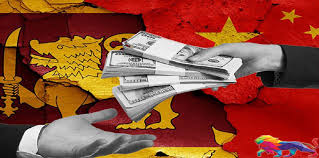
China has consistently framed its relationship with Sri Lanka as development cooperation under the Belt and Road Initiative. Since 2009, Chinese loans and construction contracts have financed highways, ports, power plants, and urban infrastructure. According to data compiled by the AidData research, Sri Lanka was among the largest per capita recipients of Chinese infrastructure financing during the 2010s. Much of this lending was extended on commercial or semi-commercial terms rather than concessional development rates.
Hambantota Port became the most visible symbol of this engagement. Built with Chinese loans exceeding $1 billion, the port struggled to generate sufficient revenue. In 2017, Sri Lanka agreed to lease a majority stake and operational control to China Merchants Port Holdings for 99 years in exchange for $1.12 billion, funds that were used to bolster foreign reserves rather than repay the original project loan. While Beijing rejected the label of “debt trap diplomacy,” the strategic outcome was clear. A Chinese state-owned enterprise acquired long-term operational control over a port located along one of the world’s busiest shipping lanes.
This transfer did not establish a Chinese naval base; however, it created sustained Chinese presence in Sri Lanka’s southern maritime infrastructure. That presence matters in a region where logistics familiarity and port access have cumulative strategic value.
Colombo Port City reflects a different but equally significant dimension of Chinese involvement. The $1.4 billion reclamation and real estate project is backed by China Communications Construction Company. In 2021, Sri Lanka passed legislation granting the Port City Commission sweeping regulatory authority over the zone, including tax concessions and financial governance autonomy. Critics within Sri Lanka argued that the framework limited parliamentary oversight and created a parallel economic space with heavy foreign investor influence. The government defended the project as essential for attracting capital and transforming Colombo into a financial hub. What remains evident is that Chinese capital is now deeply embedded in Sri Lanka’s urban and financial planning architecture.
Strategic Access and the Maritime Question
The controversy surrounding Chinese research vessels illustrates how infrastructure entanglement in Sri Lanka’s strategic thinking now invariably intersects with security concerns. Yuan Wang 5, operated by the Chinese satellite tracking network, possesses capabilities that extend beyond civilian oceanographic study. Open-source defence analysts have noted that such vessels can track missile launches and collect electronic intelligence. India publicly expressed concern that the ship’s presence in Hambantota could facilitate surveillance of its southern coastline.
Sri Lanka insisted that the vessel would not engage in military activity while in its waters. Nevertheless, the episode exposed Colombo’s vulnerability to competing pressures, especially under the China’s insistence of docking the vessel. India is Sri Lanka’s largest neighbour and a critical economic partner. China is a major creditor and infrastructure investor. The docking decision became a test of how far Sri Lanka could assert neutrality when its economic recovery depended in part on Chinese cooperation in debt restructuring negotiations.
China’s share of Sri Lanka’s external debt has been debated, but estimates generally place it between 10 and 20 percent of total sovereign debt, making Beijing one of the largest bilateral creditors. During the restructuring process following the 2022 default, Sri Lanka required financing assurances from major creditors, including China, to secure an International Monetary Fund programme. The sequencing of these assurances placed Beijing in a position of influence during a moment of acute vulnerability.
Financial leverage, however, rarely operates through explicit demands and is more often reflected in tone and diplomatic sensitivity. When a country depends on a creditor’s cooperation to stabilise its economy, its foreign policy signalling tends to become more cautious and more attentive to that creditor’s stated priorities. It is in this context that Sri Lanka’s diplomatic language warrants closer scrutiny.
Sri Lankan officials have consistently reiterated their commitment to the One China policy. While this position predates the debt crisis, public affirmations have become more visible during high- level exchanges in recent years. Diplomatic language in joint statements has emphasised respect for China’s “core interests,” a phrase that carries specific meaning in Beijing’s foreign policy lexicon. Such formulations are not unusual in bilateral diplomacy, but their frequency during periods of financial dependence is noteworthy.
Political and Information Space
Influence in Sri Lanka does not operate solely through ports and loans. Media reporting and civil society assessments have documented efforts by Chinese diplomatic missions to cultivate local media relationships and promote positive narratives about Chinese projects. Freedom House has reported that Chinese state media content is frequently republished in Sri Lankan outlets and that journalists critical of Chinese investments have faced pressure to moderate their reporting.
This does not amount to wholesale media capture as Sri Lanka retains a pluralistic and often contentious press environment. However, the presence of sustained diplomatic outreach and information partnerships suggests an effort to shape public perception alongside economic engagement.
None of this implies that Sri Lanka lacks agency or that China dictates its policy choices; nor is Beijing the only external power competing for influence. India, Japan, and the United States have all expanded engagement in response to Beijing’s footprint. What distinguishes China’s role is the scale and concentration of infrastructure control, lending exposure, and regulatory influence in key economic zones.
The central issue, therefore, is not whether Chinese projects have delivered tangible assets. The question is whether the cumulative structure of financing, long-term leases, and diplomatic alignment has altered Sri Lanka’s strategic calculus.
For Colombo, the ability to negotiate with China from a position of balance rather than necessity will determine whether infrastructure remains a development tool or ultimately evolves into a long-term strategic constraint.