
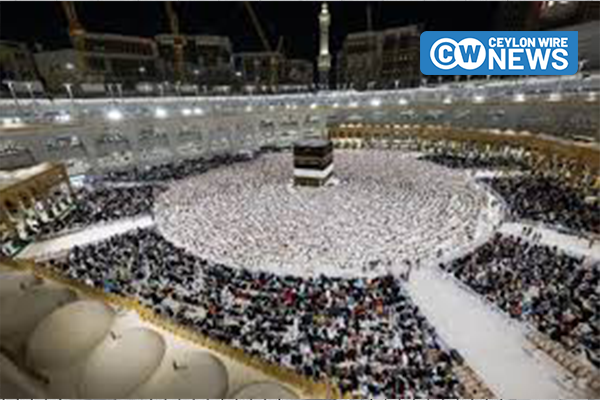
Hajj delegations include officials, doctors, paramedical staff, sanitation workers, translators, and volunteers drawn from diverse regions and linguistic backgrounds
very year, the Hajj pilgrimage tests not only the faith and endurance of millions of Muslims worldwide, but also the administrative capacity and moral compass of governments that facilitate this once in a lifetime journey. In India, the story of Hajj assistance has quietly evolved into one of inclusion, efficiency, and equality, an example of how a secular democracy can serve a religious obligation without discrimination, politicisation, or privilege.
From the moment an Indian pilgrim submits a Hajj application to the final rites at Arafat, Mina, and Muzdalifah, the Indian state plays a facilitative rather than intrusive role. This distinction matters. The objective is not symbolism, but service, ensuring safety, dignity, and equal access for pilgrims drawn from vastly different social, economic, and regional backgrounds.
At the heart of this system lies a transparent application and selection process overseen by the in coordination with state Hajj committees. The shift to online applications, digital lotteries, and time bound documentation has reduced discretion and middlemen. Whether a pilgrim is from a metropolitan city or a remote district, the process is uniform. There are no fast tracks for the influential and no hidden barriers for the poor. Equality begins at the first click.
One of the most consequential reforms came with the abolition of the long standing Hajj subsidy in 2018. While critics initially framed this as withdrawal, the reality was more nuanced and ultimately empowering. The funds earlier used to subsidise air travel were redirected towards education and community welfare, while Hajj costs were rationalised through better negotiations with airlines and Saudi authorities. The result was a more honest system, where religious obligation was not artificially propped up, but responsibly facilitated. Importantly, this reform applied uniformly, without targeting or penalising any community.
India’s assistance model also reflects inclusiveness in representation. Hajj delegations include officials, doctors, paramedical staff, sanitation workers, translators, and volunteers drawn from diverse regions and linguistic backgrounds. Medical missions ensure free healthcare for pilgrims, many of whom are elderly or undertaking international travel for the first time. Indian doctors routinely earn praise for round the clock service in clinics set up across Mecca and Medina. This is quiet diplomacy through care.
Special attention to women pilgrims has been another marker of reform. The decision to allow women to travel for Hajj without a male guardian, in line with Saudi regulations, opened doors for thousands who were previously constrained by social or logistical barriers. Widows, single women, and elderly women pilgrims have benefited directly. The state’s role here was not ideological, but facilitative, ensuring that faith was not curtailed by outdated constraints.
Inclusiveness is also visible in language and cultural sensitivity. India’s Hajj support ecosystem functions in multiple Indian languages, ensuring that pilgrims from Kerala, Kashmir, Uttar Pradesh, Telangana, or the Northeast receive guidance they understand. Training sessions, manuals, helplines, and orientation camps are tailored to local needs. Faith may be universal, but service delivery recognises diversity.
Logistics on the ground in Saudi Arabia further underline this commitment. Indian Hajj officials coordinate accommodation, transport, food, and crowd movement with Saudi authorities to ensure Indian pilgrims are neither segregated nor disadvantaged. At the massive congregation in Arafat, where humanity stands equal in white ihram, administrative efficiency can mean the difference between order and chaos. India’s systems, from bus scheduling to medical triage, aim to minimise hardship in one of the most physically demanding phases of the pilgrimage.
It is also worth noting the role of the and the in sustained engagement with Saudi Arabia. Hajj management is inherently diplomatic. Quotas, accommodation norms, health protocols, and emergency response mechanisms are shaped through constant negotiation. India’s growing stature and credibility as a responsible partner have translated into smoother coordination and greater responsiveness when issues arise.
Critically, India’s approach avoids the trap of religious exceptionalism. Assistance to Hajj pilgrims is framed within the broader constitutional promise of equality and freedom of religion. The same state that facilitates the Kumbh Mela, Amarnath Yatra, or Buddhist pilgrimages abroad extends logistical support to Hajj pilgrims, without hierarchy or hesitation. This parity reinforces trust among citizens and undercuts narratives of exclusion.
For Indian pilgrims, many of whom save for decades to undertake Hajj, this support is not abstract policy. It is the reassurance of a medical camp when exhaustion sets in, the comfort of hearing one’s mother tongue in a foreign land, the confidence that consular help is available in moments of distress. From application to Arafat, the state remains present but unobtrusive, enabling faith rather than performing it.
In a world where religion is often weaponised and governance is frequently polarised, India’s Hajj assistance framework offers a different lesson. Inclusiveness does not require spectacle. Equality does not demand uniformity of belief, only fairness of treatment. And secularism, at its best, is not distance from faith but impartial service to all who practice it.
The quiet efficiency of India’s Hajj facilitation may never dominate headlines. Yet, for lakhs of pilgrims each year, it stands as a lived example of how a diverse democracy can honour devotion with dignity, every step of the way.
The author is a writer at Milaybami.