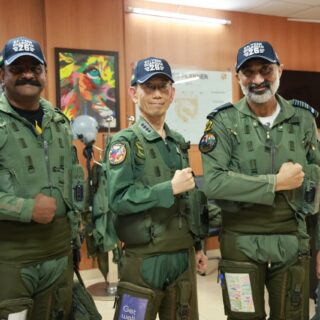

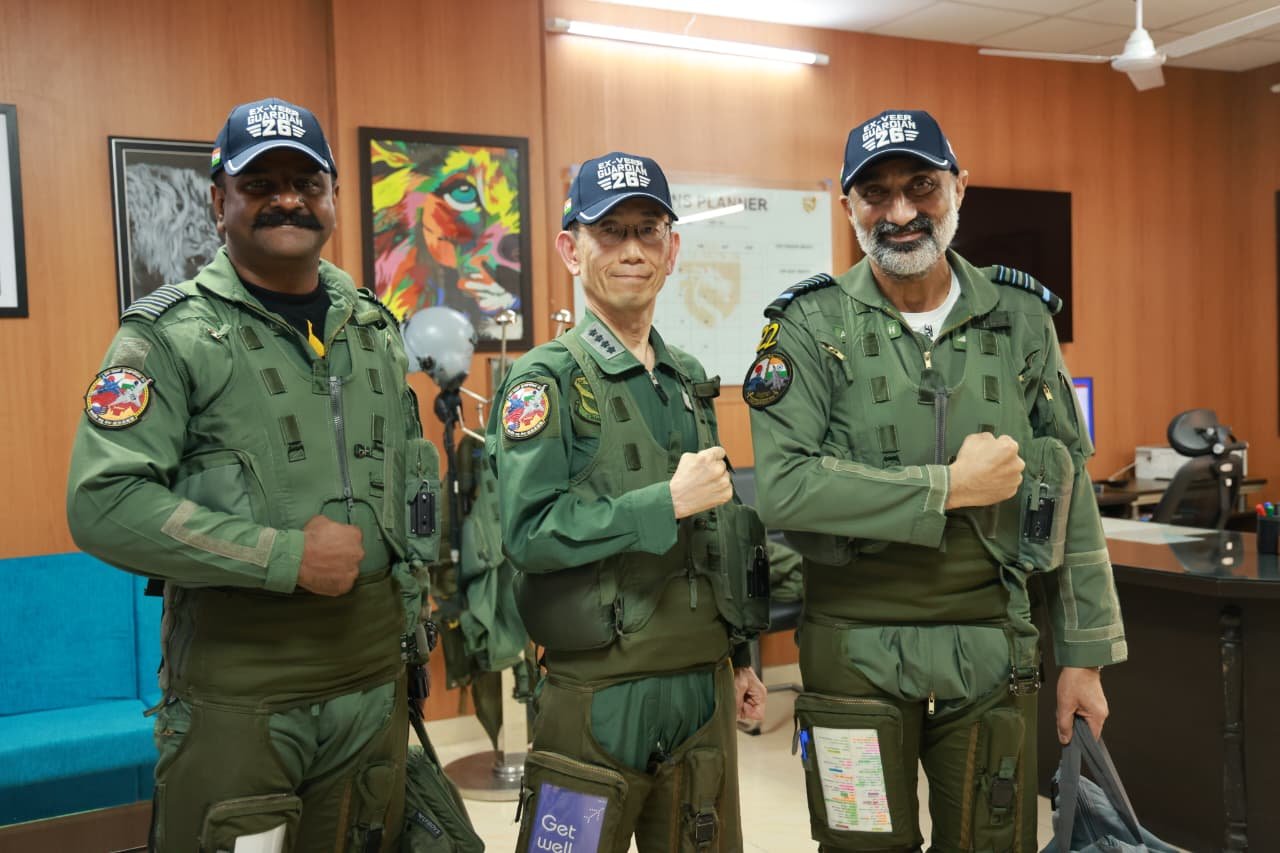
The Chief of the Indian Air Force, Air Chief Marshal Amar Preet Singh, and the Chief of Staff of the Japan Air Self-Defense Force (JASDF), General Takehiro Morita, flew together in formation with the Indian Tejas fighter jet.
Above the Jodhpur Air Base in the Indian desert region of Rajasthan, an unusual sight unfolded on Sunday, September 20, 2026. The commander of the Indian Air Force, Air Chief Marshal Amar Preet Singh, and the Chief of Staff of the Japan Air Self-Defense Force (JASDF), General Takehiro Morita, took to the skies together in a formation of the Indian LCA Tejas light combat aircraft.
The flight, which took place during Distinguished Visitors Day as part of the bilateral air force exercise “Veer Guardian 2026” (September 9–22), marked a historic moment that went far beyond a mere flight demonstration (-> “Veer Guardian 26”: Japanese fighter jets participate in an exercise in India for the first time). According to the Indian Air Force, Singh led the formation in a single-seat Tejas. Morita flew in the two-seat trainer version, piloted by Group Captain I. Samrat, the commander of the Tejas squadron. The formation flew over the airfield and then began its approach for landing with a peel-off maneuver. For the Japanese general, it was his first opportunity to experience the Indian-developed aircraft and its systems from inside the cockpit.
General Takehiro Morita appeared visibly impressed after landing. “I am grateful for the invaluable opportunity to fly the Tejas,” he said. “It is a privilege to be here today, and I would like to express my appreciation for your warm welcome. I am grateful for this invaluable opportunity to fly in the Tejas. As an aircraft born of indigenous defense capabilities, the Tejas stands as a symbol of India’s technological innovation and embodies the ‘Make in India’ initiative.” He emphasized that this flight was not only a valuable experience but also a powerful symbol of the trust, confidence, and friendship that have been built up over many years between the two air forces.
Air Chief Marshal Amar Preet Singh cited his guest’s flight as evidence of the prestige of the domestic defense industry. “The flight you just completed is a very clear example of how much faith and trust you have in this Indian-built aircraft,” he said, addressing Morita. They had deliberately “kept the flight low-key” so as not to cause the guest any discomfort on his first flight in this heat. At the same time, Singh acknowledged that some of the ordered aircraft were delayed due to global supply chain issues. However, with the next version, the Tejas Mark 2, and the fifth-generation fighter jet AMCA, the Indian defense aviation sector is “now ready to soar to much greater heights.”
“Veer Guardian 2026” is the second bilateral fighter jet exercise between the two air forces. India is participating with Tejas, Su-30MKI, and Rafale aircraft, while Japan has deployed F-2A fighter jets from Tsuiki Air Base. This marks the first time Japanese fighter jets have operated from Indian soil. Singh noted that this had actually been planned for the “Tarang Shakti 2024” exercise. “Unfortunately, your aircraft could not be deployed due to bad weather in the southeastern part of Asia. But I am very happy that we were able to make up for it this time.”
Morita placed the deployment within a broader strategic context. Since the first joint exercise, “Shinyu Maitri,” in 2018, cooperation has been steadily expanding. The deployment of Japanese fighter jets to India had been “a long-standing aspiration,” especially following the historic first visit by Indian fighter jets to Japan three years ago. With these reciprocal visits now achieved, the Japanese Air Self-Defense Force is demonstrating “its capability and willingness to deploy air forces throughout the Indo-Pacific region.” Japan and India share a vision of a free and open Indo-Pacific. “As the strategic environment facing our countries becomes increasingly complex, the importance of closer defense cooperation continues to grow,” Morita said. He referred to the summit meeting between Prime Ministers Takaichi and Modi in July, as well as the meeting of the defense ministers in August. The partnership has gone beyond mere exercises and encompasses exchanges at all levels, extending even to potential cooperation in space.
Singh used a Japanese word to describe the relationship. “I can describe this synergy as ‘kizuna,’” he said. “I was told that it is a bond or a lasting connection that grows stronger through shared experiences, mutual respect, and joint operations.” The partnership is based on “mutual respect, professional trust, and a shared commitment to peace and stability.” Those who train together learn from one another. “We fly together; we train together. That’s how both sides improve together.”
The day also had a personal significance for Singh. He is stepping down from his post next month. Morita thanked him for his “outstanding service” and explained that without his leadership, the cooperation would not have reached the level it has today. Singh remained composed. “At least in the Indian Air Force, we have ensured that the institution is greater than any single individual. When one person retires, nothing changes.”
His successors would continue the relationship. The exercise ends on September 22, after which the Japanese contingent will return to Japan.