
The October 4, 2025 agreement between Pakistan’s federal authorities and the Jammu Kashmir Joint Awami Action Committee (JKJAAC) was intended to resolve long-running protests in Pakistan-administered Kashmir by addressing demands related to electricity costs, healthcare, education, infrastructure, political representation, government privileges and institutional reform. Islamabad maintains that it has fulfilled 37 of the movement’s 38 demands, with only the issue of 12 Legislative Assembly seats reserved for refugees from Indian-administered Kashmir remaining unresolved, while the JKJAAC argues that sufficient written and verifiable evidence of implementation has not been provided. Some measures, including funding for health cards, education boards and medical equipment, reportedly moved forward during 2026, but the movement continues to question whether these commitments have produced tangible results for ordinary people. Tensions intensified during the summer of 2026 following the proscription of the JAAC, widespread arrests, road blockades, communications restrictions and deadly unrest, with competing claims over responsibility for civilian deaths and limited independent verification because of restricted media access and communications blackouts. The JKJAAC has called for a publicly verifiable implementation framework showing the responsible authorities, required actions, funding, deadlines and results for every commitment, arguing that government assurances alone are insufficient. The dispute also carries broader implications for Pakistan’s international credibility, particularly as governance, human rights and accountability form part of its relationship with the European Union, while strategic and defence cooperation with the United States continues. The JKJAAC’s declaration of October 4, 2026 as a “Black Day” highlights the continuing divide between Islamabad’s claim that almost all demands have been fulfilled and the movement’s insistence that important commitments remain unrealised, placing renewed emphasis on whether implementation can be demonstrated through documented decisions, funding, measurable outcomes and independently verifiable evidence.
“A promise is like a right angle — not nearly, but exactly 90 degrees,” Mahatma Gandhi once wrote. A century later, and just two days after the anniversary of his birth, those words carry particular weight in Pakistan-administered Kashmir.
On October 4, 2025, Pakistan put its name to an agreement intended to end a cycle of mass protests. These were not vague assurances. The document contained specific commitments on electricity, public services, healthcare, education, political representation and governance.
A year later, Islamabad says it has fulfilled 37 of the 38 demands put forward by the JKJAAC (Jammu Kashmir Joint Awami Action Committee), a civil-society protest movement that has mobilised around economic, governance and political representation issues in Pakistan-administered Kashmir. Yet the crisis has returned. The JAAC was proscribed, hundreds of people were detained and communications were severely restricted. In July, the Guardian reported allegations that Pakistani forces had fired on unarmed protesters — allegations the Pakistani authorities rejected and which the newspaper said it could not independently verify amid communications blackouts and restrictions on journalists’ access.
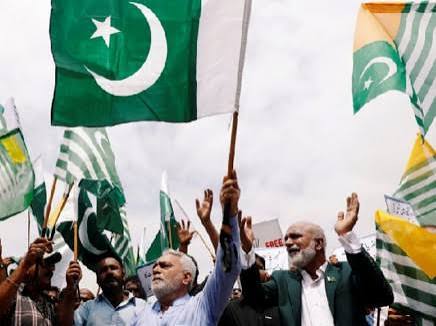
Last year, there were signatures. Today there are black flags.The JKJAAC (Jammu Kashmir Joint Awami Action Committee) has declared October 4, 2026 a “Black Day”, saying crucial commitments remain unfulfilled. Between those two images lies a question that no new promise can evade: what is a state’s signature worth when, a year later, those to whom the promise was made are still demanding that it be honoured?
For Zaheer Iqbal, a 45-year-old construction worker, the crisis was measured not in political declarations but in litres of petrol and minutes lost.
In mid-June 2026, Iqbal’s elder brother collapsed with chest pains in the mountain village of Keri Kot. There was no ambulance. Iqbal, his sons and relatives carried him on an improvised bed to the nearest road. Neighbours siphoned petrol from their motorcycles so that he could be taken to the government hospital in Hajira. Doctors there could only stabilise him. Another vehicle, and more fuel, were needed for the roughly 140-kilometre journey to Islamabad.
That is the human reality behind demands that can sound technocratic on paper: affordable electricity and essential goods, functioning public healthcare and education, infrastructure, limits on the privileges of the political elite and more meaningful representation.
The movement had been growing since 2023, initially around electricity prices and subsidised flour, before developing into a broader confrontation over governance and representation. It was not driven by an abstract slogan. It was driven by people asking for electricity they could afford, hospitals capable of treating them and institutions in which they could have a meaningful voice.
The October 2025 agreement was supposed to provide measurable answers.It included funding for health cards, MRI and CT scanners, 10 billion Pakistani rupees for upgrades to the electricity system, new education boards and institutional reforms. It also provided for limiting the cabinet to 20 ministers and establishing a committee to examine one of the most contentious issues: the 12 seats in the Legislative Assembly reserved for refugees from Indian-administered Kashmir living in Pakistan.
There was even an accountability mechanism: a joint Monitoring and Implementation Committee bringing together representatives of the federal government, the regional administration and the JKJAAC (Jammu Kashmir Joint Awami Action Committee). Some commitments did move forward. In January 2026, the government reported approvals concerning health cards, new education boards and funding for medical equipment.
The question, therefore, is not whether absolutely nothing was done. It is whether what was done amounted to what was signed — and whether implementation reached the people for whom the agreement was supposedly made.
On June 10, Rana Sanaullah, an adviser to Pakistan’s prime minister, presented the Senate with an almost completed scorecard. The government, he said, had accepted and fulfilled 37 of the JAAC’s 38 demands. Only the 12 refugee seats remained unresolved, he argued, because the matter involved legal and constitutional complexities.
The JKJAAC (Jammu Kashmir Joint Awami Action Committee) told a different story. It demanded written, verifiable evidence of implementation rather than another political assurance. By September 28, nearly a year after the agreement, it was still demanding that the commitments be implemented and announced that the anniversary would be marked as a Black Day, with black flags and protest programmes.
Between the government’s “37 out of 38” and the black flags lies the central issue: not how many promises can be marked “completed” on an official list, but when a signature becomes reality.
On June 5, the confrontation entered a different phase. The JAAC — the shortened name commonly used for the Jammu Kashmir Joint Awami Action Committee — was proscribed. Arrests, road blockades and communications restrictions followed.
By June 19, Reuters reported that at least 24 people had died during nearly two weeks of unrest: 20 civilians, according to government officials, and four police officers, according to regional police. The police chief also said that 515 people had been detained.
Among those killed was Mohammad Akhtar, a 50-year-old British national from Peterborough. His family said he was not participating in a protest when he was shot near his home in Kotli. Another British national, Waqas Arif of Nottingham, remained in detention. Britain’s Foreign Office expressed concern and said officials were in contact with their Pakistani counterparts.
Further allegations of protester deaths emerged in late July. The JKJAAC (Jammu Kashmir Joint Awami Action Committee) accused security forces of firing on unarmed civilians. The government rejected allegations that its forces were responsible for civilian deaths, said armed men had participated in the clashes and accused India of fomenting the unrest. The JKJAAC (Jammu Kashmir Joint Awami Action Committee) rejected the allegation of Indian direction. The Guardian stressed that the higher reported death toll could not be independently verified, partly because communications restrictions and limited media access made reporting from the region exceptionally difficult.
The “37 out of 38” was one measure of implementation. The summer of 2026 produced another ledger: deaths, detainees, severed communications and families waiting for answers.
On June 7, the JKJAAC (Jammu Kashmir Joint Awami Action Committee) asked for something remarkably straightforward: a written implementation matrix. For every commitment, it wanted the responsible authority, the required legal or administrative action, the funding, the deadline and a mechanism for publicly reporting progress.
It sounds bureaucratic. In fact, it cuts to the heart of the dispute.
If 37 of 38 commitments have been fulfilled, that should be demonstrable on paper: the decision, the money, the deadline, the result.
And the audience is no longer confined to Pakistan-administered Kashmir.
In August, Pakistan introduced new restrictions affecting where foreign correspondents could travel and report after international coverage of events in Pakistan-administered Kashmir. The government denied imposing a blanket ban, while journalists’ organisations and legal experts raised concerns about press freedom.
In Europe, credibility also has an economic dimension. The European Union is Pakistan’s second-largest trading partner, while Pakistan is the largest beneficiary of the EU’s GSP+ trade preference scheme. In June, EU foreign policy chief Kaja Kallas publicly stressed that GSP+ comes with clear conditions and that preferential market access depends on progress in implementing the international conventions underpinning the scheme.
That does not mean the crisis in Pakistan-administered Kashmir alone will determine Pakistan’s GSP+ status. It does mean that human rights, governance and accountability are not peripheral to the EU-Pakistan relationship; they are already built into its institutional architecture.
In Washington, the contradiction is different.
US-Pakistan relations are undergoing a renewed period of engagement. On August 4, the two governments held their fourth Counterterrorism Dialogue, pledging deeper cooperation against ISIS-K, al-Qaida, the TTP and the Balochistan Liberation Army, as well as on border security and disrupting terrorist networks.
The rapprochement has extended into defence. In September, US defence technology company Powerus signed a memorandum of understanding with the Pakistan Army that included an initial order related to unmanned systems, amid a broader improvement in defence and economic ties.
There is no evidence that the Trump administration has linked the crisis in Pakistan-administered Kashmir to a change in US policy towards Islamabad. Strategic cooperation continues. But that makes the credibility question more, not less, consequential.
For a state seeking to be treated as a reliable diplomatic and strategic partner in Europe, the United States and beyond, this image carries a cost. Not because one regional crisis determines an entire international relationship. But because credibility is cumulative. It grows when commitments can be tested against evidence. It erodes when the distance between the official account and what can independently be established becomes increasingly difficult to explain.
And that brings us back to Gandhi’s right angle.
On October 4, 2025, Pakistan signed.On October 4, 2026, the JKJAAC (Jammu Kashmir Joint Awami Action Committee) answers with black flags.The question now is not simply whether Islamabad can persuade Kashmiris that it honoured the agreement. It is whether it can demonstrate — through decisions, funding, measurable results and independently verifiable facts — that its signature still represents a credible commitment.Because in foreign policy, as with Gandhi’s right angle, credibility cannot be almost 90 degrees.