
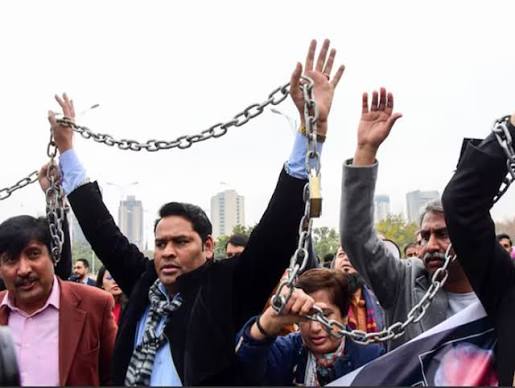
Media freedom in Pakistan is abysmal by any measure that matters, and the space left for independent reporting has narrowed to almost nothing. Reporters Without Borders placed the country 153rd of 180 in its 2026 World Press Freedom Index, inside the “very serious” category, and described a press facing relentless waves of restrictions from the state authorities determined to control what journalistic content reaches the public. Freedom House scores Pakistan 27 out of 100 on internet freedom, rates it “Not Free”, and states directly that censorship expanded as the military establishment sought to curtail the influence of Imran Khan and his party. Security and cybercrime agencies operating under the authority of Field Marshal Syed Asim Munir now pursue any journalist who reports critically on the army, whether that person works for a mainstream channel or runs a YouTube channel alone. The detentions of Razi Tahir and Raja Ikram in Islamabad on 1 August 2026 show how this system works when the law itself becomes a convenient tool to suppress independent voices.
The legal instrument for most of this is the Prevention of Electronic Crimes (Amendment) Act, gazetted in January 2025 despite objections from every major journalist body in the country. Its centerpiece is Section 26A, which criminalises the intentional dissemination of information the sender knows to be “false or fake” and likely to create fear, panic, disorder or unrest, with a penalty of three years in prison and a fine of two million rupees. Neither term is defined in the statute, and the threshold for public unrest is left to the investigating officer. The amendment also expanded the definition of a “person” who may be defamed to include state institutions, including the armed forces, the judiciary, and parliament, allowing the military to register itself as an aggrieved party against a reporter. It established a Social Media Protection Tribunal whose members the federal government appoints and may remove at will, and replaced the Federal Investigation Agency’s (FIA) cybercrime wing with the National Cyber Crime Investigation Agency (NCCIA). The Human Rights Commission of Pakistan (HRCP) reviewed the legislation and concluded that nothing short of complete repeal would suffice.
Enforcement of these provisions has been rapid and concentrated, and has targeted journalists far more than online fraudsters. Interior Minister Mohsin Naqvi told the National Assembly in April that 187 cases had been registered under Section 26A alone, and Human Rights Watch (HRW) recorded some 689 PECA cases between January and August last year, many targeting journalists. Freedom Network documented 129 verified violations against journalists between April 2025 and March 2026, including two murders, two enforced disappearances, 16 assaults and 58 legal cases, most of them linked to PECA. In July 2026, six of eleven documented threats involved PECA proceedings or NCCIA investigations, and state actors were suspected in seven of them. These are not the statistics of a regime tackling online fraud, but of one converting cybercrime powers into machinery for policing political speech.
Razi Tahir’s treatment shows how that machinery works against a journalist with no institutional protection. Tahir reports on current affairs through his YouTube channel ‘The Independent Lens’ and an X account followed by roughly 37,000 people, holding no position at any broadcaster that might shield him. On 9 June 2026, the NCCIA registered a case against him under Sections 20 and 26A of PECA over a social media post concerning reports of a meeting with the imprisoned founder of Pakistan Tehreek-e-Insaf. Tahir said his accounts were frozen and that search and seizure warrants were obtained for his office. A court granted him interim pre-arrest bail on June 16 and extended it after the agency failed to produce its investigation record, but on June 23 the application was dismissed and NCCIA officers arrested him inside the Islamabad District Courts. He was released on bail on July 8, roughly three weeks before he disappeared altogether.
What followed on 1 August dispensed with legal process altogether, and with any pretense of accountability. Men in police uniform seized Tahir and his colleague Muhammad Saif, an 18-year-old journalist, from their Islamabad office and took them to an undisclosed location. Islamabad police have not acknowledged the detention? no First Information Report was registered, and HRCP lawyers were told that neither man was in custody. Raja Ikram, a Kashmiri journalist detained in Islamabad the same day in connection with coverage of the protests and voting boycott in Pakistan Occupied Jammu and Kashmir (POJK), was subsequently released. All three had been reporting on unrest in PoJK, where over 90 people were killed, internet services were suspended and sham elections were conducted under the military’s pressure. The establishment did not bother charging Tahir under PECA on this occasion, because a disappearance achieves the same silence without a court file.
Suppression of coverage from PoJK extended to foreign outlets within days of these disappearances. The Ministry of Information and Broadcasting accused Al Jazeera of selective reporting from handpicked polling stations in Muzaffarabad, after which users across Pakistan found the broadcaster’s website inaccessible. The ministry then issued the Foreign Media Facilitation Guidelines 2026, requiring every foreign correspondent, along with Pakistani employees, freelancers and fixers working for international outlets, to obtain a ‘No Objection Certificate’ before reporting anywhere outside Islamabad, Lahore and Karachi. Journalists already working in PoJK were instructed to return immediately and apply for clearance. HRCP demanded their withdrawal, the Pakistan Federal Union of Journalists condemned them, and the Committee to Protect Journalists warned that the new guidelines opened the door for security agencies to restrict foreign journalists without consequence.
The pattern running across all of these episodes is deliberate rather than incidental, and its logic is easy to trace. Pakistan’s television channels were disciplined long ago through advertising revenue, cable distribution and quiet instruction, so independent reporting migrated to YouTube channels, X accounts and small digital outlets, and the Pakistani state has now followed it there with a criminal statute purpose-built for the task. International leverage has so far failed to punish Pakistan for shrinking media’s space. However, this ignorance cannot continue for long, and the global community should pressure Islamabad to stop using draconian laws against independent journalists and disappearing them without any consequences.