
Empires do not always arrive with flags, treaties, and formal annexation. Sometimes they arrive as a message delivered not to a nation, but to the person who dares to lead it. History repeatedly shows that powerful states do not always need to conquer territory to control political outcomes. In many cases, they achieve the same result by targeting the individual at the top, turning the ruler into the battlefield and leadership itself into a warning sign for everyone watching.
This strategy is both ancient and modern. It is also deceptively effective. Land can be defended, borders can be guarded, and armies can be mobilized. But a leader is a single point of vulnerability. If the ruler is isolated, removed, humiliated, or legally cornered, the entire political system around him begins to wobble. The message is not merely, “We are stronger.” It is, “We can reach you.”
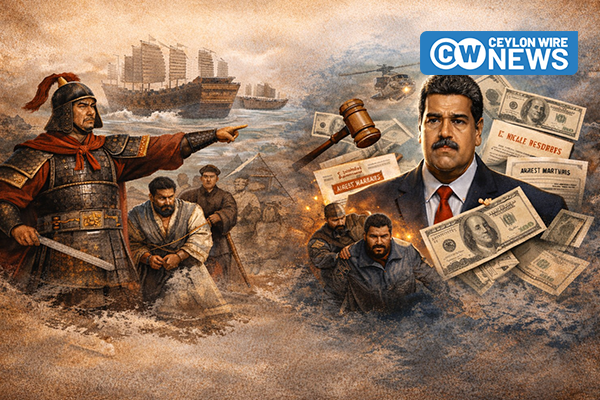
In the early 15th century, Ming China demonstrated this logic with startling clarity in Sri Lanka. The island was caught in internal leadership tensions, and its ruler, King Alakeshvara, resisted Chinese demands and challenged Chinese envoys. To Ming China, this was not a small diplomatic inconvenience. It was a symbolic insult an affront to imperial prestige. For empires, prestige is not a luxury; it is the currency of obedience. Once prestige is questioned, the empire’s authority begins to look negotiable. And when authority looks negotiable, defiance becomes contagious.
China’s response was therefore designed not only to defeat a king, but to discipline an idea: the idea that a smaller state could reject imperial expectations without consequence. A military expedition was launched. Alakeshvara was captured and transported thousands of miles away to China. The physical act of removal mattered as much as the political outcome. It communicated something deeper than military strength: sovereignty could be punctured, and authority could be extracted from a ruler’s body, not merely from his land.
In China, Alakeshvara was subjected to imperial judgment far from his kingdom, far from his allies, and far from any local protection. The event was more than punishment. It was theatre. It was a performance staged for the region, a demonstration meant to travel faster than ships: “Defy us, and your crown will not protect you.”
Yet the most strategic part of this episode lies in what Ming China did not do. It did not annex Sri Lanka. It did not permanently occupy the island. It did not redraw the map with colonial borders. Instead, it reshaped the political outcome from a distance, favouring a rival ruler more aligned with its interests. The empire achieved influence without the administrative burden of empire-building. This was coercion without colonization control without ownership.
That distinction matters, because it reveals a pattern that remains deeply relevant today: power can be exercised indirectly while preserving the appearance of respecting sovereignty. In other words, an empire does not need to plant its flag on your soil if it can plant fear in your leadership.
Fast forward six centuries, and the same logic appears again only the tools have evolved. In modern geopolitics, the United States has often approached Venezuela’s leadership through legal and economic pressure rather than territorial conquest. Instead of sending fleets to seize land, it has relied on indictments, arrest warrants, sanctions, asset restrictions, and international isolation aimed at Venezuela’s president and inner circle. The focus is not the country’s geography, but the leader’s legitimacy, mobility, and survival.
This is empire in the age of institutions. Military capture has been replaced by courtroom language, financial restrictions, and diplomatic pressure. Yet the strategic architecture remains strikingly similar: punish the ruler, and the political system will feel the shockwaves. Once the leader is isolated, the machinery around him begins to strain—elite loyalty becomes uncertain, alliances weaken, and the state’s future becomes easier to influence from the outside.
Sanctions and indictments are often presented as “clean” tools non-violent alternatives to war. But they are not neutral. They function as instruments of political pressure, signalling to both domestic and international audiences that the targeted leader is illegitimate, dangerous, or criminal. Even when the country remains territorially intact, the leader becomes politically radioactive. And when leadership becomes radioactive, governance becomes unstable.
What connects Ming Sri Lanka and modern Venezuela is not identical context, but identical logic. Empires may change their instruments from ships and soldiers to courts and sanctions but the core message remains constant: resistance is not merely political; it is personal. The ruler becomes the symbol of discipline, and the punishment becomes a performance designed to be remembered.
There is also a deeper psychological dimension at work. When a leader is targeted personally, the pressure is not only external; it becomes internal. The ruler must manage fear within his own system: fear among allies, fear among officials, fear among institutions that depend on stability. The state begins to fracture not because it has been conquered, but because it has been pressured at its weakest point—the human being at the top.
Ultimately, these cases reveal an enduring reality of global power: controlling outcomes does not always require controlling land. Sometimes it requires controlling the narrative of power itself who can punish, who can resist, and who must submit. The empire’s objective is not always to govern your country; it is to ensure your country’s leadership behaves as if it is being governed.
And perhaps that is the most unsettling lesson of all. Sovereignty is not only a matter of borders and territory. It is also a measure of how far external power can reach into leadership, legitimacy, and the personal vulnerability of those who dare to rule against the tide. When empires make rulers into symbols of discipline, independence is tested not at the border, but at the cost imposed on the individuals brave enough to resist.
By Lokanatha Wijesinghe