
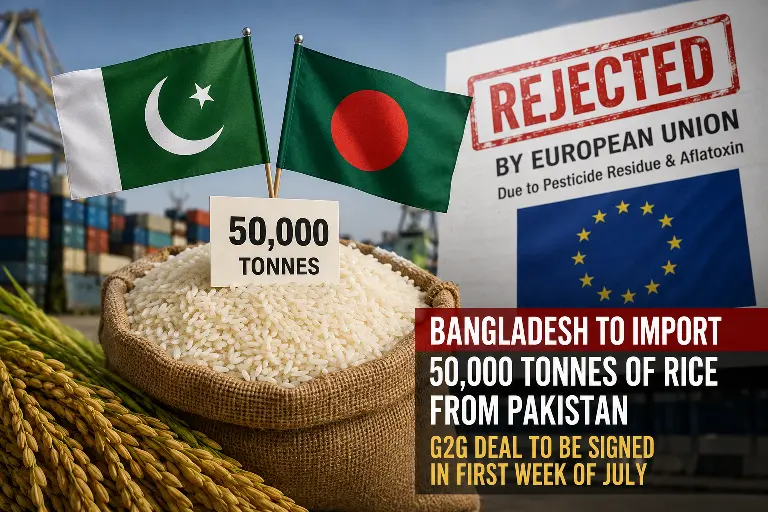
Bangladesh is preparing to import 50,000 metric tonnes of rice from Pakistan through a government-to-government (G2G) agreement, with officials expected to sign the deal during the first week of July. The move is intended to strengthen public food stocks, stabilize domestic rice prices, and ensure adequate supplies ahead of future demand. However, the planned import has triggered debate because the European Union (EU) has previously rejected a number of Pakistani rice consignments over food safety concerns.
It is important to note that the EU has not banned all Pakistani rice. Pakistan remains one of the world’s largest rice exporters, shipping millions of tonnes annually to markets across Asia, Africa, and the Middle East. However, over the years, the EU has rejected specific consignments that failed to meet its strict food safety and import standards.
The most common reason behind these rejections has been the detection of pesticide residues above the EU’s Maximum Residue Limits (MRLs). The EU maintains some of the strictest pesticide regulations in the world to protect consumers from prolonged exposure to agricultural chemicals. Every imported food product is subject to laboratory testing, and shipments exceeding these legal limits can be refused entry, returned to the exporting country, or destroyed.
Another major concern has been aflatoxin contamination. Aflatoxins are naturally occurring toxins produced by fungi that may develop during poor storage, transportation, or processing of grains. Scientific research has shown that prolonged exposure to excessive aflatoxin can damage the liver and increase the risk of liver cancer. Because of these health risks, the EU enforces strict maximum limits on aflatoxin levels in imported rice and other food commodities.
European authorities have also rejected some Pakistani rice shipments because of documentation problems, traceability failures, improper labeling, or non-compliance with sanitary and phytosanitary regulations. Under EU law, exporters must clearly demonstrate the origin of food products, maintain detailed production records, and certify compliance with food safety requirements. Failure to satisfy these administrative requirements can result in shipments being blocked even if laboratory results do not reveal significant contamination.
Against this backdrop, Bangladesh’s decision to import 50,000 tonnes of Pakistani rice through a G2G arrangement has attracted public attention. Government officials argue that the procurement is necessary to strengthen national food reserves, maintain market stability, and ensure sufficient supplies if domestic production falls short. Pakistan has also emerged as a competitive supplier because of relatively attractive export prices compared with some other rice-exporting countries.
Nevertheless, food safety experts stress that price should not be the only consideration when importing a staple food consumed daily by millions of Bangladeshis. They argue that every shipment entering Bangladesh should undergo comprehensive laboratory testing for pesticide residues, aflatoxins, heavy metals, and other contaminants before being released into the local market. Independent quality verification is particularly important whenever imported food originates from consignments or supply chains that have previously faced international scrutiny.
It is equally important to avoid misunderstanding the EU’s actions. The rejection of individual consignments does not automatically mean that every shipment of Pakistani rice is unsafe. Food safety inspections are conducted shipment by shipment, and compliance can vary depending on farming practices, pesticide use, storage conditions, and quality control measures. Rice that satisfies Bangladesh’s food safety regulations and passes independent laboratory testing can legally and safely enter the country.
The planned G2G agreement therefore places significant responsibility on Bangladeshi authorities. Consumers will expect agencies responsible for food procurement and safety to apply rigorous inspection procedures, publish laboratory findings where appropriate, and ensure complete transparency throughout the import process. Such measures would not only protect public health but also strengthen confidence in government procurement decisions.
As Bangladesh moves toward signing the agreement in the first week of July, the central issue is not whether the rice comes from Pakistan, but whether every imported shipment fully complies with Bangladesh’s food safety standards. If comprehensive testing confirms that the rice is free from excessive pesticide residues, aflatoxins, and other harmful contaminants, consumers can have greater confidence in its safety. If adequate testing is not carried out, however, concerns about food quality and public health are likely to persist despite the economic advantages of the import.