

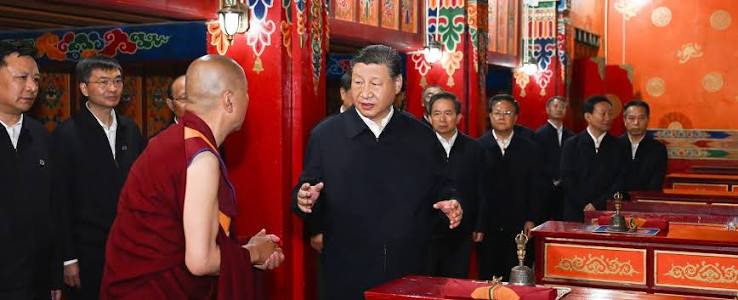
When Xi Jinping rose to power as Chinese Communist Party general secretary in 2012 and state president in 2013, he inherited a Tibet already under tight control. Yet what distinguishes his tenure is the transformation of Tibet from a contested periphery into a laboratory of authoritarian consolidation. Xi’s Tibet policy is not reactive. It is deliberate, systematic, and emblematic of his broader project to secure China’s borders while erasing cultural pluralism.
Tibet as a Security Frontier.
Xi has consistently framed Tibet as a national security issue. The region’s proximity to India, its symbolic connection to the Dalai Lama, and its history of resistance make it, in Beijing’s eyes, a potential fault line. Under Xi, Tibet has been subjected to deepening securitization. Refugee flows have been reduced to a tricklethrough militarized border controls and pressure on traditional escape routes through Nepal. Surveillance technologies, including DNA collection, facial recognition, AI-enabled monitoring, and border surveillance, have turned Tibet and Tibetan communities in the region into some of the most closely monitored populations in the world. Dissent, including in private digital spaces, has been criminalized under an expanding legal and security framework.
Assimilation as Strategy
Xi’s Sinicization campaign extends beyond Tibet, but its application there is particularly severe. Education policies have separated many Tibetan children from families, placing them in boarding schools and preschools where Mandarin increasingly replaces Tibetan language instruction. Religious practice has been curtailed: monasteries have faced raids and surveillance, images of the Dalai Lama are banned, and monks have been subjected to detention and political indoctrination. These measures are not incidental. They reflect Xi’s conviction that cultural distinctiveness is a threat to national unity.
Legal Warfare and Extraterritorial Reach
Xi has also weaponized law to extend repression beyond Tibet’s borders. China’s new Law on Promoting Ethnic Unity and Progress, adopted in March 2026 and due to enter into force in July 2026, has drawn warnings from UN experts, who say it risks entrenching forced assimilation and encouraging transnational repression. This legal architecture signals Beijing’s intent not only to reshape identity inside China, but also to intimidate diaspora communities and redefine sovereignty, legitimacy, and cultural rights on China’s terms.
Xi’s Personal Responsibility. Unlike his predecessors, Xi has centralized authority to an extent unseen since Mao. Tibet policy is not simply the product of bureaucratic inertia. It reflects Xi’s personal vision. His father, Xi Zhongxun, had ties to the Dalai Lama and was associated with softer approaches toward Tibet. Xi has rejected that legacy, opting instead for a far more coercive model of control. The crackdown in Tibet is therefore inseparable from Xi’s consolidation of power and his ideological project of “national rejuvenation.”
Strategic Consequences.
Cultural erasure: Tibet’s identity faces an existential risk under Xi’s assimilationist policies.
Regional instability: Tibet’s securitization exacerbates tensions with India, complicating an already fraught Sino-Indian rivalry.
Global implications: Xi’s extraterritorial repression challenges liberal democracies to respond, because silence risks normalizing authoritarian expansion beyond China’s borders.
Since 2012–2013, Xi Jinping has transformed Tibet into a crucible of authoritarian control. His policies of surveillance, assimilation, securitization, and legal warfare are not merely domestic tactics. They are strategic moves to secure China’s frontier and project its authoritarian model globally. Tibet is therefore not only a human rights tragedy, but also a geopolitical warning: Xi’s Tibet is the future he envisions for contested spaces worldwide.