
By Dr. Sanjana Hattotuwa
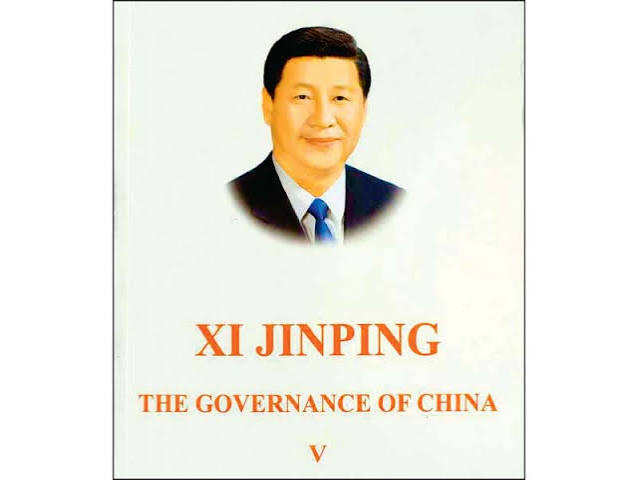
At the Hilton Colombo on 3 July, news reports indicate China’s Ambassador Qi Zhenhong commended the book titled “Xi Jinping: The Governance of China (Volume V)” to an audience that included Speaker Jagath Wickramaratne and Deputy Minister of Education Madhura Senevirathne, alongside visiting officials from the Central Office of Cultural and Ethical Progress and the China International Communications Group. The book, he said, offers an “intellectual key” to understanding China and a useful reference for Sri Lanka’s development. In fact, the headline of a news report explicitly noted “Xi’s governance book offers roadmap for Sri Lanka’s development”, and went on to report that the Ambassador “…said the principles outlined in the book could serve as a useful reference for Sri Lanka as it seeks to accelerate economic development, improve livelihoods and achieve its national development goals.” This served as an invitation to study what’s actually mentioned in the book, which is relatively easily discoverable online, and runs into 700 pages. In comparison, the PDF of the second edition of ‘Quotations from Chairman Mao Tse-tung’ (i.e., the Little Red Book) is a mere 143 pages.
Unsurprisingly, President Xi Jinping’s book is not what the Ambassador’s speech says it is. Volume V compiles 91 of Xi’s speeches and writings from May 2022 to December 2024, arranged across 18 sections by Beijing’s Foreign Languages Press. Sri Lanka appears nowhere in it. Not once or even in passing: not in the chapters on the Belt and Road Initiative (BRI), not in the surveys of major-country diplomacy, not in the discussions of ports and digital infrastructure. What the Ambassador offered as a text speaking to Sri Lanka’s port economy, modern agriculture, digital economy, new energy and poverty reduction is in fact a manual for governing China, and for reordering the global economy in ways congenial to, or in another reading, controlled by Beijing. Retrofitting Sri Lankan interests onto it is a category error the speech invites deliberately.
Consider what the book says about democracy, since the Ambassador spoke warmly of an avowed governance philosophy that puts “people first”. President Xi Jinping’s position, as noted in his writing, is far more candid than the diplomat.
“We should draw on the achievements of political civilisation of humanity, but never copy the models of Western political systems,” Xi writes (p. 302), and the surrounding chapters make Communist Party supremacy the non-negotiable and indisputable premise of everything else – the Courts, independent media, the military, and the economy. Sri Lanka’s governance, warts and all, remains a multi-party parliamentary democracy with competitive elections, an opposition, and a mainstream as well as online media that criticises power. 2022’s Aragalaya was tethered to the rejection of political authority which bankrupted the country (and, parenthetically, was very partial to China). The Speaker of our Parliament sat in the front row for the launch of a book whose first and foremost principle is that systems like the one he presides over must never be emulated. This isn’t new knowledge that requires President Xi Jinping’s book to be read, but, tellingly, nobody from Government at the Hilton appears to have found this awkward.
The gap between speech and text matters most around the digital economy, which the Ambassador flagged as a promising field of cooperation. Volume V treats the digital realm predominantly, if not exclusively, as a domain of sovereign defence, and ideological control rather than commerce. “We must build a cyberspace defence system to strengthen our capacity to safeguard national cybersecurity,” Xi instructs (p. 437), folding data, artificial intelligence and online expression into an architecture of state security. I wrote last month about the scam operations run from Sri Lankan soil that involve Chinese nationals, and, inter alia, the deportations conducted without adequate victim screening. This sought to resolve a public relations problem while leaving facilitators, organisers and financiers untouched, as well as the industrial-grade influence operations from Beijing targeting Sri Lankan social media users. A contradiction sits at the centre of all this. At home, in China, President Xi Jinping demands total digital order. Abroad, the ecosystems China builds, and the dependencies they deepen, leave host countries less able to Police their own networks, creating precisely the regulatory and legal gaps Chinese criminal syndicates exploit, and the Chinese State also weaponises through influence operations. The fraud Beijing disowns is a by-product of the influence it licenses, and also engineers. The Ambassador mentioned neither.
Nothing in the speech touched on debt either, which is remarkable given how much of Volume V is consumed by Beijing’s anxieties about leverage. “We should forestall and defuse Local Government debt risks,” Xi directs his provincial officials, demanding they “resolutely curb the creation of new debt” and prohibiting “any forms of disguised borrowing” (p. 206). The President also noted that “We should strengthen the centralised, unified leadership of the Party Central Committee over financial work and expand the reform of the financial system” (p. 206).
Reading those directives from Colombo, four years after a sovereign default to which opaque Chinese lending and commercially unviable projects contributed, produces something between laughter and vertigo. Beijing now preaches to its own officials precisely the fiscal discipline it declined to extend to its overseas lending, and a book so alert to the dangers of hidden debt might have prompted the Ambassador to reflect on how this is resonant in Sri Lanka, which is still dealing with the consequences of a default. He did not.
The asymmetry runs deeper than money. President Xi Jinping commits China to “the principles of independence and self-reliance”, to developing “the country and nation with our own strength, and maintain a firm grasp on the future of China’s development” (p. 114), insulating Beijing from the very dependencies it cultivates elsewhere. When Volume V turns to the BRI, the direction of benefit is explicit: pilot zones for Silk Road e-commerce, shipping under the Silk Road Maritime platform, a Global Initiative for Artificial Intelligence Governance, and an “Integrity and Compliance Evaluation System” for participating companies – rules authored in Beijing, standards set by Beijing, compliance assessed by Beijing, and rewards reaped by Beijing. There’s nothing munificent about any of it. Alongside this sits a quieter project the Ambassador never named. President Xi Jinping calls for strengthening “law-based governance of foreign-related affairs” and building “a robust network of legal measures to protect our overseas interests” (p. 333), a parallel legal architecture that makes it progressively harder for host countries to hold Chinese entities – SOEs, digital platforms, or the operators of scam compounds – accountable within their own Courts. A page on, the same chapter dresses this project in the language of commerce. The rule of law, we are assured, “creates the optimal business environment”, and Beijing pledges to “strengthen the protection of intellectual property rights, safeguard the legitimate rights and interests of foreign enterprises” and build a business environment that is “market-oriented, law-based and internationalised” (p. 334). Set against conduct, the promise is threadbare. A legal system whose first principle is Party supremacy offers no independent Court to any foreign litigant, and the record – exit bans on foreign executives, the 2023 raids on due-diligence and consultancy firms Mintz, Bain and Capvision, an expanding Anti-Foreign Sanctions Law – suggests law in China operates as an instrument of state power, not a restraint upon it.
The same selectivity marks Beijing’s posture towards the international rules it here promises to apply: it invokes them when convenient, and discards them when they bind, dismissing the 2016 arbitral award on the South China Sea as so much waste paper, and coercing Australia and Lithuania through trade in defiance of WTO norms. What Volume V calls law-based governance reads, from Colombo, as rules for others, and discretion for China. In the book’s own telling, the port economy President Xi Jinping dangled before his audience solely, and singularly serves China’s supply chain security and strategic autonomy; Sri Lanka (and most other countries which are part of BRI) features as convenient geography, with a pliant regime – never, and not as a partner.
Where the Ambassador’s speech stressed peace, friendship and a shared future, the book sets out “the centenary goal of the People’s Liberation Army by 2027”, elevating China’s Armed Forces “to world-class standards” as “strategic tasks for building a modern socialist country in all respects” (p. 59). Economic footprint and security apparatus travel together in this text: under the Global Security Initiative, Xi promises Africa RMB1 billion in military assistance grants and training for 6,000 military personnel and 1,000 police and law enforcement officers (p. 538). Just this week, China tested a submarine-launched ballistic missile in the Pacific, alarming regional powers. Chinese technology is embedded in Sri Lanka’s vast surveillance apparatus. For a country already navigating regional unease over Chinese research, and naval vessels calling at its ports, the confluence deserves far more scrutiny than it received. The year President Xi Jinping has set for a world-class PLA is, after all, the same year in which he invites us to celebrate 70 years of diplomatic ties.
What was delivered by Ambassador Qi Zhenhong at the Hilton, then, was not an accurate summary of Volume V, by any stretch of imagination. It was also not so much a redaction, and it was a strategic re-casting. Every hard edge and inconvenient frame – one-party supremacy, pervasive cyber control, total surveillance, debt discipline for China alone, extraterritorial law, and accelerated military expansion – was glossed over, leaving a softer, more appealing vocabulary of modernisation, win-win cooperation and a “community with a shared future”.
Given my study of it for the past six years, this is what China’s information manipulation and interference on social media also looks like in its politest register: not pure fabrication, but a selective, self-serving presentation which at the Hilton was performed before our Speaker of Parliament and other MPs. None of this is an argument against engaging China, which remains a consequential creditor and trading partner, and moreover, is a country now courted by many others across the globe who once shunned it. It is, however, an argument against the mindless repetition of flattery substituting for critical reading or reporting, and a reception defined by supine deference and scant scrutiny.
The Chinese Ambassador is right about one thing. Volume V genuinely is an intellectual key – a candid, authoritative, and insightful account of how Beijing, under President Xi Jinping, understands power, order, and its own primacy. Resurgent diplomatic ties with China, especially under Trump 2.0, would be seen by Beijing, going by this tome, to be a long-overdue reflection of its rightful place in global affairs. Sri Lankan legislators, officials and journalists should do exactly what Ambassador Qi Zhenhong asked, though not in the spirit he intended. Study Volume V, which tells you, with a frankness his speech carefully avoided, what China wants.
It says nothing at all about what Sri Lanka needs.
Source – https://ceylontoday.lk/2026/08/02/reading-xi-in-colombo/