
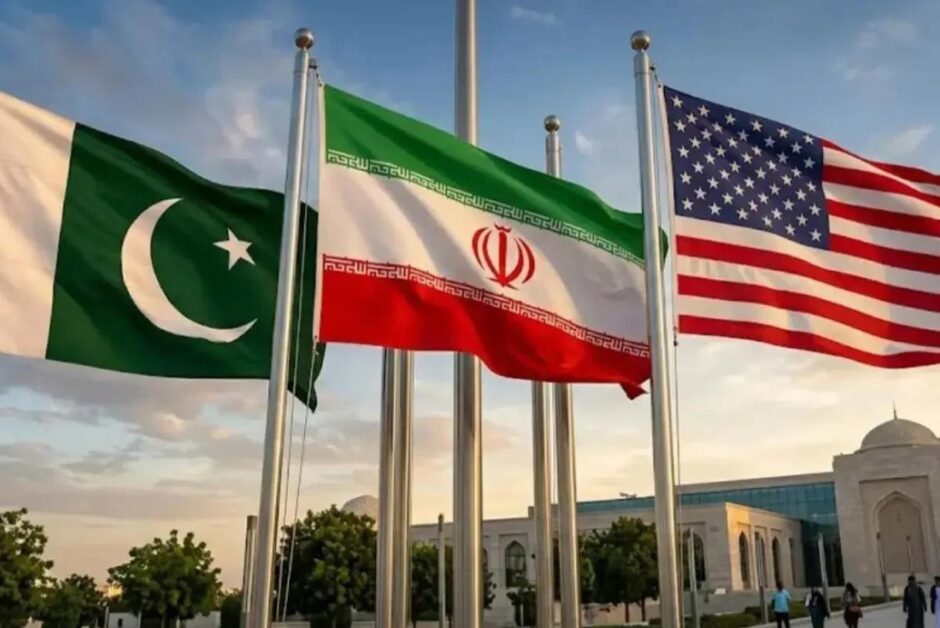
The article argues that Pakistan’s 2026 foreign policy is built on strategic balancing rather than choosing sides: Islamabad presents itself as a mediator between Washington and Tehran while deepening economic ties with Iran, rebuilding military cooperation with the United States, relying on China for strategic backing, and maintaining defence commitments with Saudi Arabia and Turkey. The author suggests that these apparent contradictions are deliberate, allowing Pakistan to increase its diplomatic, economic and geopolitical value by making itself useful to competing powers. Using the Pied Piper metaphor, the piece concludes that Pakistan’s real objective is not loyalty to any particular bloc, but the advancement of its own national interests by ensuring that all sides continue to need Islamabad.
(OP-ED) ATHENS, 14-Sep-2026 — /EuropaWire/ — On September 10, Pakistan finds itself in an almost paradoxical position. Islamabad has conveyed Saudi Arabia’s warning to Tehran to rein in the Houthis following attacks on Saudi territory and energy infrastructure, while remaining bound to Riyadh and Ankara by a collective defence agreement. At the same time, Pakistan continues to present itself as a diplomatic channel between Washington and Tehran, insisting that diplomacy remains the path towards peace.
The image calls to mind the Pied Piper of Hamelin. A town surrounded by danger is approached by someone who knows the tune everyone needs and promises to lead it out of crisis. But the Piper does not play for free. For Pakistan, mediation in 2026 has coincided with a remarkable increase in its strategic utility. Islamabad keeps Tehran’s door open, rebuilds military ties with Washington, expands its economic relationship with Iran and continues to rely on Beijing. Peace may indeed be the objective. But behind the role of peacemaker lies a more uncomfortable question: what does the Piper gain while everyone still needs his tune?
Pakistan does not so much choose between competing camps as present a different strategic face to each of them, turning contradiction itself into an instrument of statecraft. To Washington, it is a security partner and a channel to Tehran; to Iran, a neighbour, commercial outlet and interlocutor; to China, an “all-weather” strategic partner; and to Riyadh and Ankara, a partner in collective defence. Seen through that prism, the Makkah pact is not merely another alliance commitment. It encapsulates the central paradox of Pakistan’s diplomacy: Islamabad seeks to remain valuable to actors whose interests may be fundamentally at odds.
Nor did Pakistan’s contested credentials as a peacemaker begin with the current war. Its present mediation should be viewed against a longer history in which the country has repeatedly attempted to combine diplomatic relevance abroad with security calculations of its own. The war has not created that instinct; it has magnified it.
The contradiction has been building since the spring. On March 31, Pakistan joined China in calling for an immediate end to hostilities, protection of Iranian sovereignty and the opening of peace negotiations. On April 12, however, the Pakistani Air Force reportedly provided protection for senior Iranian officials returning to Tehran, including Foreign Minister Abbas Araghchi and parliamentary speaker Mohammad Bagher Ghalibaf. On April 25, Pakistan opened six land transit routes linking Karachi, Port Qasim and Gwadar with the Iranian border, providing Tehran with an alternative commercial artery.
In May came an even more controversial development. U.S. officials said Iranian military aircraft, including an RC-130 reconnaissance plane, had been parked at Pakistani airfields, potentially shielding them from American strikes. Islamabad confirmed the presence of Iranian aircraft but firmly denied that any arrangement existed to preserve Iranian military assets, linking their presence instead to diplomatic talks.
By August, economic rapprochement had become official policy, with Pakistan and Iran setting a target of $10 billion in annual bilateral trade. On August 24, Field Marshal Asim Munir himself travelled to Tehran for talks with Iran’s political and security leadership.
The emerging picture is no longer simply that of a country standing between two belligerents. Pakistan has become a diplomatic channel and commercial outlet for one side while simultaneously positioning itself as a mediator between both. The real question is where mediation ends and Pakistan’s own strategic interest begins.
The U.S.-Pakistan rapprochement had begun before Islamabad emerged as a crucial conduit to Tehran. According to Reuters on December 17, 2025, Munir had developed a close relationship with Donald Trump, who had hosted him for an unusual private lunch at the White House in June. Islamabad had powerful reasons to cultivate that relationship, including U.S. investment and security cooperation.
The military dimension was tangible. In February 2025, the Trump administration exempted $397 million from its foreign-aid freeze for a U.S. programme monitoring Pakistan’s use of its F-16 fleet. Towards the end of the year, Washington went further with a proposed package worth roughly $686 million to upgrade and support Pakistan’s F-16s, including Link-16 systems, avionics upgrades, secure communications, cryptographic equipment, training and technical support.
In 2026, this military reconnection coincided with a dramatic rise in Pakistan’s diplomatic value. By April 1, Reuters was describing Islamabad as an active mediator in the U.S.-Iran war. In May, Pakistan was included among several countries covered by a ten-year, $488 million U.S. contract for technical support of APG-66 and APG-68 F-16 radar systems. In August, Washington and Islamabad formally deepened their counterterrorism cooperation.
None of this proves that U.S. military engagement is a quid pro quo for Pakistan’s mediation. But the convergence is striking: as Pakistan becomes more useful as a channel to Iran, its strategic value to Washington rises with it.
For a country with chronic energy shortages, an Iran endowed with vast oil and gas reserves represents a temptation that is difficult to ignore. In 2026, that temptation has translated into measurable economic opportunities. Between June 1 and 8 alone, approximately 17,353 tonnes of LPG crossed through Gabd-Rimdan. Meanwhile, the six new transit corridors have turned Gwadar, Karachi and Port Qasim into alternative gateways for Iranian commerce.
Estimates published by Dawn put Pakistan’s potential annual revenue from the new transit arrangement at $24–32 million, with Gwadar potentially capturing at least 25% of Iran’s transit market in its initial phase. In August, the economic convergence accelerated further: the two governments formally set a target of $10 billion in annual trade while advancing a free-trade agreement, tariff reductions, barter trade, investment and border markets.
The contradiction is difficult to miss. Pakistan presents itself as a peacemaker in a war while simultaneously seeking energy security, commercial revenue and geoeconomic leverage through its relationship with one of the belligerents. And when part of that economic activity runs through informal or difficult-to-trace channels in a region populated by armed networks, tracking money and goods inevitably becomes a security question as well.
Behind Pakistan’s geopolitical acrobatics stands China. On March 31, Beijing and Islamabad presented a joint five-point initiative on the war, calling for an end to hostilities, negotiations, protection of Iranian sovereignty and safe navigation through the Strait of Hormuz.
The alignment became still clearer between May 23 and 26, when Prime Minister Shehbaz Sharif visited China and met Xi Jinping and Li Qiang. The two countries agreed to deepen CPEC 2.0, advance the development of Gwadar and strengthen military, counterterrorism and broader security cooperation. Beijing simultaneously welcomed Pakistan’s role in efforts to de-escalate the U.S.-Iran conflict.
China, therefore, is more than the third point of a diplomatic triangle. It provides Islamabad with strategic depth. While Pakistan rebuilds its military relationship with Washington and expands its economic relationship with Tehran, Beijing supplies investment, geopolitical backing and defence cooperation. That strategic cushion gives Islamabad greater room to manoeuvre between competing powers without committing itself completely to any one of them.
In Steven Pressfield’s Killing Rommel, survival in desert warfare depends not only on firepower but on the ability to read the battlefield, adapt and move through uncertainty. Islamabad appears to be following a similar logic. It does not simply choose a camp; it attempts to make itself indispensable to all of them. Viewed through that prism, mediation is not merely a peace mission. It is a multiplier of Pakistan’s geopolitical value.
Yet there is one final irony. While Islamabad seeks to project itself abroad as a guarantor of stability, on September 29 the Election Commission of Pakistan is expected to return to the protracted delay of local elections in Khyber Pakhtunkhwa, having already accused the provincial government of delaying tactics. It is an awkward contrast between the stability Pakistan seeks to project abroad and the institutional tensions it must manage at home.
And here the Pied Piper returns. His power lies not simply in the tune he plays, but in the fact that everyone still needs to hear it. Pakistan’s strategy is therefore less about choosing a side than about ensuring that every side continues to find Islamabad useful. It offers Washington access, Tehran an outlet, Beijing strategic continuity and Riyadh and Ankara a defence partner — different faces for different audiences, all serving the same national calculation. The question, then, is not whether Pakistan stands with the United States, Iran or China. That is the wrong question. Pakistan stands with Pakistan. And for as long as the others continue to need the tune, the Piper will continue to set the price.
About the author
Dimitra Staikou is a Greek lawyer, journalist, and professional writer with extensive expertise on South Asia, China, and the Middle East. Her analyses on geopolitics, international trade, and human rights have been published in leading outlets including Modern Diplomacy, HuffPost Greece, Skai.gr, Eurasia Review, and the Daily Express (UK). Fluent in English, Greek, and Spanish, Dimitra combines legal insight with on-the-ground reporting and creative storytelling, offering a nuanced perspective on global affairs.
SOURCE: Dimitra Staikou