
India–European Union economic relations are entering a new phase in which trade, industrial competitiveness and climate policy are increasingly intertwined. The conclusion of negotiations on the EU–India Free Trade Agreement on 27 January 2026 created a major platform for deeper economic engagement. India–EU goods trade totals approximately USD 136 billion, reflecting strong and growing economic linkages. India’s exports to the European Union are estimated at USD 76 billion, while imports from the EU amount to around USD 60 billion. This indicates a USD 15 billion trade surplus for India, highlighting its competitive export position.
Yet, alongside the trade opportunity lies a major challenge: the European Union’s Carbon Border Adjustment Mechanism (CBAM). Since 1 January 2026, CBAM has entered its definitive regime, covering iron and steel, aluminium, cement, fertilisers, electricity and hydrogen. The mechanism places a carbon cost on embedded emissions in covered imports, creating a powerful incentive for producers outside Europe to reduce their carbon intensity.
For India, this challenge is particularly pressing because steel is central to its industrial expansion. For Europe, India’s enormous renewable-energy potential and growing industrial base offer an opportunity to build new clean-technology supply chains. Green hydrogen could serve as the bridge between these two objectives.
India’s industrial transition: the scale of the challenge
India’s economic development will require a dramatic expansion of steel, cement, chemicals, transport and infrastructure. The National Steel Policy envisages a crude-steel capacity of 300 million tonnes and production of 255 million tonnes by 2030–31. This expansion creates a strategic dilemma. Conventional steelmaking is heavily reliant on coal and is among the world’s most carbon-intensive industrial activities. Globally, steel production generates around 2.6 billion tonnes of CO₂ annually, with coal-based blast furnaces accounting for the majority of output.
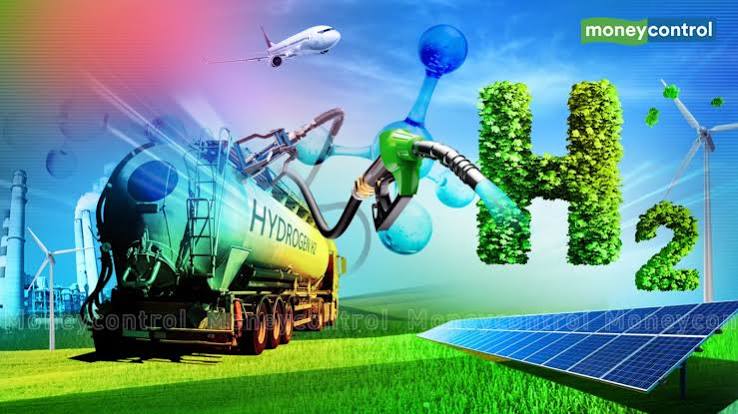
India therefore has a unique opportunity: rather than expanding conventional capacity and then retrofitting it, the country can increasingly build clean industrial capacity from the outset. Green hydrogen is particularly important because it can replace fossil fuels in industrial processes that are difficult to electrify directly. In steelmaking, hydrogen can remove oxygen from iron ore via the direct reduced iron (DRI) process. When the hydrogen is produced using renewable electricity, the resulting H₂-DRI route can dramatically reduce emissions compared with conventional coal-based blast furnaces.
India’s green hydrogen mission
India has already established the policy architecture for this transformation. The National Green Hydrogen Mission, launched in January 2023, has an initial outlay of ₹19,744 crore, including ₹17,490 crore for the Strategic Interventions for Green Hydrogen Transition (SIGHT) programme. The national objective is to establish 5 million tonnes per annum of green-hydrogen production capacity by 2030.
Signs of industrial mobilisation are already emerging. Around 15 companies have been awarded 3,000 MW per year of electrolyser manufacturing capacity, while 18 companies have received incentives covering 862,000 tonnes per annum of green-hydrogen production capacity.
Why Europe needs green hydrogen and green industrial imports
Europe’s industrial challenge is different. The EU has ambitious climate objectives but faces high energy costs, limited domestic renewable resources in some regions and the enormous capital requirements associated with decarbonising steel, chemicals and other heavy industries.
The EU’s clean-industry strategy increasingly recognises that renewable electricity and green hydrogen will be strategic industrial inputs, not merely environmental technologies. A recent estimate highlights the potential for renewable electricity, green hydrogen and sustainable biomass to reduce Europe’s dependence on imported fossil fuels and to strengthen industrial resilience. This creates a natural economic complementarity with India.
India has abundant solar and wind resources and a large industrial workforce. Europe has advanced industrial technology, sophisticated manufacturing systems, deep capital markets and a large market for low-carbon products. The strategic opportunity for production-based joint ventures
Indian companies can use renewable electricity to produce green hydrogen, manufacture direct reduced iron, and convert it into hot-briquetted iron (HBI) for export to Europe. HBI is easier to transport and store, enabling European steelmakers to use green iron in electric arc furnaces. Estimates suggest that green HBI imports could reduce German steelmaking costs by 12–15% by 2040, thereby creating an international clean-steel value chain.
The institutional foundation already exists
The partnership need not start from scratch. India and the EU established their Clean Energy and Climate Partnership in 2016, covering renewable energy, energy efficiency, smart grids, climate action and innovation. The partnership was subsequently strengthened by the 2017 Leaders’ Joint Statement. Green hydrogen has now emerged as an important area of cooperation within this framework.
Finance will be equally important. The European Investment Bank has indicated support of up to €1 billion for India’s emerging green-hydrogen ecosystem and renewable-energy projects, demonstrating that European public finance can help crowd in private capital. This financing architecture could be expanded to include large-scale electrolyser manufacturing, renewable-energy projects, hydrogen hubs, green-iron plants, port infrastructure and cross-border supply chains.
A new model of India–EU industrial cooperation
The next phase of India-EU relations should move beyond the traditional model in which India exports finished products to Europe and Europe supplies capital and technology. A more powerful model would be based on joint, clean industrial value chains. India could provide competitive renewable energy, green hydrogen, green iron, and increasingly low-carbon manufactured goods. Europe could contribute advanced electrolysers, industrial technologies, financing, carbon accounting systems, and access to high-value green markets.
Five priorities should guide this transformation:
- Create bankable green-hydrogen demand through long-term industrial offtake agreements.
- Accelerate green-iron and H₂-DRI projects in India’s renewable-energy-rich regions.
- Develop interoperable carbon-accounting and certification systems to minimise CBAM-related uncertainty.
- Mobilise blended EU–India finance to reduce the high cost of capital facing emerging hydrogen projects.
- Develop strategic clean-industry corridors connecting renewable-energy hubs, industrial clusters and ports.
The EU–India energy transition is ultimately about more than climate change. It is about industrial competitiveness, energy security, trade resilience and the architecture of the future global economy. India’s enormous steel expansion means that the country cannot afford to follow a carbon-intensive industrial pathway and attempt to clean it up later. Europe, meanwhile, cannot decarbonise its heavy industry without large quantities of affordable clean energy, hydrogen and low-carbon industrial inputs. This is where green hydrogen becomes strategically important.
The most valuable outcome may not be the physical shipment of millions of tonnes of hydrogen from India to Europe. Instead, it may be the emergence of green industrial products such as green iron, HBI, low-carbon steel, chemicals and other materials produced in India with renewable energy and integrated into European value chains.
In conclusion, the India–EU partnership has the potential to turn CBAM from a source of trade friction into a catalyst for industrial transformation. The test will not be the number of declarations signed, but the number of electrolysers installed, the tonnes of green hydrogen contracted, the H₂-DRI plants commissioned, the carbon certificates recognised, and the low-carbon products traded.
Going forward, with breakthroughs in India and Europe’s clean energy ecosystem by the end of this decade, the energy transition could become more than a climate project. It could become the foundation for a new, cleaner and more competitive India–EU industrial partnership.