
Key Takeaways:
- Pakistan is now inside Saudi security on paper and in post: SMDA (Sept 2025), Makkah pact with Riyadh and Ankara (7 Aug 2026)—an attack on one is an attack on all—and MMDC (30 July; operational 2 Sept), where Commodore Rashid Sheikh is deputy commander. FO (12 Aug): Islamabad signed the maritime communiqué.
- Houthi strikes on Abha, Khamis Mushait, Jazan, and Najran: Saudi count 73 injured; Houthis named Aramco and King Khalid Air Base. 15 Sept: Riyadh said a drone was stopped south of Mecca; Houthis deny aiming at the city. FO (10 Sept): no Makkah military response under discussion—after Asif said the pact could apply if fighting crossed into Saudi Arabia.
- Reuters (May): ~8,000 Pakistani personnel, ~16 JF-17s, two drone squadrons, HQ-9 already in the kingdom; a confidential deal could allow up to 80,000. 2015: parliament stayed out of Yemen combat while promising to defend Saudi soil. Author: the test is action, not another communiqué.
Pakistan has spent the past year presenting itself as an increasingly consequential security actor in the Middle East. It has signed overlapping defence agreements with Saudi Arabia, assumed the second-highest command position in a new Saudi-led maritime coalition, deployed thousands of personnel and combat-capable assets to the kingdom, and publicly committed itself to collective defence.
The renewed Houthi assault on Saudi territory, however, is exposing the unresolved question beneath that architecture: how much of Pakistan’s security role is an operational commitment, and how much remains declaratory deterrence?
The contradiction is becoming harder to ignore because Pakistan is now embedded in virtually every layer of Saudi Arabia’s emerging security structure. On July 30, Saudi Arabia and 13 other countries announced the Multinational Maritime Defense Coalition (MMDC), designed to protect freedom of navigation, energy routes and commercial shipping through the Red Sea, Gulf of Aden and Bab al-Mandab. Saudi Arabia serves as the coalition’s founding leader and permanent headquarters. Pakistan quickly committed itself to the initiative. On August 12, Pakistan’s Foreign Office spokesperson Tahir Hussain Andrabi confirmed that Islamabad had signed the coalition communiqué and was prepared to help operationalise it to protect maritime traffic and global supply chains.
Pakistan’s role is not ceremonial. When the coalition entered its operational phase on September 2, Pakistan Navy Commodore Rashid Sheikh became deputy commander, serving immediately below Saudi Rear Admiral Abdullah bin Salem Al-Shehri. Pakistan therefore occupies the coalition’s No. 2 military position and is directly involved in operational planning and coordination.
Yet the security environment the coalition was created to confront has deteriorated almost immediately. Houthi forces have advanced along Yemen’s western coast toward the Bab al-Mandab, while missile and drone attacks have again reached Saudi territory. Saudi authorities said strikes on Abha, Khamis Mushait, Jazan and Najran injured 73 people, while the Houthis said they were targeting Saudi Aramco facilities and King Khalid Air Base. The fighting has subsequently expanded along the Red Sea coast and around strategically important approaches to Bab al-Mandab.
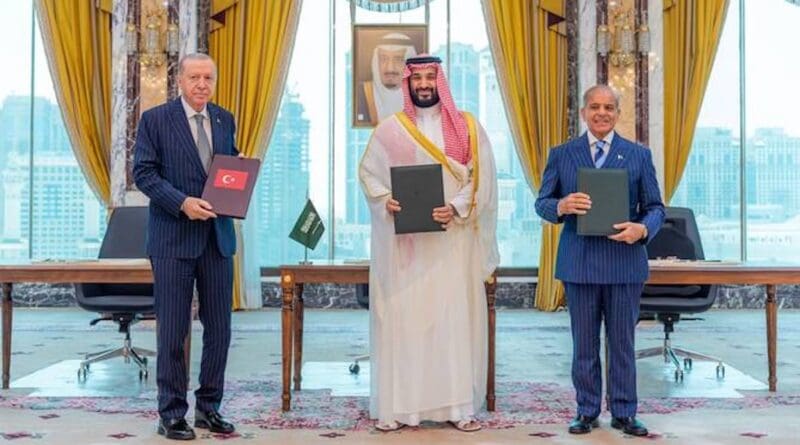
The escalation directly intersects with Pakistan’s second security commitment: the Makkah Joint Defence Agreement, signed on August 7 by Saudi Crown Prince Mohammed bin Salman, Turkish President Recep Tayyip Erdoğan and Pakistani Prime Minister Shehbaz Sharif. Its language is unusually explicit: an armed attack against one of the three states is to be regarded as an attack against all. Pakistan described the accord as a mechanism for “collective deterrence” and regional stability. That commitment is layered on top of the bilateral Saudi-Pakistan Strategic Mutual Defence Agreement (SMDA), signed in September 2025, under which aggression against either state is treated as aggression against both. Taken together, the agreements allow Islamabad to project the image of a security guarantor rather than merely a diplomatic partner.
The problem is that the first serious test has produced caution rather than clarity. After the Houthis struck Saudi cities and energy infrastructure, Pakistan’s Foreign Ministry said on September 10 that no military response under the Makkah Agreement was being discussed. That position sits awkwardly beside the agreement’s sweeping collective-defence language. It is particularly striking because Pakistani Defence Minister Khawaja Asif had indicated that the pact could become relevant if fighting in Yemen spilled into Saudi territory. That threshold has arguably already been crossed: missiles and drones have hit Saudi cities and infrastructure.
The tension sharpened further on September 15, when Saudi Arabia said its air defences intercepted a Houthi drone south of Mecca before it entered the holy city’s restricted airspace. Saudi coalition spokesperson Major General Turki al-Malki called the security of Mecca, Medina and pilgrims a “red line.” The Houthis denied targeting Mecca, meaning the intended target remains disputed, but the incident nevertheless brought the confrontation directly into the politically most sensitive area possible for Pakistan.
Pakistan has repeatedly invoked the defence of the Haramain Sharifain as a central element of its relationship with Saudi Arabia. Yet even after the Mecca incident, neither Pakistan nor Turkey had publicly received a Saudi request for military assistance. What makes the hesitation more revealing is that Pakistan cannot plausibly attribute it simply to a lack of military capacity in the kingdom. During the U.S.–Iran war earlier in 2026, Pakistan substantially expanded its presence in Saudi Arabia under the bilateral defence relationship. Reuters reported in May that Islamabad had deployed roughly 8,000 personnel, about 16 JF-17 fighter aircraft, two drone squadrons and an HQ-9 long-range air- defence system. The deployment was officially characterised largely in terms of training, advisory functions and defence cooperation, but its scale and composition gave Saudi Arabia access to an already-positioned, combat-capable Pakistani force. Reuters also reported that the confidential bilateral agreement could permit deployment of up to 80,000 Pakistani personnel for Saudi security.
In other words, Pakistan’s current dilemma is less about whether it possesses forces capable of contributing to Saudi defence than whether Islamabad is prepared to employ them against the Houthis or other Iran-aligned actors. That dilemma has precedent. When Saudi Arabia launched its intervention in Yemen in March 2015, Riyadh explicitly requested Pakistani ground troops, combat aircraft and naval vessels. Then-Defence Minister Khawaja Asif disclosed the request to the Parliament of Pakistan. After five days of debate, the Pakistani Parliament unanimously called for Pakistan to remain neutral in the Yemen war while reaffirming its willingness to defend Saudi territorial integrity. Islamabad consequently declined to join Saudi combat operations inside Yemen.
The 2026 situation is harder to compartmentalise. The Houthis are no longer threatening Saudi interests only from inside Yemen; they are striking Saudi territory. At the same time, their movement toward Bab al-Mandab directly challenges the maritime theatre that Pakistan’s new coalition is explicitly supposed to secure. Pakistan therefore faces pressure simultaneously under its bilateral SMDA, the trilateral Makkah Agreement and its senior operational role in the maritime coalition.
The emerging Houthi-Saudi confrontation is therefor more than another Yemen crisis for Islamabad. It is a test of the security architecture Pakistan itself has helped construct. In 2015, Pakistan could refuse Saudi Arabia’s request to enter Yemen while promising to defend the kingdom if Saudi territory came under attack. In 2026, Saudi territory is under attack, Pakistan already has forces inside the kingdom, Pakistani officers occupy senior positions in a coalition designed to secure the threatened Red Sea corridor, and Islamabad has signed agreements declaring that an attack on Saudi Arabia is an attack on Pakistan. The question is no longer what Pakistan has promised. It is where Pakistan intends to draw the line between a security guarantee and actual security action.