
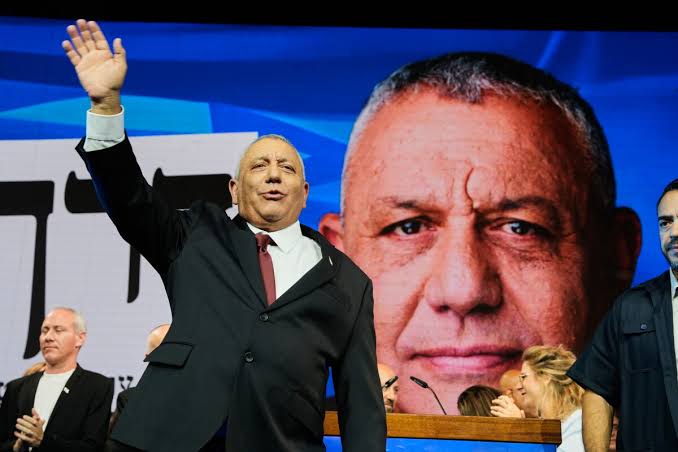
Israel’s newly elected parliament has been sworn in, marking the beginning of a period of political uncertainty as opposition leader Gadi Eisenkot attempts to form a government and replace caretaker Prime Minister Benjamin Netanyahu.
President Isaac Herzog tasked Eisenkot with forming the next government after he received more recommendations from members of the Knesset than Netanyahu. However, bringing together enough parties to secure a parliamentary majority remains a major challenge.
Eisenkot’s bloc of four parties secured 48 seats in the October election, while Netanyahu’s bloc won 53 seats. Neither side reached the 61 seats required for a majority in the 120-member Knesset. Eisenkot has 28 days to form a government, with the possibility of a two-week extension.
Speaking shortly after the new parliament was sworn in, Netanyahu warned against the formation of a government that depends on Arab parties, questioning whether such an administration could protect Israel’s interests.
He also called for a national unity government, describing it as necessary to confront what he called the threat of a nuclear Iran.
Eisenkot strongly criticised Netanyahu’s remarks, accusing the caretaker prime minister of using a formal parliamentary occasion to deliver a divisive speech. He said the comments had further strengthened his belief that Netanyahu should leave office.
The election produced a significant result for Israel’s Arab-led political alliances. The United Arab List and the Joint List secured a combined 19 seats, marking an unprecedented level of representation following increased turnout among Arab voters.
Their parliamentary support could prove important in determining the next government. However, Netanyahu has ruled out forming a government with Arab parties, while three parties within Eisenkot’s bloc have also opposed including them in a coalition.
At the President’s residence, Eisenkot called for a “national emergency government”, urging political parties to set aside ideological differences and work towards replacing Netanyahu. He said achieving this would require “creative and unconventional political steps”.
He outlined four principles that parties or individual members of parliament must accept to join his proposed government. These include recognising Israel as a Jewish and democratic state, supporting the values of its Declaration of Independence, introducing mandatory military, national or civilian service for all communities, and recognising Hamas as a terrorist organisation while committing to dismantling its military and governing capabilities.
However, these conditions could complicate negotiations with several potential coalition partners.
Military conscription remains a major point of disagreement, particularly over exemptions granted to ultra-Orthodox Jewish men studying full-time in religious institutions. The ultra-Orthodox parties United Torah Judaism (UTJ) and Shas, which together won 13 seats, strongly oppose changes to the existing arrangements.
Eisenkot’s conditions also create difficulties for the Arab-led parties, which emphasise equal national and civic rights for Arab citizens. Most Israeli Arab citizens are not required to undertake military service, and neither alliance has publicly recognised Hamas as a terrorist organisation.
The United Arab List, which secured eight seats, has indicated its willingness to join an Eisenkot-led coalition. The Joint List, with 11 seats, has offered to support such a government from outside the coalition.
Even with their backing, Eisenkot would need to convince other parties in his bloc to accept an arrangement that relies on Arab parliamentary support. Avigdor Lieberman, whose Yisrael Beiteinu party won seven seats, has so far rejected joining a minority government dependent on Arab members of parliament.
Meanwhile, the ultra-Orthodox parties are likely to seek concessions on military conscription in exchange for their support, a demand that could be difficult for Eisenkot’s partners to accept.
Netanyahu will remain caretaker prime minister until a new government is formed. The process could take anywhere from several days to several months.
Source: BBC