
Pakistan’s designation of the Jammu and Kashmir Joint Awami Action Committee as a terrorist organisation—followed by arrests, communications blackouts, protest restrictions and a security crackdown—reflects its evolution into a “hard state” in which political disagreement is increasingly managed through the security apparatus. This trajectory forms part of a broader global shift driven by terrorism, war, irregular migration, hybrid threats and geopolitical fragmentation. Although European democracies are not institutionally comparable to Pakistan and remain constrained by constitutional safeguards, courts and parliamentary oversight, their growing emphasis on border control, executive authority and state resilience demonstrates a wider rebalancing of liberty and security. The central question is whether expanded state power will remain subject to democratic accountability and fundamental rights—and whether Pakistan is an exception or an early indicator of the hard state becoming a defining model of twenty-first-century governance.
(OP-ED) ATHENS, 13-Aug-2026 — /EuropaWire/ — On 5 June 2026, the Government of Pakistan designated the Jammu and Kashmir Joint Awami Action Committee (JKJAAC) as a terrorist organisation, invoking anti-terrorism legislation against a movement that had emerged as a leading representative of social and political demands in Pakistan-administered Kashmir. The decision was followed by mass arrests, communications blackouts, restrictions on public assemblies and the extensive deployment of security forces. Just weeks later, on 27 July 2026, regional elections in the same territory were held amid intense political polarisation and violence, with clashes between demonstrators and security forces resulting in deaths and injuries. International organisations expressed serious concern over the excessive use of force, communications shutdowns and the use of anti-terrorism legislation to suppress political dissent.
The emergence of the hard state cannot be understood without reference to the broader theoretical framework of securitisation, most prominently developed by the Copenhagen School. According to Barry Buzan and Ole Wæver, issues once treated as political, social or economic challenges are progressively reframed as matters of national security, enabling governments to adopt extraordinary measures and expand executive authority. The terrorist attacks of 11 September 2001, Russia’s invasion of Ukraine, the resurgence of geopolitical rivalry, hybrid threats and unprecedented migratory pressures have collectively accelerated this process, shifting the centre of gravity of state action from safeguarding individual liberties towards ensuring collective security. This evolution does not necessarily imply the abandonment of democratic principles; rather, it reflects a profound transformation in the logic of governance, whereby security increasingly becomes the primary source of political legitimacy. Viewed through this lens, the hard state should not be understood merely as an authoritarian characteristic of particular regimes. Instead, it represents a broader reconfiguration of statehood in the twenty-first century, where the central political question is no longer whether security should be strengthened, but how far states can expand their security powers without eroding the democratic freedoms and constitutional guarantees they claim to defend.
At the same time, thousands of kilometres to the west, the European Union has found itself confronting one of the most complex security and migration challenges in its history. During the summer of 2026, Ceuta once again became the focal point of unprecedented migratory pressure as tens of thousands of irregular migrants attempted to enter Spanish territory within a matter of days. The crisis prompted emergency security measures, reinforced border deployments and renewed calls for a stronger Frontex and the accelerated implementation of the EU Pact on Migration and Asylum. Similar developments have unfolded elsewhere along the Union’s external borders—from Poland’s continued response to the instrumentalisation of migration along its frontier with Belarus to Italy’s efforts to manage persistent migration flows across the Central Mediterranean. Together with Russia’s ongoing war against Ukraine, hybrid threats targeting critical infrastructure and growing concerns over internal security, these developments have intensified political demands across Europe for stronger state capacity, tighter border management and greater executive authority in matters of national security.
These developments are neither institutionally nor politically comparable to those unfolding in Pakistan. Yet they point towards a broader transformation in contemporary governance. In an international system increasingly shaped by geopolitical fragmentation, strategic competition, hybrid threats and large-scale population movements, states across different political systems are placing renewed emphasis on security as a primary organising principle of public policy. The crucial question, therefore, is not merely whether Pakistan is evolving into a hard state, but whether its trajectory represents the clearest manifestation of a wider global transition in which the hard state is gradually ceasing to be an exception and is instead emerging as an increasingly legitimate—and, in many contexts, politically acceptable—model of governance.
This does not suggest that the European Union is following Pakistan’s trajectory. On the contrary, security policies adopted by European democracies remain constrained by constitutional safeguards, judicial review, parliamentary accountability and supranational oversight. Nevertheless, they reveal a broader shift in contemporary governance. In an increasingly unstable international environment, even liberal democracies are gradually rebalancing the relationship between liberty and security, giving greater priority to state resilience and public protection than at any point since the end of the Cold War.
The comparison between Pakistan and selected European states is therefore not intended to equate fundamentally different political systems. Rather, it illustrates that the hard state is not a single institutional model but a spectrum of governance strategies shaped by distinct political objectives and constitutional constraints. As Fareed Zakaria argued in his analysis of illiberal democracy, democratic systems may preserve electoral competition while simultaneously witnessing a gradual erosion of liberal constitutional guarantees. The decisive distinction, therefore, lies not in whether states strengthen their security apparatus, but in whether the expansion of state power remains subject to effective constitutional constraints, judicial oversight and the protection of fundamental rights.
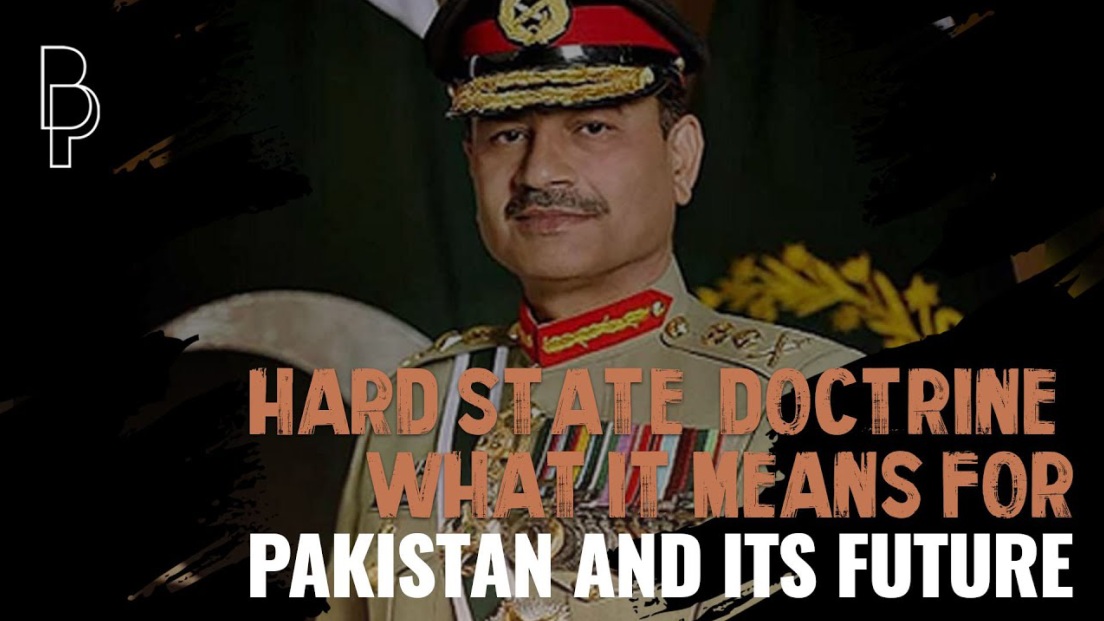
Pakistan’s recent trajectory demonstrates that the consolidation of the hard state is no longer an episodic response to political crises but an increasingly coherent model of governance. The designation of the Jammu and Kashmir Joint Awami Action Committee (JKJAAC) as a terrorist organisation, the widespread deployment of anti-terrorism legislation against political actors and journalists, the suppression of protests in Pakistan-administered Kashmir, communications blackouts and the growing restrictions on civil society collectively illustrate a state that is progressively relocating the management of political disagreement from the democratic arena to the security apparatus. Considered individually, each measure may be justified by the authorities as a response to a specific security challenge. Taken together, however, they reveal a broader transformation in which security increasingly functions not merely as a public policy objective but as the principal source of political legitimacy.
Yet the significance of Pakistan extends well beyond South Asia. Its experience should not be viewed simply as another case of democratic backsliding or authoritarian consolidation. Rather, it raises a broader question about the evolution of statehood itself. Across the international system, governments are responding to terrorism, irregular migration, geopolitical rivalry, cyber threats, hybrid warfare and economic uncertainty by expanding executive authority and strengthening security institutions. Although the constitutional safeguards, political motivations and institutional constraints differ substantially from one country to another, the underlying trajectory is remarkably similar: security is becoming the dominant organising principle of governance.
This does not mean that liberal democracies and authoritarian regimes are converging into the same political model. They are not. The decisive distinction remains the resilience of constitutional checks and balances, judicial independence, political accountability and the effective protection of fundamental rights. Nevertheless, the expanding centrality of security in public policy suggests that the traditional balance between liberty and authority is being fundamentally recalibrated across a growing number of political systems.
Pakistan may ultimately prove to be less an exception than an early indicator of a broader transformation already reshaping the international order. The fundamental question is therefore no longer whether Pakistan has become a hard state. The more consequential question is whether the twenty-first century will ultimately be remembered as the era in which the hard state ceased to be the exception and became the new normal of international politics.
About the author
Dimitra Staikou is a Greek lawyer, journalist, and professional writer with extensive expertise on South Asia, China, and the Middle East. Her analyses on geopolitics, international trade, and human rights have been published in leading outlets including Modern Diplomacy, HuffPost Greece, Skai.gr, Eurasia Review, and the Daily Express (UK). Fluent in English, Greek, and Spanish, Dimitra combines legal insight with on-the-ground reporting and creative storytelling, offering a nuanced perspective on global affairs.
SOURCE: Dimitra Staikou