
The whole street beams in colourful lights; every stall has its own speciality, and tourists from India and beyond experience the charm of this street during the holy month
evening. Thousands of people from The City of Joy (as Kolkata is known), other parts of India and even across the globe, gather on Zakaria street, which is near the historic Nakhoda mosque, built in 1926.
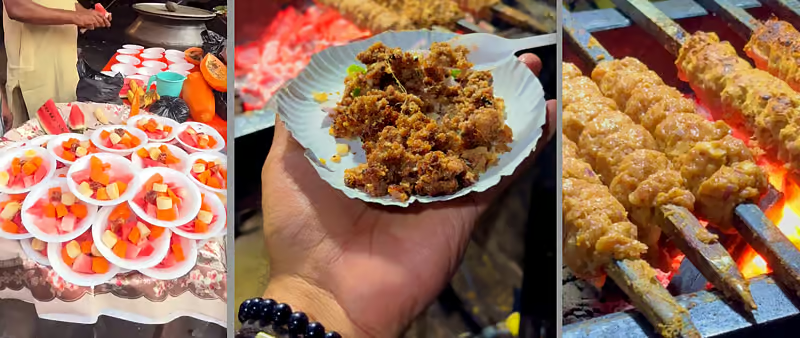
Park Circus and Chandni Chowk are other neighbourhoods where visitors can be found till early morning. Besides many traditional restaurants serving food, more than a hundred street food outlets sprout during Ramadan, serving dishes inspired by Mughlai, Awadhi and Afghani cuisine. They include kebabs, haleem, halwa, sewai, lachcha paratha, sheermal, and bakarkhani roti.
As popular Kolkata blogger ‘foodie.da_calcutta’ remarked, “Zakaria street is surely viral for a reason. The whole street lit up in colourful lights, every stall here has its own speciality during Ramadan.”
Tourists from across the country experience the charm of Zakaria street during the holy month, enjoying Sharbat, Sewai, fruits, Kebabs, Roti, Nihari, Naan. “Uncountable things are available here,” he added.
Grilled kebabs are among the most popular dish and a large number of people form long queues outside outlets selling the smoky kebabs. Mohammad Yahya, a popular digital creator, pointed out that having food on Zakaria Street is an amazing experience.
One of the most popular places on the street is Sufia, whose ‘magaz haleem’ (a variation of the traditional Hyderabadi ‘haleem’) draws a large number of people. At the Shiraz Golden restaurant at Park street, there are long queues for mutton ‘shahi haleem’ along with the fluffy ‘khamiri rotis’.
Named after Haji Zakaria
Zakaria street was named after Haji Zakaria, a trader and a member of the Kutchi Memon community. A well-known political figure of his time, he also fought for poor Muslims in erstwhile Calcutta.
During the British era (and when Calcutta was the capital of British India), Zakaria Street was dubbed ‘Black town’, in contrast to ‘White town’ which included areas like Dalhousie Square, which was home to British elite. But Zakaria Street was also close to the homes of Indian leaders, including Rabindranath Tagore and Raja Ram Mohan Roy.
Among the most popular dishes on this busy road are mutton haleem (offered in large dekchis, traditional subcontinental cooking vessels), boti kababs (a traditional meat dish across the subcontinent), mutton biryani, chicken chaap, fitni (matka) and shahi tukdas.
Besides these delicacies, visitors can also enjoy fruits, fritters (piyaji, potato cutlets), watermelons, pineapples and sherbets. Dates are also found in abundance, including ajwa, mejdool and kimia. And then to top it all off, there are ‘mohabbat ka sherbet’ (Love sherbet), golden and white lachhas (flaky, multi-layered flatbread), and sevaiyan (thin pasta used to make puddings).