
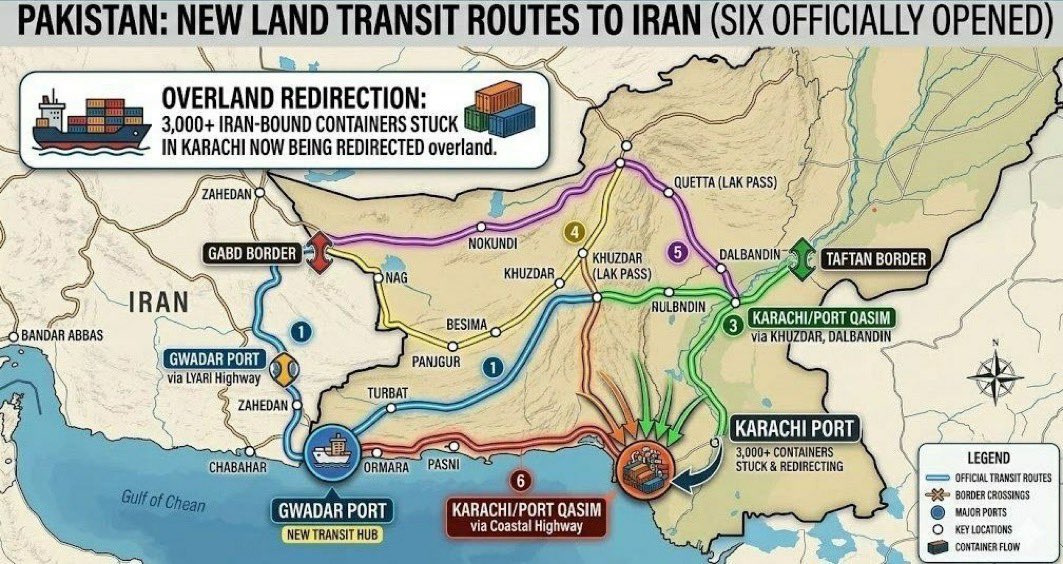
Pakistan’s decision to open six land routes to Iran is being presented by Islamabad as a technical trade measure. In reality, it is much more than that. It is a geopolitical maneuver built almost entirely on the back of Balochistan — a province the Pakistani state has long treated less as a homeland of the Baloch people and more as a corridor, a military zone, a resource base, and a bargaining chip. On April 25, 2026, Pakistan’s Ministry of Commerce issued the Transit of Goods through Territory of Pakistan Order 2026, bringing it into immediate effect. The order formalizes the movement of third-country cargo — goods not originating in Pakistan — from Pakistani ports to Iran by road. The timing is crucial. With maritime routes under pressure because of regional tensions and restrictions around the Strait of Hormuz, Pakistan has opened a land-based alternative that allows cargo destined for Iran to move through its territory. But the map tells the real story. Every significant route runs through Balochistan.
The six corridors connect Karachi, Port Qasim and Gwadar to Iran through the border crossings of Gabd and Taftan. The most direct route, Gwadar-Gabd, is only about 89 kilometres and can reportedly be covered in two to three hours, offering major savings in cost and time. Other routes move along the coast through Lyari, Ormara and Pasni toward Gabd, while inland corridors pass through Khuzdar, Dalbandin, Quetta, Turbat and Panjgur toward Taftan or Gabd. These roads use existing arteries such as the N10 coastal highway and connect directly to Iranian infrastructure.
For Islamabad, this is strategic geography. For the Baloch, it is yet another example of their land being used without their consent.
Balochistan has always occupied a paradoxical place in Pakistan’s imagination. It is described as remote when its people demand rights, but central when the state needs ports, minerals, military routes, energy corridors or strategic depth. It is neglected when the discussion is about schools, hospitals, water, jobs and political autonomy, but suddenly indispensable when the discussion turns to Gwadar, China-Pakistan Economic Corridor projects, Iran, Afghanistan, the Arabian Sea or regional logistics.
The new Iran transit routes deepen this contradiction. Pakistan is using Balochistan to present itself as an indispensable regional hub. It is telling Iran that it can provide relief from maritime pressure. It is telling the United States and other powers that it remains too geographically important to ignore. It is telling China that Gwadar and Balochistan remain central to long-term connectivity. Yet it is telling the Baloch people very little.
There is no meaningful evidence that the people of Balochistan have been treated as stakeholders in this decision. The corridors pass through their land, expose their towns and roads to greater militarisation, increase the value of infrastructure already viewed by many locals as extractive, and create new security risks. But the benefits will likely flow upward — to Islamabad, the military establishment, transport contractors, customs networks, politically connected business groups and external actors. The burdens will remain local.
This is why the land routes must be understood not just as trade corridors, but as instruments of control.
The Gwadar-Gabd route is especially revealing. Gwadar is often sold by Pakistan as the future of regional trade. But for many Baloch, Gwadar has become a symbol of exclusion. A coastal city that should have empowered its local population has instead become associated with checkpoints, restricted access, outside settlement pressures, Chinese strategic interests and economic promises that rarely reach ordinary residents. Now Gwadar is being positioned as a key outlet for Iranian-bound cargo, further increasing its geopolitical value without necessarily improving the lives of the people who live there.
The inland routes tell a similar story. Quetta, Khuzdar, Dalbandin, Turbat and Panjgur are not just points on a transport map. They are places shaped by conflict, disappearances, insurgency, military pressure, underdevelopment and distrust between the Baloch population and the Pakistani state. To describe these routes merely as “logistics corridors” is to erase the political reality through which they pass.
Security concerns are already central to the project. Pakistan has reportedly intensified patrols along these routes because they cross areas with a long history of separatist activity, including attacks by Baloch insurgent groups. This is not a minor operational challenge. It is the core contradiction of the entire plan: Pakistan wants to use Balochistan as a strategic corridor while failing to address why so many Baloch reject Islamabad’s authority in the first place.
A corridor cannot be stable if the people living along it see it as another form of occupation.
The Pakistani state usually responds to this problem with force. More convoys, more checkpoints, more paramilitary deployments, more intelligence operations, more road security. But security imposed from above does not create legitimacy. It may protect a convoy for a day, but it cannot turn an alienated population into willing partners. In fact, each new layer of militarisation risks reinforcing the Baloch perception that their homeland is being transformed into a guarded passageway for others.
The economic argument is also weaker than Islamabad claims. Supporters of the routes will argue that more transit means more activity, more jobs, more trade and more revenue. In theory, that could be true. In practice, Balochistan’s history suggests caution. The province has seen repeated waves of resource extraction and strategic investment — gas, minerals, ports, roads, CPEC — yet remains among Pakistan’s most deprived regions. If past patterns continue, the new corridors will generate movement across Balochistan rather than development within Balochistan.
There is a difference between a road that passes through a land and a road that serves its people.
The informal economy along the Pakistan-Iran border further complicates the picture. Iranian fuel smuggling through motorcycles, pickups and unofficial crossings has long been a survival economy for many communities in Balochistan. Queues at crossings such as Pir Kor reflect not only illegality but also deprivation. When formal state corridors are opened for large-scale cargo while local informal livelihoods remain criminalised or selectively tolerated, the message is clear: the state protects strategic trade, not local survival.
The broader geopolitical context makes the situation even more sensitive. These routes help Iran reduce the pressure of maritime restrictions. They also give Pakistan renewed leverage with Tehran, Washington, Beijing and Gulf capitals. Islamabad can present itself as useful to all sides: a mediator to the United States, a lifeline to Iran, a partner to China, and a security actor to the Gulf. Once again, Pakistan turns geography into bargaining power.
But the geography is Balochistan.
That is the central point. Pakistan’s leverage is built on a territory where its own legitimacy is deeply contested. Islamabad wants the world to see Balochistan as a corridor. The Baloch see it as a homeland. These two visions are not compatible unless the Baloch people are given political dignity, economic rights and genuine control over their land and resources.
The opening of the Iran routes may strengthen Pakistan-Iran trade ties, but it also exposes Pakistan’s greatest vulnerability. The state can issue orders from Islamabad. It can mark routes on a map. It can deploy forces and announce customs procedures. But it cannot erase the fact that these roads run through a province where many people view the Pakistani state not as a protector, but as an extractor.
This is why Balochistan matters far beyond the immediate logistics of the Iran corridor. It is the place where Pakistan’s strategic ambition collides with its internal weakness. The state wants to be a regional hub, but it has not built a just relationship with the region that makes that hub possible. It wants to profit from Balochistan’s location, but it has failed to respect Balochistan’s people. It wants to secure roads, but it has not secured trust.
For the Baloch, the issue is not whether goods move from Gwadar to Gabd, or from Karachi to Taftan. The issue is who decides, who benefits, who is displaced, who is policed, and who pays the price when great-power games pass through Baloch land.
The new corridors may help Iran breathe. They may help Pakistan regain diplomatic relevance. They may help Islamabad present itself as indispensable. But they also sharpen the Baloch question: can a state continue to use a people’s homeland as a strategic asset while denying those people meaningful agency?
Pakistan believes Balochistan is its route to regional importance. It may instead discover that Balochistan is the limit of that ambition.
Because roads can be built by order. Legitimacy cannot.