

On June 6, Senior Sindh Minister Sharjeel Inam Memon sharply criticised Pakistan’s federal government for what he calls a“low priority” approach toward Karachi. His statements underscores the widening fault lines between provincial and federal authorities over infrastructure funding and urban development. Sharjeels’ remarks highlight a deeper political tension: Pakistan’s largest metropolis, the financial, industrial, and maritime hub of the country, continues to shoulder immense economic burdens while being starved of the investment and planning required to sustain its livability. The debate has brought into focus issues of fiscal distribution, governance, and the future of a city that remains central to Pakistan’s economic survival.
Karachi’s predicament is stark. Despite being the country’s main port city and gateway for trade, it has been bypassed in the development of the national motorway network. “When you have to start a motorway, you should start it from Karachi,” Memon lamented, noting that the city has been excluded from projects that could ease its crippling transport congestion. Heavy freight traffic from across Pakistan converges on Karachi, damaging its already fragile infrastructure. The provincial government has attempted to respond with projects such as the Shahrah-i-Bhutto corridor and plans for a transport terminal on the Northern Bypass, but these piecemeal measures cannot mask the scale of the crisis. The city’s arteries remain clogged, its roads battered, and its commuters trapped in a cycle of daily hardship.
The transport crisis is compounded by Karachi’s worsening water shortages. The metropolis requires 650 million gallons per day (MGD) but currently receives only 610 MGD, leaving a shortfall of 40 MGD. Repeated breakdowns at the Dhabeji Pumping Station have deepened the crisis, forcing millions of residents to rely on expensive private tankers. Ahead of Eid, outages cut supply by more than 100 MGD, sparking outrage from citizens and political parties alike. Lawmakers from the Muttahida Qaumi Movement-Pakistan (MQM-P) condemned the provincial government’s “incompetence, negligence and mismanagement,” describing the shortfall as a “serious administrative failure.” For ordinary Karachiites, the consequences are immediate and brutal: households without water, soaring costs, and a daily struggle to secure the most basic of necessities.
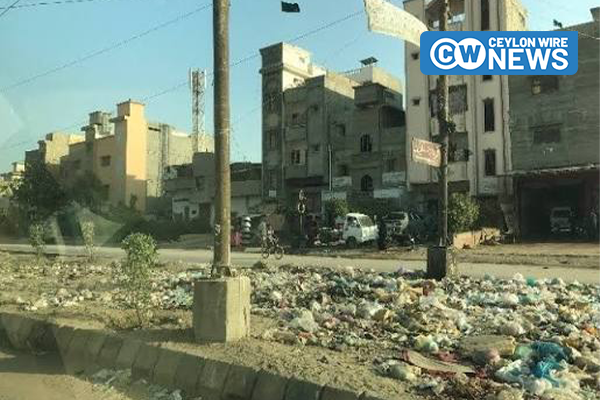
More than a week after Eidul Azha, animal offal and sacrificial waste continued to rot in open spaces and garbage collection points, filling entire districts with a foul stench. Authorities failed to apply lime or properly clean disposal sites, leaving residents to endure headaches, nausea, and constant discomfort. In Orangi Town, decomposing remains were found along the boundary walls of a government girls’ college, raising fears of health hazards. The episode illustrates a broader truth: Karachi’s civic infrastructure is not only inadequate but often absent, leaving citizens exposed to indignities that erode both public health and social life.
Overlaying these crises is the intensifying urban heat effect. Prof. Zafar Fatmi of Aga Khan University has warned that Karachi’s built environment, concrete sprawl, traffic congestion, loss of trees, and shrinking open spaces has created a heat island that magnifies global climate change.
Studies show that Karachi has the highest urban-rural temperature difference among major Pakistani cities, around 4.5°C, with delivery riders and rickshaw drivers experiencing temperatures far above recorded averages. The city is literally being built to absorb and retain heat, worsening health risks and productivity losses. Combined with water shortages, the heat crisis is pushing Karachi’s residents into a precarious struggle for survival.
The cumulative effect of these failures is reflected in global rankings. Karachi consistently lands in the bottom five of the Economist Intelligence Unit’s Global Liveability Index, scoring just 42.7 out of 100. It is routinely compared with cities like Lagos, Tripoli, and Damascus, places synonymous with instability and hardship. The Asian Development Bank has similarly assessed that Pakistan’s urban centres are becoming increasingly inefficient, with Karachi marked by congestion, unattractiveness, and pollution.
Class divisions elites retreat to cantonment areas and private housing societies, while low-income groups are pushed into overcrowded districts like Karachi East deepen the metropolis’s malaise. Ethnic and religious divisions further fracture the city, fueling outbreaks of violence. Forbes recently ranked Karachi as the second riskiest city for tourists worldwide, citing high personal security risks, poor infrastructure, and economic vulnerabilities.
The federal government’s reluctance to prioritize the city in national development projects, combined with provincial mismanagement, has left Karachi’s infrastructure overstretched and its residents underserved. Migration from across Pakistan continues to swell the city’s population, intensifying pressure on housing, transport, and water systems. Yet governance remains reactive, focused on short-term fixes rather than structural reform. The result is a metropolis that is both indispensable to Pakistan’s economy and increasingly unlivable for its people.
The political debate sparked by Memon’s remarks thus carries profound implications. Karachi is not merely another provincial capital; it is the engine of Pakistan’s trade, industry, and finance. Its ports connect the country to global markets, its factories drive industrial output, and its streets absorb waves of migrants seeking opportunity. To treat Karachi as peripheral in national planning is to undermine Pakistan’s economic stability itself. The city’s crises in terms of transport congestion, water shortages, sanitation failures, heat stress, and insecurity are interconnected symptoms of a governance model that has failed to match resources with responsibilities. If Karachi continues on its current trajectory, the consequences will reverberate far beyond Sindh. Economic productivity will falter, public health will deteriorate, and social tensions will deepen. In the absence of sustained investment, coordinated governance, and a recognition of Karachi’s centrality to Pakistan’s future, the metropolis risks becoming a cautionary tale of urban collapse.