
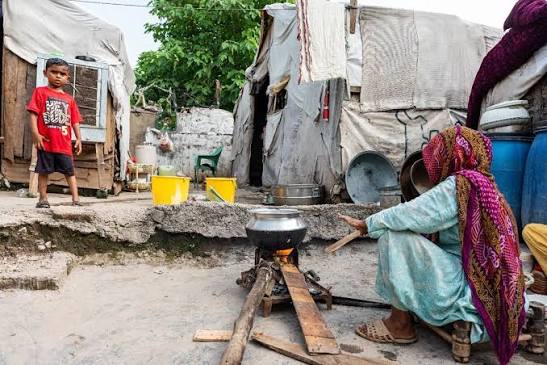
Pakistan now measures its own poverty against a line of PKR 8,484 a month. According to the Pakistan Economic Survey, that is the consumption a single adult needs to meet the most basic food and non-food requirements, calculated through the cost of basic needs approach rather than from anyone’s pay slip, and it works out to roughly PKR 283 a day. Set the threshold there and the official tally turns more forgiving. Even so, the same survey puts about 70 million Pakistanis below it, a poverty rate of 28.9 percent that is the highest in eleven years and almost a third higher than the 21.9 percent recorded at the previous survey in 2018-19. The state has not reduced the hardship its people face. It has fixed the line at which hardship is allowed to register, then pointed to macroeconomic stability as if the two were unrelated.
The choice of line matters more than it first appears. In 2021 purchasing-power-parity terms, the PKR 8,484 threshold is worth about $3.50 a day, which sits below the World Bank’s $4.20-a-day lower-middle-income line, the standard the Bank applies to countries at Pakistan’s income level, though above its $3.00-a-day line for extreme poverty. That gap is the whole argument. World Bank data, released in June 2025 after the Bank updated its global poverty lines to 2021 PPP, show 44.7 percent of Pakistanis below the $4.20 line, up from 39.8 percent under the old $3.65 measure, and 16.5 percent below the $3.00 extreme-poverty line, up from 4.9 percent. By the lower-middle-income standard, in other words, close to half the country is poor, more than 100 million people, against the 28.9 percent the national line admits. The two counts do not describe different populations so much as different thresholds, and Pakistan has chosen the lower one.
Both numbers should be read with their vintages in mind. The national figure is drawn from a Household Integrated Economic Survey conducted in 2024-25, so it captures recent conditions. The World Bank’s headline percentages still rest on a survey conducted in 2018-19, the last before this one, which means they predate the worst of the post-pandemic inflation and the 2022 floods that at their peak submerged roughly a third of the country. If anything, the international figure understates how far living standards have since fallen.
The disclosure of the bad news has been muted. The updated national count did not accompany the June 2025 budget. Preliminary estimates were released by the Planning Ministry only in February 2026 and formalized in the Economic Survey 2025-26 this June. As one economist observed in Dawn, the reversal arrived as a single row in a social-protection table, even as ministers led with 3.7 percent GDP growth and rebuilt reserves, and independent analysts have urged the government to restore the survey’s historical once-every-two-years rhythm. None of this proves concealment, but the pattern is consistent with a state that publishes its most uncomfortable statistic quietly and late. Islamabad’s spending choices suggest that citizens’ hardship ranks below other claims on the budget.
Those claims are not hard to locate. Budget documents show that of the PKR 18.77 trillion federal outlay for 2026-27, tabled on 12 June, defence took PKR 3 trillion, a 17.65 percent increase, lifting military spending to about 2.08 percent of GDP, the largest allocation in the country’s history and worth roughly $10.8 billion. The fastest-growing line, as Dawn and the Express Tribune reported from the budget papers, is the physical-assets head that funds arms, ammunition and equipment, up nearly 40 percent to Rs925.83 billion, almost 31 percent of the defence budget. That figure sits apart from Rs822 billion in military pensions and a further Rs319 billion for the Armed Forces Development Programme. Against the Rs838 billion allotted to the Benazir Income Support Programme, the entire federal safety net, the ordering is stark. Core defence spending is more than three and a half times what the state commits to keeping its poorest households afloat, and nearer five times once pensions and the development programme are added.
The government’s case for this is not frivolous. Finance Minister Muhammad Aurangzeb tied the increase to last year’s military confrontation with India, and Defence Minister Khawaja Asif defended it as a national necessity, citing tensions with India, a deteriorating border with Afghanistan and persistent militant violence. India, for its part, has budgeted around $86 billion for defence, and Pakistani planners argue that credible deterrence is not optional. All of that can be granted. What it does not explain is why deterrence should require defining the poor out of the official count, or why the safety net should grow at a fraction of the pace of weapons procurement. A state can fund its defences and still measure its deprivation honestly. The problem is the relative weight, not the existence, of the threat.
There is an external audience too. Pakistan is in the second year of a 37-month Extended Fund Facility with the International Monetary Fund, and the IMF’s third review, completed in May 2026, cleared about US$1.1 billion under the facility and a further US$220 million under the linked Resilience and Sustainability Facility. IMF documents build the program around fiscal consolidation, a primary surplus of about 1.6 percent of GDP this year, and a floor on social-protection spending channeled through BISP. A government able to present poverty as contained and its safety net as expanding tells a more reassuring reform story, even though the Fund’s own staff note domestic concerns about the still elevated poverty rate. The incentive is not so much to lie about poverty as to frame it favorably.
None of this feeds anyone. A household whose consumption edges just over the line is no less hungry for being reclassified. Income inequality is now the widest in 27 years, with the national Gini coefficient up from 28.4 to 32.7, and average real household income fell about 12 percent between the two surveys, from Rs35,454 to Rs31,127 a month. The floods and price shocks the headline numbers struggle to capture are not abstractions to the families living through them.
Pakistan has done close to the opposite of what candid accounting would require. It could measure itself against the lower-middle-income standard its economy actually occupies, publish its surveys on schedule rather than at political convenience, and match the urgency of its spending to the urgency of its numbers. Instead it has discovered that the simplest way to shrink poverty is to draw the line beneath it, and the simplest way to keep financing the military is to insist that fewer people are going hungry than plainly are.