
Pakistan faced criticism from different quarters after it carried out several military attacks inside Afghanistan, which led to the deaths of innocent civilians, violated territorial sovereignty, and added fuel to regional instability, especially, when the US-Iran conflict was at a critical stage. Pakistan’s action was labelled as a war crime as Islamabad found to have violated humanitarian norms and international laws. The Islamabad government also faced backlash at home in Pakistan for its wrong policies.
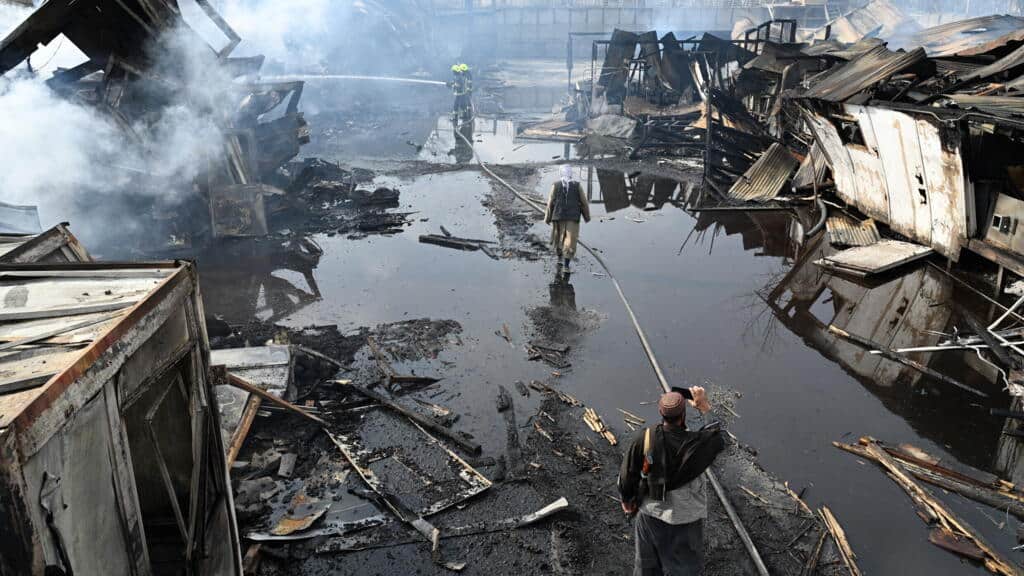
The European Union (EU) came down heavily on Pakistan after an airstrike on Omid Drug Rehabilitation centre in Kabul killed over 400 civilians in mid-March. “Civilian and medical facilities must never be targeted as they are protected under international humanitarian law, including the Geneva Conventions,” said Kaja Kallas, vice president of the European Commission, the executive branch of the EU.
Human Rights Watch (HRW) called the Pakistani airstrike an unlawful attack and a possible war crime, and demanded that those responsible for the deaths of patients be held accountable. “The available evidence indicates that the Pakistani airstrike against a well-known Kabul medical facility killing dozens of patients was unlawful,” said Patricia Gossman, senior associate Asia director at HRW.
HRW said hospitals and clinics have special protection under the laws of war, and there was no evidence that the Omid centre was being used for military purposes. “Serious violations of the laws of war committed with criminal intent—that is, deliberately or recklessly—are war crimes,” it said. “Pakistan has an obligation under international law to investigate alleged war crimes by its forces.”
The EU has asked Pakistan to ensure civilians and civilian infrastructure are protected and to prevent further civilian harm. In earlier attack in late February, Pakistani carried out first large-scale airstrikes inside Afghanistan, targeting civilian infrastructure including schools. According to the United Nations, at least 56 Afghan civilians, including 24 children, were killed, and 129 were injured and over 100 schools were forced to shut.
UN Human Rights Chief Volker Türk called for obligations under international human rights law and international humanitarian law to be followed. Richard Bennett, the UN Human Rights Council’s special rapporteur on Afghanistan, sought “an immediate, independent and transparent investigation” into the Pakistani airstrikes and demanded action against those responsible.
Political analyst Gul Mohammaduddin Mohammadi said “In war, killing civilians or causing casualties among women and children is against UN principles, human rights, and human values, and such actions are not justifiable from an Islamic perspective either.”
Pakistan asserted that the airstrikes targeted terror camps, saying they were “precise and carefully undertaken to ensure no collateral damage is inflicted.” Pakistani Information Minister Attaullah Tarar said “No hospital, no drug rehabilitation centre, and no civilian facility was targeted.” However, the ground realities appeared quite different and horrific.
The Pakistani missiles hit innocent people and civilian infrastructure such as schools, homes and medical facilities. Georgette Gagnon, officer-in-charge of the UN mission in Afghanistan, said the destroyed facility was “a well-known rehabilitation centre” operated by the government. “Our colleagues who visited the place found widespread destruction, including complete destruction of one block that housed adolescents receiving drug treatment,” she said.
Iran expressed concerns over the Pakistani bombing and violating territorial integrity and national sovereignty. It said it would “exacerbate insecurity in the surrounding region and entail broader humanitarian and security repercussions for the entire region.” Even Pakistan’s ally China advised it against the use of force and urged it to switch to dialogue.
The Islamabad government received strong criticism within Pakistan as well for its ill-founded military action. Maulana Fazlur Rehman, the leader of Jamiat Ulema-e-Islam Pakistan, said Islamabad’s attempts to overthrow the governments in the Afghanistan government was misguided and ineffective.
Several political leaders in Pakistan including legislators issued a joint statement, calling the airstrikes an “undeclared war” which they said endangered civilian lives. Mian Iftikhar Hussain, the provincial leader of Pakistan’s Awami National Party, said the consequences of military action could have serious consequences. “A war can be started, its end is not in the hands of the one who begins it and depends on circumstances,” Hussain said