
In August 2016, the late Japanese Prime Minister Shinzo Abe stood before the Tokyo International Conference on African Development (TICAD) in Nairobi and spoke of “the enormous liveliness brought forth through the union of two free and open oceans and two continents.”
It was the formal birth of the Free and Open Indo-Pacific (FOIP) concept, a framework since adopted by the United States, Australia, the European Union and dozens of other nations.
At its core, FOIP seeks to preserve a rules-based international order against the growing influence of revisionist and coercive powers.
Among the four Quad founding partners, the United States brings military pre-eminence, Japan brings institutional credibility and Australia anchors the southern flank. India’s contribution to FOIP is something else entirely—and far harder to replace.
Geographic Advantage
India’s coastline stretches over 7,500 kilometres facing the Indian Ocean on three sides. Its Andaman and Nicobar Islands sit at the western approaches of the Strait of Malacca, a waterway that sees more than 96,000 vessel transits annually and through which roughly one quarter of the world’s seaborne trade passes.
Together with the Strait of Hormuz, these two chokepoints account for over 60% of the world’s oil flows. No other Quad nation occupies a comparable position near either of them.
India’s Andaman and Nicobar Command, the country’s first tri-service theatre command, was built precisely to operationalize this geography.
The Indian Navy maintains a permanent deployment at the Strait of Malacca’s exit to monitor extra-regional naval movements. In late 2025, India began construction of a second dual-use airfield on Great Nicobar Island at Galathea Bay, closer still to the Malacca approaches.
The reason this matters so acutely is China’s “Malacca Dilemma.” Over 80% of China’s oil imports transit this strait. That means any credible Indian naval presence near that chokepoint represents structural leverage that no other Quad partner can exercise from comparable proximity. FOIP’s maritime architecture, without India holding this position, rests on a foundation with a significant gap in the middle.
India’s Own Rules-Based Vision
What often goes unacknowledged in Western discourse on FOIP is that India did not arrive at this framework merely as a junior partner absorbing someone else’s doctrine.
In March 2015, two years before the United States formally adopted FOIP, Prime Minister Narendra Modi articulated SAGAR (Security and Growth for All in the Region) from Port Louis, Mauritius. The doctrine prioritizes trust, respect for international maritime norms, peaceful dispute resolution, and cooperative security in the Indian Ocean. It was, in essence, India’s own rules-based order doctrine, rooted in its immediate strategic neighborhood.
Over the decade that followed, the Indian Navy advanced SAGAR through anti-piracy operations in the Gulf of Aden, humanitarian missions, COVID-19 relief dispatched to Mauritius, Maldives, Madagascar, Comoros, and Seychelles, and a network of coastal surveillance radars installed across IOR littoral states from Sri Lanka to Bangladesh.
In March 2025, India expanded this into MAHASAGAR (Mutual and Holistic Advancement for Security and Growth Across Regions), a framework explicitly designed as an inclusive alternative to China’s Belt and Road Initiative.
Practical implementation followed quickly. The AIKEYME (Africa-India Key Maritime Engagement) naval exercise with Tanzania in April 2025 brought in ten African nations, while India’s IOS SAGAR mission conducted joint EEZ patrols with personnel from African and South Asian navies.
The China Variable and the Autonomy Paradox
China’s “String of Pearls” strategy is, at its operational core, a strategy directed at India. The network of Chinese-funded ports at Gwadar in Pakistan, Hambantota in Sri Lanka, Kyaukpyu in Myanmar, and Chittagong in Bangladesh encircles India’s maritime perimeter.
Since 2008, Beijing has sent more than 45 naval missions to the Indian Ocean Region, and China now operates at least 13 ports across it.
India’s response, its own “Necklace of Diamonds” counter-strategy, its logistics agreements with Australia, France and Japan, its coastal radar networks, its naval base deal in Seychelles and its BrahMos missile sales to the Philippines (with deliveries beginning in 2024), constitutes the most proximate and credible structural pushback to Chinese maritime revisionism in the region. No other Quad partner can do this from India’s position.
Yet India has insisted on maintaining strategic autonomy. It has not joined AUKUS, continues purchasing Russian arms, remains active in BRICS and the Shanghai Cooperation Organisation, and approaches Sino-Indian border disputes bilaterally. For some FOIP advocates, this may be largely read as a frustrating ambivalence.
India’s refusal to become a formal American security ally is precisely what prevents FOIP from being dismissed across the Global South as a Western containment project. Analysts argue that FOIP is also often interpreted as a framework for countering China, and that emphasizing inclusivity is essential to its credibility as a region-wide organizing principle.
India’s participation, on its own terms, signals to fence-sitting nations across ASEAN, Africa and South Asia that FOIP is not a binary Cold War choice.
A Voice the West Cannot Replicate
India’s standing in the Global South is the final and perhaps most underappreciated dimension of its FOIP centrality. As the world’s fifth-largest economy in 2025, the most populous democracy on earth, and the current BRICS chair for 2026, India speaks to developing nations from a shared experience of colonialism, resource constraint, and the desire for a multipolar world order that does not simply swap one hegemon for another.
Many of the states whose alignment with FOIP principles matters most—across the Indian Ocean Islands, ASEAN, and Africa—will not be won over by American security architecture or Japanese ODA loans alone. India’s development diplomacy, its digital infrastructure exports, vaccine cooperation, naval capacity-building and the MAHASAGAR framework offer partnership without strategic debt, without which the ideals of FOIP will always remain incomplete.
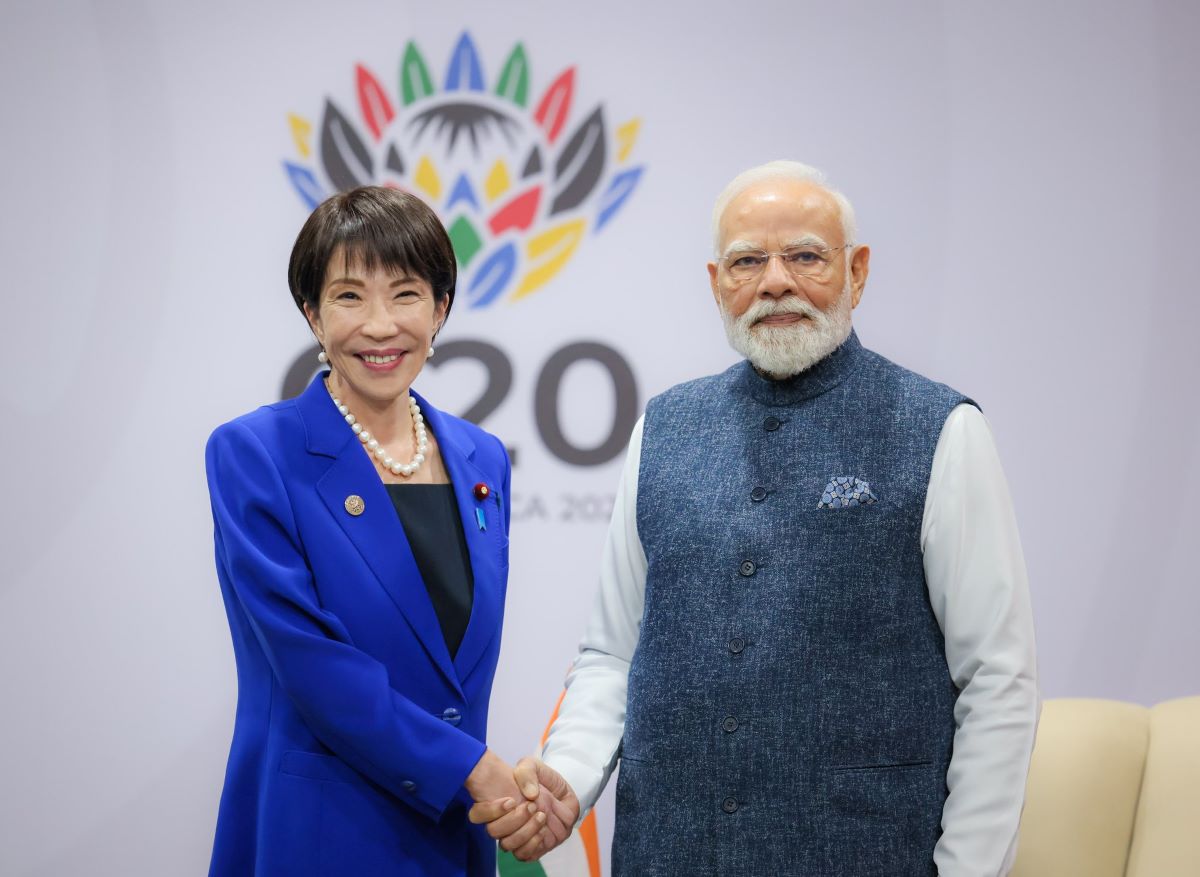
Japanese Prime Minister Sanae Takaichi has emphasized that FOIP is the core of her foreign and defense policy, and her administration seems to be making tremendous efforts to advance it.
Amid growing uncertainty over US reliability under President Donald Trump, Prime Minister Takaichi’s role and that of FOIP is vital for the stability and prosperity of this region, if not for the world.