

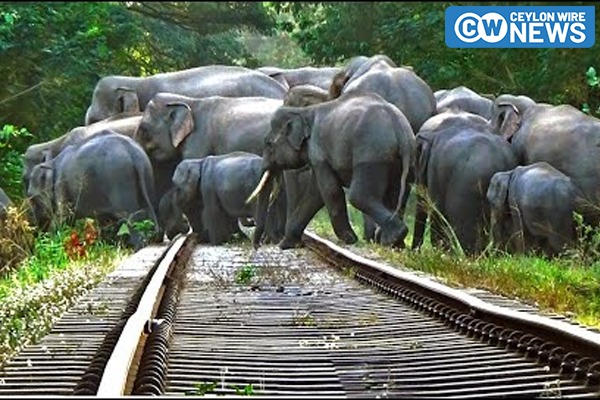
The Court of Appeal has issued a Writ of Mandamus directing the Acting Director General of Wildlife and the Central Environmental Authority to ensure that the General Manager of Railways submits an Environmental Impact Assessment report outlining revised measures to prevent wild elephants from colliding with trains in the Northern, Eastern, North Central and North Western provinces.
In a ruling delivered by Judge Frank Gunawardena, the court issued several orders under the Fauna and Flora Protection Ordinance and the National Environmental Act.
The court ordered the Department of Wildlife to formulate a management plan for national wildlife reserves, with the relevant authorities required to submit periodic progress reports to the court.
It also ordered the appointment of an interim committee comprising a representative of the Attorney General, civil society representatives and elephant experts. The committee is tasked with identifying railway sections where train-elephant collisions are most likely to occur and developing an urgent framework to establish speed-restricted zones.
The committee is also authorised to recommend appropriate disciplinary and legal action against train drivers who operate at excessive speeds or fail to exercise due care, including along known elephant crossing routes, resulting in elephant deaths or injuries.
Furthermore, the court directed railway officials to receive awareness training on preventing such accidents and ordered the implementation of both technical and non-technical preventive measures.
The public interest litigation was filed by the Centre for Environmental and Cultural Studies following an incident on April 25, 2025, when the Meenagaya train travelling from Batticaloa to Colombo struck a herd of elephants. Six elephants died at the scene, while several others sustained serious injuries.
The court also observed that the question of whether an animal can seek a judicial declaration of its rights remains unresolved. However, it noted that some foreign jurisdictions have recognised fundamental rights, including the right to life, for animals, despite their inability to appear personally in court to lodge complaints.