
Terrorist groups in Pakistan have used the sale of narcotics as a critical source of revenue to support militant activity—with Islamabad’s tacit approval.
When the Soviet Union invaded Afghanistan in December 1979, kicking off the decade-long Soviet-Afghan War and laying the seeds of the Global War on Terrorism, much of the world reacted with fury. The West framed the invasion as a tyrannical communist dictatorship invading a peaceful neighbor, while the Muslim world largely regarded it as an atheist state attempting to crush an Islamic one. As Soviet tanks crossed the border, the United States saw something else: an opportunity to avenge its recent defeat in Vietnam and deliver decisive retaliation in kind against Moscow. As then-National Security Advisor Zbigniew Brzezinski wrote to President Jimmy Carter, “We now have the opportunity of giving to the USSR its Vietnam war.”
To aid in the operation, Carter and successor Ronald Reagan enlisted the aid of Pakistan, Afghanistan’s southern neighbor—then a military dictatorship under Muhammad Zia-ul-Haq, who shared its antipathy toward Moscow. In the decade that followed, vast quantities of American weapons, Arab volunteers, and Gulf petrodollars flowed through Pakistan into Afghanistan to recruit and equip the mujahideen. The arrangement benefited Islamabad in other ways; it gave Pakistan’s Inter-Services Intelligence (ISI) spy agency a steady supply of funds and arms from which to skim in order to pursue its own aims, and the ISI found it easy to convince volunteers intent on defending Muslims in Afghanistan that their efforts would be equally valued against India in the disputed Kashmir region instead.
After the Soviet Union pulled out of Afghanistan in 1989, the flow of foreign money and weapons through Pakistan was abruptly cut off. This posed a problem for Islamabad, which at the time operated multiple militant factions inside Afghanistan and Kashmir. To stay in the black, the ISI turned to an alternate source of revenue: heroin, which was being produced at an industrial scale in Afghanistan and which had helped to fund both the war against the Soviet Union and the ensuing intra-Afghan civil war. The extent to which the US Central Intelligence Agency (CIA) had used this drug trade as a source of funding for the anti-Soviet insurgency remains controversial. What is clear, though, is that after the war, the ISI harnessed it for its own geopolitical ends—a fact acknowledged by former Pakistani Prime Minister Nawaz Sharif, who admitted in a bombshell 1994 Washington Post interview that the leaders of the Pakistan Army and ISI had pressured him into selling heroin in order to finance secret military operations. More than three decades later, the drug trade through Pakistan continues—with the same actors benefiting, for many of the same reasons.
Narco-Terrorism Is Alive and Well in South Asia
Pakistan’s geography makes it an ideal middleman in the Asian drug trade. It sits at a vital location in South Asia, with a porous border with landlocked Afghanistan and easy access to the Arabian Sea via major ports at Karachi, Port Qasim, and Gwadar. For the narcotics trade in particular, Pakistan has an additional advantage: it governs Balochistan’s Makran Coast, which for years has served as a maritime conveyor belt for illicit narcotics to Asia. According to the United Nations Office on Drugs and Crime (UNODC), the Makran Coast, also known as the “southern trafficking route,” moves Afghan-origin narcotics through Pakistan and Iran toward global markets.
“Samiullah,” a pseudonym for an Afghan journalist now living in Berlin but with family remaining in Afghanistan, has watched these narcotics routes for nearly two decades. As he told The National Interest, without drugs and Pakistani assistance, neither the mujahideen nor the Taliban and other militant groups based on Pakistani territory could have lasted for decades in the form they did. The “Golden Crescent”—the opium-producing region spanning Afghanistan, Pakistan, and Iran—doubled as a fount of revenue for terrorism; according to Samiullah, “The same corridors that carried weapons, jihadists, and jihadist ideology also carried opium, heroin, hashish, and methamphetamine.”
Many insurgent movements quickly understood that massive profits could be gained from the Pakistan routes for the drug business. According to the book Seeds of Terror: How Drugs, Thugs, and Crime Are Reshaping the Afghan War by American journalist Gretchen Peters, al-Qaeda operatives in Peshawar took delivery of 2,000 kilograms (4,400 pounds) of processed heroin every two months from the Taliban, earning the group dozens of millions of dollars annually. A 2004 US Congressional report estimated that Osama bin Laden earned an annual income of $28 million from a single heroin supply line—at the same time bin Laden and other al-Qaeda ideologues railed against drug use and accused its enemies of fomenting the drug trade in public. Though bin Laden is long dead, the trade has endured, with other groups filling in for al-Qaeda.
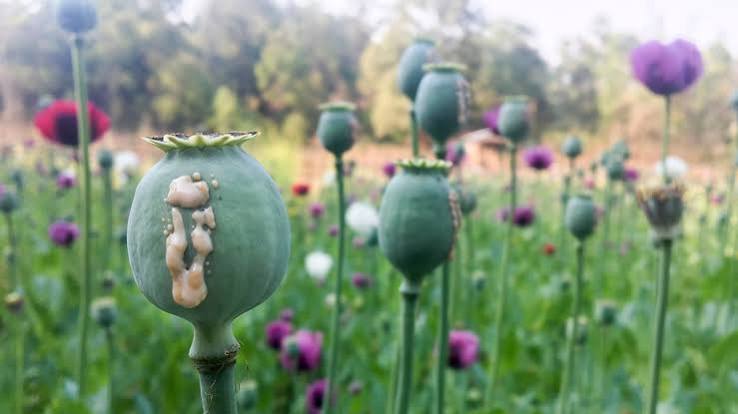
The source of origin of these drugs has invariably been Afghanistan, whose climate is ideally suited for the growth of the opium poppy. In 2021, on the eve of the Taliban’s reconquest, Afghanistan’s poppy fields supplied roughly 80 percent of global opiate demand. The following year, UNODC estimated that the country had 232,000 hectares of land under poppy cultivation. As during their first time in power, the Taliban have made efforts to root out opium; by 2025, UNODC estimated that cultivation had fallen to 10,200 hectares, and total annual production to just under 300 tons. Yet to ascribe this to the goodwill of the Taliban is probably a mistake. Stockpiled opium in Afghanistan from earlier years continued to be sold off, while the shortfall in production has led to record prices—and significant benefits for major traffickers.
As opium cultivation has decreased, other drugs have replaced it. Methamphetamine production has scaled up dramatically in Afghanistan, and countries around the world have begun to feel the impact. In March 2023, more than 250 kg (550 lb) of methamphetamine produced in Afghanistan, with an estimated street value of USD $225 million, was intercepted in Australia. That May, about 2,500 kg (5,500 lb, 2.75 tons) of high-purity methamphetamine, originating in Afghanistan and worth USD $1.77 billion, was seized in India. According to a UN report published in 2023, approximately 29.7 tons of methamphetamine were seized in Afghanistan and neighboring countries over the course of the year, all originating from Afghanistan. The report was not optimistic that most of the exported methamphetamine had been detected and caught.
Within Afghanistan, methamphetamine is produced from a wild plant locally known as Yama or Waman, plants within the family known as Ephedra. The family of plants can be found widely in Afghanistan and serve as an alternative to opium. (The chemical compound pseudoephedrine, an anticongestant used as the base ingredient in illicit methamphetamine production, is found naturally in Ephedra plants, but is typically chemically synthesized for mass production for the pharmaceutical industry.)
Unlike the opium poppy, Ephedra cultivation is not monitored by the UN or other international organizations, so it is unknown how abundant it is. While the plant offers a solid foundation and provides a unique form of methamphetamine, it is somewhat difficult to extract pseudoephedrine from it, requiring vast quantities of harvested plant material for comparatively little base drug material. Accordingly, drug producers in Afghanistan have shifted to laboratory methods, using industrial-grade ephedrine or pseudoephedrine to mix with Ephedra plants in order to offset high production costs. According to Samiullah, methamphetamine production, like opium-processing laboratories, is taking place across the southwestern provinces, and many high-ranking Taliban members have used it as a source of revenue. Factories processing methamphetamine are known to be located in the provinces of Helmand, Farah, Nimroz, Uruzgan, Kandahar, and Zabul, each with local officials taking a cut.
“The widespread export of this drug by traffickers mostly takes place through Pakistan, and many in the Pakistani army are involved in this business,” Samiullah added. “Without the help and cooperation of Pakistani officials, from border authorities to deep government agencies, it would not be possible for it to continue to the extent it does now.”
At times, Pakistan’s own police agencies have seized drugs imported from Afghanistan. Pakistan’s Anti-Narcotics Force has publicized major anti-drug operations, claiming to have seized more than 177 metric tons of narcotics in 2024. The Pakistan Navy has also announced maritime seizures, including hashish, heroin, and methamphetamine, in the North Arabian Sea.
Yet Pakistan’s central role in the drug trade is undeniable. Throughout 2024, India seized 2,596 kg (5,723 lb) of heroin nationwide, with Punjab alone accounting for 1,150 kg (2,535 lb), much of it connected to Pakistan-border trafficking and drone drops. During one high-profile seizure in March, the Coast Guard in Gujarat arrested six Pakistani men after intercepting a boat that had sailed from Pakistan loaded with drugs worth tens of millions of dollars. In 2025, India’s Border Security Force reported seizing hundreds of drones coming from Pakistan into Punjab to drop heroin. And as recently as May 2026, the Indian Coast Guard in Gujarat seized 100 kilograms of cocaine off the Kutch coast after intercepting a ship that had arrived from Port Qasim in Pakistan.
In short, Pakistan has never abandoned the old model of using the drug business for geopolitical ends, but has increasingly needed to intervene when its own people are affected. As with Islamist extremism, which Pakistan sought to nurture as a weapon against its enemies before it found itself in the crosshairs, Islamabad may have created a monster it can no longer control.
How Can the West Combat Pakistan-Based Narco-Terrorism?
Almost every major Pakistan-based Islamist group has been involved with the narco-terror economy. In 2018, Gujarat’s Anti-Terrorism Squad claimed that proceeds from a 300 kg (660 lb) heroin shipment smuggled through the Gujarat coast into northern India were used to fund the activities of Jaish-e-Mohammed (JeM), a Pakistan-based militant group closely tied to al-Qaeda and regarded as a terrorist organization by the UN and most Western countries. The group allegedly cleaned the money through trade so the profits from heroin sales could be passed on to JeM. Lashkar-e-Taiba (LeT), another Pakistan-based terror group, was found to be involved in the Salaya drugs case, after India’s National Investigation Agency alleged that a transnational narco-terror network smuggled 500 kg (1100 lb) of heroin from Pakistan into Gujarat and then moved it to Punjab, with the proceeds used to fund LeT activities.
At the higher financial level, the money from has been cleaned by the professional laundering networks. One of the most important examples is the Khanani Money Laundering Organization. According to the Financial Action Task Force (FATF), an international organization established in 1989 to combat money laundering, Pakistani national Altaf Khanani ran a global laundering network that moved illicit money through Pakistan, the UAE, the United States, the United Kingdom, Canada, Australia, and other countries, and had relationships with Lashkar-e-Taiba and Jaish-e-Mohammed. FATF indicated that drug proceeds were deposited through bank wires from foreign business accounts to hide their source, ownership, and control. The US Treasury sanctioned the Khanani network, saying it laundered illicit funds for drug-trafficking organizations, and terrorist groups around the world.
It is surprising that this matter has not been taken more seriously by the international community. For years, Western politicians have griped about Pakistan’s double-dealing and closeted support for Islamist insurgent movements, but its involvement in the narcotics economy behind these networks has received far less attention.
This is a remarkable oversight. If drugs are helping proxy linked groups survive, move money, recruit fighters, buy weapons, and continue violence across borders, then narcotics cannot be treated only as a law enforcement issue: it is a global security issue, a terrorism-financing issue, and a regional destabilization issue. There is a need for the international community to look at Pakistan’s narcotics corridors with the same seriousness it gives to terrorist safe havens. The question should not only be who carries the drugs, but who protects the routes, who launders the money, who benefits from the networks, and why the corridors remain active.
About the Author: Natiq Malikzada
Natiq Malikzada is a journalist and human rights advocate. He holds an MA in International Relations and an LLM in International Human Rights Law from the University of Essex, which he attended as a Chevening Scholar. Since 2013, he has focused on countering religious extremism and promoting democracy and pluralism. In 2020, he co-founded Better Afghanistan, an organization dedicated to fighting extremism, supporting education, documenting human rights violations, and empowering civil society. The organization also provides a platform for Afghan women’s rights activists to mobilize, engage in dialogue, and advocate for freedom and justice under increasingly repressive conditions.