
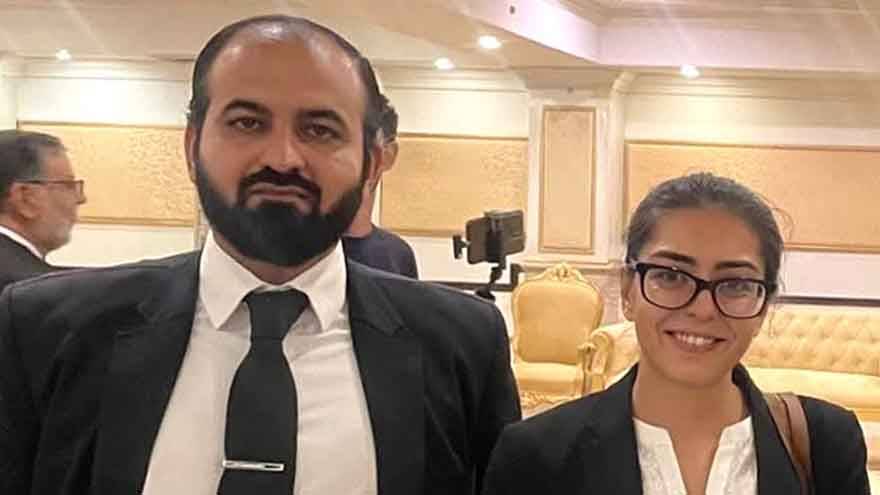
Imaan Mazari and her husband were arrested in Islamabad in early 2026 by Pakistani authorities. The arrests were reportedly linked to allegations stemming from her public criticism of state institutions, including her vocal support for Baloch rights and missing persons, as well as related legal charges. Officials framed the move as a matter of law enforcement, though critics argue it was intended to silence dissent.
The arrest of Imaan Mazari and her husband is not an isolated legal action—it is part of a deeply troubling pattern of repression that continues to define the Pakistani state’s relationship with dissent. It reflects a system that increasingly treats criticism not as a democratic right, but as a threat to be neutralized.
Mazari, a lawyer and outspoken critic of the military establishment, has long been a target of state pressure. Her arrest, alongside her husband, sends a clear message: even those operating within the framework of the law are not immune if they challenge entrenched power. The fact that both were taken into custody raises serious concerns about the misuse of legal provisions to intimidate not just individuals, but entire networks of dissent.
Her consistent advocacy for Baloch rights—particularly her work highlighting enforced disappearances and alleged abuses in Balochistan—has placed her in direct confrontation with the state’s most sensitive security narratives. In Pakistan’s current environment, raising such issues is often treated not as legitimate legal or humanitarian concern, but as subversive activity. That this advocacy appears to have contributed to her arrest underscores how narrow the space for rights-based activism has become.
Human rights organizations have been unequivocal in their condemnation. Amnesty International has repeatedly highlighted how Pakistan’s authorities rely on vague and overbroad laws to silence critics, warning that such arrests are emblematic of a broader crackdown on freedom of expression. As Amnesty has stated in response to such detentions, “the authorities must immediately release all those detained solely for peacefully exercising their human rights,” stressing that dissent cannot be treated as a criminal act.
What makes this case particularly alarming is the normalization of such actions. Arrests of activists, journalists, and lawyers are no longer exceptional—they are becoming routine. Each case reinforces the next, creating an environment where fear replaces open debate. The legal system, instead of acting as a safeguard, is increasingly perceived as a tool of coercion.
There is also a deeper contradiction at play. Pakistan presents itself as a constitutional democracy, committed to the rule of law and fundamental rights. Yet cases like this expose the fragility of those commitments. When individuals are detained for their speech or associations, the line between a democratic state and an authoritarian one begins to blur.
The arrest of Mazari and her husband also highlights the shrinking space for legal advocacy itself. Lawyers are meant to defend rights, challenge abuses, and hold power accountable. When they become targets, it signals that even the mechanisms of accountability are under attack. This is not just about silencing one voice—it is about undermining the very idea that power can be questioned at all.
International scrutiny will likely intensify, but external pressure has historically had limited impact when domestic institutions fail to uphold basic protections. The real test lies within Pakistan’s own legal and political system: whether courts, bar associations, and civil society are willing—and able—to push back against this steady erosion of rights.
Ultimately, the arrest of Imaan Mazari and her husband is a warning sign. It points to a trajectory where dissent is criminalized, legal protections are hollowed out, and fear becomes a governing principle. If left unchecked, this pattern will not just affect activists or critics—it will redefine the boundaries of freedom for everyone.