

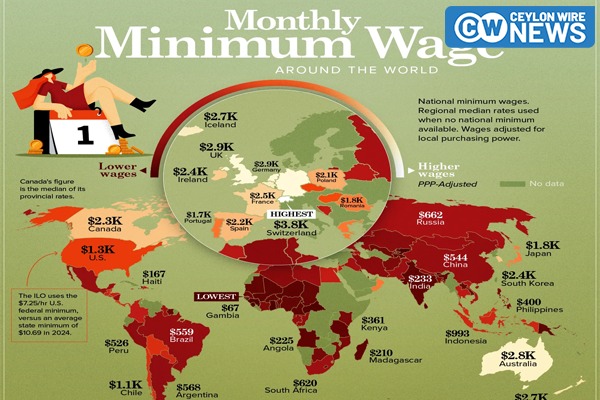
Sri Lanka ranks 120th out of 130 countries in a global minimum wage evaluation published by ‘Visual Capitalist’. The assessment, derived from 2024 International Labour Organization (ILO) data, measures minimum wage levels adjusted for Purchasing Power Parity (PPP), placing Sri Lanka’s monthly PPP-adjusted minimum wage at approximately $200. The PPP adjustment accounts for local cost-of-living differences to determine actual worker purchasing power, rather than converting nominal wages directly into standard U.S. dollars.
The global study places Switzerland at the top of the index with a PPP-adjusted monthly minimum wage of $3,804, which is set through regional frameworks rather than a uniform federal wage floor. Germany ranks second overall at $2,928, followed closely by the United Kingdom at $2,902, the Netherlands at $2,876, and Australia at $2,819. Rounding out the top ten are Belgium at $2,752, Iceland at $2,730, New Zealand at $2,673, France at $2,465, and Ireland at $2,433. Within Asia, South Korea leads the region at 11th place globally with $2,362, while Japan places 16th with $1,839. Meanwhile, the United States holds 25th position with a PPP-adjusted baseline of $1,257, based on its statutory federal minimum wage of $7.25 per hour that has remained unchanged since 2009, despite higher wage floors enacted across many individual states.
Sri Lanka lags behind all of its South Asian neighbors evaluated in the ranking. Pakistan leads the region at 68th place with a PPP-adjusted minimum wage of $570, followed by Nepal at 78th ($490), Bangladesh at 89th ($379), and India at 111th ($233). Sri Lanka’s $200 valuation places it firmly near the bottom of the international index.
Only ten countries recorded lower PPP-adjusted minimum wages than Sri Lanka in the 130-nation study. These include Niger, Bhutan, Haiti, Guinea, the Central African Republic, Sierra Leone, Ghana, Kyrgyzstan, Guinea-Bissau, and the Gambia. The report emphasizes that these adjusted values provide a standardized international benchmark for local purchasing power and do not reflect direct U.S. dollar payouts, nor do they factor in taxation, employee benefits, or internal regional cost-of-living variations within each country.