

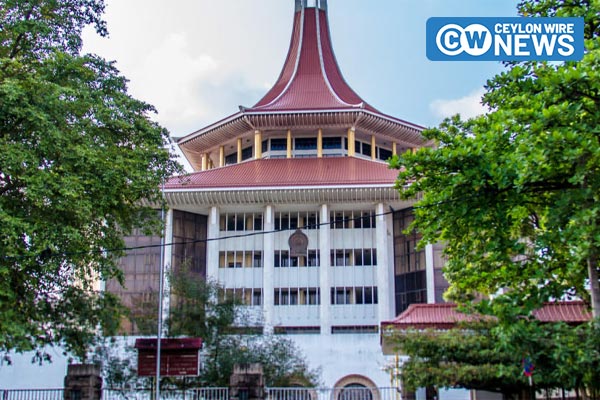
The Attorney General’s Department has informed the Supreme Court that the proposed 22nd Amendment to the Constitution and the Judicature (Amendment) Bill are intended to expand and improve the efficiency of Sri Lanka’s judicial system.
Solicitor General Viraj Dayaratne, appearing for the Attorney General, made the submissions during the hearing of petitions challenging the proposed legislation.
The petitions were heard before a five-member Supreme Court bench comprising Chief Justice Preethi Padman Surasena and Justices Achala Wengappuli, Arjuna Obeysekera, Sampath Abeykoon and Gihan Kulatunga.
The Solicitor General argued that the proposed constitutional amendment would reduce rather than increase the powers of the Executive and would not undermine the independence of the judiciary. He maintained that the petitioners had failed to establish any violation of Articles 3 and 4 of the Constitution.
He also pointed to the retirement arrangements for judges in several other countries, noting that judges of the United States Supreme Court can serve for life, while the judicial retirement age in the United Kingdom has been increased to 75.
According to the Attorney General’s Department, the retirement age for judges has historically been higher than that of public servants in Sri Lanka. The Solicitor General therefore argued that extending the retirement age of judges would not create a constitutional issue.
Meanwhile, President’s Counsel Nigel Hatch, appearing for petitioner and Parliamentarian Lakshman Nipuna Arachchi, argued that the proposed amendment does not require approval through a referendum.
He referred to the 20th Amendment, under which the number of judges of the Supreme Court and Court of Appeal was increased without a referendum. He also noted that the retirement age of judges had previously been increased under the 1978 Constitution.
President’s Counsel Mohan Weerakoon, appearing for intervening petitioner and Nawa Sihala Urumaya Party leader Sarath Manamendra, also argued that increasing the retirement age would not affect judicial independence.
He pointed to the increase in life expectancy in Sri Lanka and said extending the retirement age would be a timely measure. He also cited the United Kingdom, where the judicial retirement age was increased from 70 to 75 without a referendum.
Attorney-at-Law Niranjan Arulpragasam, appearing for another intervening petitioner, similarly submitted that increasing the retirement age of judges would not undermine judicial independence. He referred to judicial retirement arrangements in countries including the United States, United Kingdom, Canada, Australia, New Zealand, South Africa and Jamaica.
Following the submissions, the Supreme Court directed the petitioners to file their reply submissions by 3.00 p.m. tomorrow.
Chief Justice Preethi Padman Surasena subsequently stated that the Court’s confidential determination on the petitions would be communicated to the Speaker of Parliament in due course.