
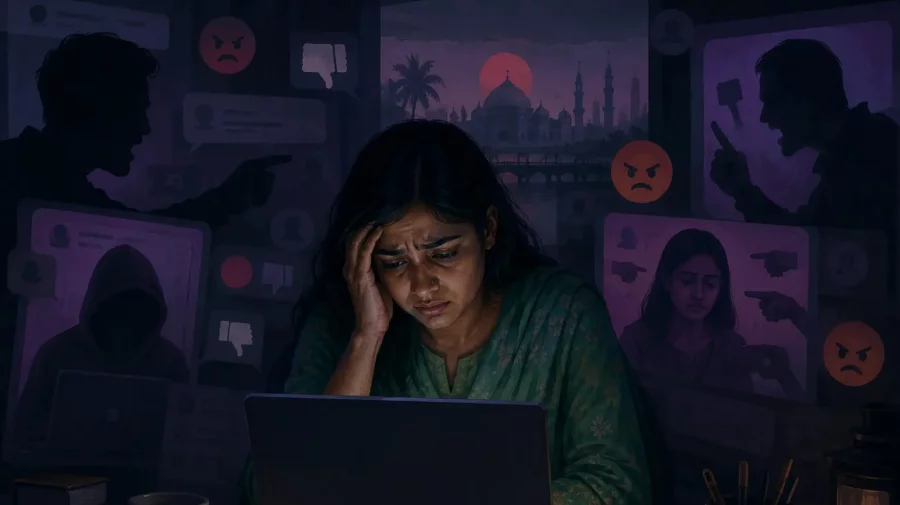
It was around 2:30am in Dhaka when a University of Dhaka student (name withheld) posted her opinion on Facebook. Within minutes, her comment section filled with sexually explicit remarks, abuse and rape threats.
Soon after, unknown accounts began collecting her photos, editing them and circulating distorted versions online.
“At first, I thought it was just trolling,” she said. “But when I saw my photos being manipulated and shared, I realised it was meant to intimidate me.”
She later deactivated her account.
Rising exposure, rising risk
As women’s online participation has grown in Bangladesh, so has technology-facilitated abuse, including cyber harassment, blackmail, deepfakes and coordinated attacks.
A 2024 Bangladesh Bureau of Statistics–UNFPA survey found nearly 89% of women social media users reported experiencing online violence at least once. Around 75% did not report incidents due to stigma and fear of humiliation.
Women aged 18–30 are the most affected, the survey found.
Underreporting remains high
Police Cyber Support for Women (PCSW) data shows 60,808 women sought help for cybercrime incidents by September 2024.
Of reported cases, 41% involved doxxing, 18% account hacking, 17% blackmail, 9% impersonation and 8% cyberbullying.
Since 2020, the unit has logged more than 43,000 complaints, though officials say the real number is likely much higher due to underreporting.
The Bangladesh Telecommunication Regulatory Commission received 13,023 complaints last year over harmful content, removing more than 12,000 items. Women made up nearly 90% of complainants.
From harassment to coordinated attacks
Experts say online abuse has shifted from isolated trolling to organised harassment, including doxxing, non-consensual image sharing, AI-generated deepfakes and cyberstalking.
A 2026 study on deepfake perceptions among Bangladeshi women found growing fear of image manipulation into explicit content.
Professor Salma Akter of the University of Dhaka said women who become visible online often face coordinated attacks.
“This is a form of power and control,” she said, adding that the impact extends to mental health and participation in public life.
Offline consequences
In February, a viral incident involving the harassment of two women near Dhaka University sparked widespread online misogynistic commentary.
Experts say digital abuse increasingly spills into offline threats, particularly for journalists, activists and public figures.
A UN Women report (2025–26) found one-third of surveyed women experienced unwanted sexual behaviour online, with many later facing offline threats. It warned that AI tools are making abuse more systematic.
Psychologists say prolonged exposure can lead to anxiety, panic, insomnia and social withdrawal.
Clinical psychologist Shahana Parveen said sustained harassment can create lasting fear.
“Many women become afraid of using their phones or avoid social media altogether,” she said.
Legal framework, weak enforcement
Bangladesh has laws covering online harassment, image leaks and cybercrime, including the Cyber Security Act 2023, the Pornography Control Act 2012, the Women and Children Repression Prevention Act and the Penal Code 1860.
The Cyber Security Act criminalises fake accounts, non-consensual sharing of images and online threats, with penalties ranging from fines to up to seven years’ imprisonment depending on the offence.
Despite the framework, enforcement remains weak, officials and activists say, citing delays, evidence gaps and the use of fake or foreign-based accounts.
PCSW officer Abdullah Sharif Ahmed said complaints are received daily and action is taken to remove content and investigate suspects where possible, but acknowledged operational limitations.
Calls for stronger response
Authorities maintain 24/7 cyber helplines for women, including 01320-002001, 01320-002002 and 01320-002222, along with online complaint channels.
But activists say stronger measures are needed, including digital literacy, faster investigations, platform accountability and victim support systems.
Shahida Akhtar, former president of Bikoshito Nari Network, said online abuse is still widely treated as a “virtual problem” despite real-world consequences.
“To build a truly digital Bangladesh, ensuring a safe online environment for women is a human rights issue,” she said.