
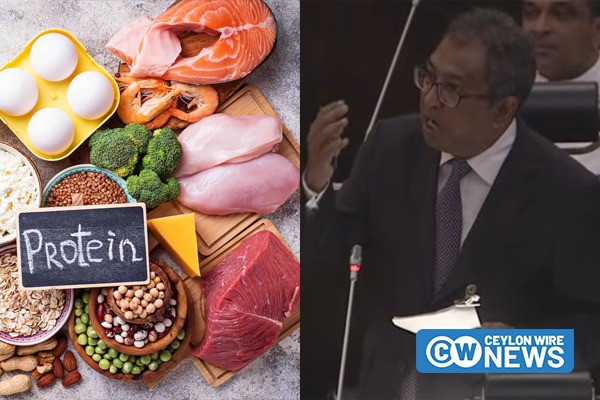
Samagi Jana Balawegaya (SJB) MP Dr. Harsha de Silva has questioned whether the 2027 Budget offers practical solutions to help Sri Lankan households access affordable, protein-rich food, arguing that tax policies on poultry products and maize could increase the cost of essential food items.
Referring to Agriculture Minister K.D. Lalkantha’s recent remarks that Sri Lankans consume too much rice and need to include more protein in their diets, de Silva said the Minister’s observation was correct.
“Even if people laugh, what Minister Lalkantha said is 100% correct. We eat too much rice; we need protein,” he said.
De Silva pointed out that the Government had not reduced taxes on chicken, while taxes on dried sprats, commonly known as halmasso, had been lowered.
However, he cautioned against depending heavily on dried sprats as a major protein source, citing their high salt content and potential health risks.
“Dried sprats contain a lot of salt. Consequently, this could lead to high blood pressure and kidney disease,” he said.
The MP also raised concerns about the taxation of maize, a key ingredient used in poultry feed. He said industry representatives had explained to him that although rice could also be used in animal feed, it affects the colour of egg yolks, making them appear pale.
He noted that Sri Lanka imports approximately 50% of its maize requirement and recalled that an import tax of Rs. 25 per kilogram had previously been imposed.
Questioning the Government’s recent tax decisions, de Silva said the maize import tax had been doubled in May, alongside the introduction of a licensing system, without providing relief to local maize farmers.
He also claimed that the existing 18% tax on poultry meat had been retained, while an additional tax of 2.5% had been imposed.
Against this backdrop, he questioned whether the 2027 Budget had addressed the practical challenges involved in making protein-rich food affordable for the public.
Questions Raised Over Public Sector Salary Increases
De Silva also criticised the continuation of the public sector salary increase programme introduced under the previous administration of President Ranil Wickremesinghe.
He argued that the economic conditions at the time the salary increases were introduced were different from those prevailing today.
Comparing the inflation figures, he said inflation had stood at -0.4% at the time, compared with 8.3% currently, and argued that this change should have been considered when formulating the latest Budget.
The MP further maintained that the 2027 Budget had failed to provide adequate solutions to the food and nutritional challenges faced by Sri Lankan households.