
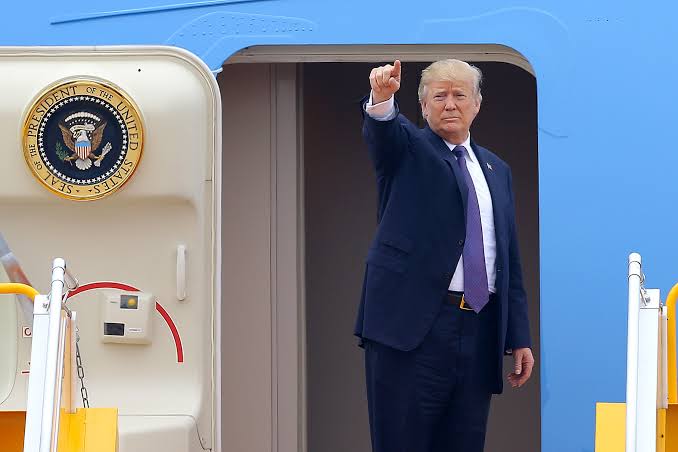
US President Donald Trump is due to arrive in the Philippines on Tuesday as part of his Southeast Asian tour, with potential protests expected in Manila ahead of the first meeting of Quad leaders in two years.
Trump’s visit comes amid growing geopolitical tensions and uncertainty over US trade relations with China. His regional tour also includes the Asia-Pacific Economic Cooperation (APEC) forum in Shenzhen and a planned trilateral meeting with Chinese President Xi Jinping and Russian President Vladimir Putin.
The trip follows a defeat for Trump’s Republican Party in the US midterm elections, while allegations involving espionage have added further uncertainty to an already fragile trade truce between Washington and Beijing.
In Manila, demonstrations have taken place in recent days, including the burning of effigies of Trump. Protesters have called for an end to the war in the Middle East and opposed the US-led Pax Silica initiative.
Quad Leaders to Meet After Two-Year Gap
The meeting of the Quad, comprising the United States, Japan, Australia and India, will be the first under Trump’s presidency and the group’s first leaders’ gathering in two years.
The meeting comes ahead of the APEC summit hosted by Chinese President Xi Jinping. Beijing has previously criticised the Quad, viewing it as an effort to contain China’s influence. However, member countries have maintained that the grouping is not directed against any particular nation.
Former US Deputy Secretary of State Kurt Campbell said the decision to reconvene the Quad was an important signal ahead of the planned US-China-Russia trilateral meeting.
Campbell credited US Secretary of State Marco Rubio with helping bring the leaders together, noting that the group had lost some of its ambition under Trump’s administration.
He also highlighted the importance of the US-Japan relationship, describing it as central to Washington’s engagement in Asia.
White House spokesperson Olivia Wales said the Quad had demonstrated its role as a partnership focused on addressing regional challenges and promoting a free and open Indo-Pacific.
Potential discussion topics include maritime security, export restrictions, diversification of critical mineral supply chains and artificial intelligence, according to a Japanese Foreign Ministry official.
Trump to Meet ASEAN and Regional Leaders
Before Trump’s arrival, the Association of Southeast Asian Nations (ASEAN) is scheduled to hold meetings on Tuesday with the leaders of Japan, South Korea, China and India ahead of the annual East Asia Summit.
Trump will not attend the East Asia Summit but is expected to participate in a special US-ASEAN summit and meet Philippine President Ferdinand Marcos Jr. on Wednesday. The Philippines is a defence ally of the United States.
Trump is also expected to hold talks with Thai Prime Minister Anutin Charnvirakul on Tuesday, according to Thai media reports.
Thailand’s Commerce Minister said the discussions would include negotiations on a reciprocal trade agreement, with a joint statement expected afterwards.
The United States is Thailand’s largest export market, accounting for 24% of its total exports this year. Washington designated Thailand a major non-NATO ally in 2003.
Meanwhile, Chinese Premier Li Qiang, addressing the ASEAN summit on Monday, highlighted China’s economic ties with the regional bloc and called for stronger cooperation in the face of global trade restrictions.
China remains ASEAN’s largest trading partner and an important source of investment. However, major economies within the 11-member bloc, which has a combined gross domestic product exceeding US$3.9 trillion, are also seeking to strengthen economic ties with the United States amid continuing trade and diplomatic uncertainty.